Wood Cutting Bandsaws: Guide to Precision Cutting Technology and Workshop Applications
Wood cutting bandsaws are precision woodworking machines that use a continuous blade to cut timber, boards, panels, and other wood materials. This article covers bandsaw types, components, cutting processes, workshop applications, automation, safety, maintenance, and Indian standards.
Wood Cutting Bandsaws: Guide to Precision Cutting Technology and Workshop Applications
Context
Wood cutting bandsaws are woodworking machines that use a continuous toothed blade running around rotating wheels to cut wood and wood-based materials. They are used in workshops, furniture manufacturing, sawmills, carpentry operations, timber processing, and other applications requiring controlled curved or straight cuts.
The continuous blade allows a bandsaw to make cuts through relatively thick material while providing flexibility for different cutting patterns. Machine configuration varies according to blade width, wheel diameter, cutting capacity, feed arrangement, motor power, table size, and the type of material being processed.
What Is a Wood Cutting Bandsaw?
A wood cutting bandsaw is a machine in which a continuous metal blade moves around two or more wheels. The exposed section of the blade passes through the work area and performs the cutting operation.
Depending on the design, a bandsaw can be used for straight cuts, curved cuts, resawing, contour cutting, and other woodworking operations. Industrial machines may include automatic feeding, adjustable guides, blade-tension systems, digital controls, and material-handling equipment.
Main Components of a Wood Cutting Bandsaw
| Component | Main Function |
|---|---|
| Bandsaw blade | Performs the cutting operation |
| Upper wheel | Drives or guides the blade |
| Lower wheel | Supports blade movement |
| Drive motor | Provides power for blade movement |
| Work table | Supports the workpiece |
| Blade guides | Keep the blade aligned |
| Blade tension system | Maintains appropriate blade tension |
| Fence | Supports controlled straight cutting |
| Dust extraction port | Removes sawdust from the cutting area |
| Guarding system | Reduces access to moving blade components |
| Feed system | Moves material through the cutting zone |
| Control panel | Operates machine functions |
| Emergency stop | Provides rapid machine shutdown |
How a Wood Cutting Bandsaw Works
The workpiece is positioned on the machine table or feed system. The motor rotates the bandsaw wheels, causing the continuous blade to travel through the cutting zone.
The operator or automated feed system moves the wood toward the blade at a controlled rate. Blade guides help maintain alignment while the blade teeth remove material and create the required cut.
After cutting, the workpiece is removed or transferred to another production stage. In industrial systems, conveyors, automatic feeders, dust extraction, and control systems can coordinate the complete operation.
Importance
Wood cutting bandsaws are important because they can handle a range of cutting tasks while accommodating different workpiece dimensions and cutting patterns.
Straight Cutting
Bandsaws can make straight cuts through timber, boards, panels, and other wood products.
A fence or guide can support repeatable cutting when consistent dimensions are required.
Curved and Contour Cutting
The narrow continuous blade allows suitable machines to follow curved or irregular cutting paths.
This capability is useful in furniture production, pattern making, component preparation, and other woodworking applications where a straight-line cutting machine may not provide the required geometry.
Resawing
Resawing involves cutting a thicker piece of timber into thinner sections.
A machine with suitable blade capacity, wheel configuration, guide arrangement, and cutting height can be used for resawing operations.
Timber and Sawmill Applications
Larger bandsaw systems can process logs, timber sections, and substantial wood components.
Industrial sawmills may use specialized bandsaws with automated log handling, hydraulic positioning, computerized controls, and production monitoring.
Furniture Manufacturing
Furniture production can use bandsaws for preparing components, cutting curves, trimming boards, and processing solid wood.
The machine configuration depends on production volume, material dimensions, required accuracy, and the type of furniture components being produced.
Workshop Applications
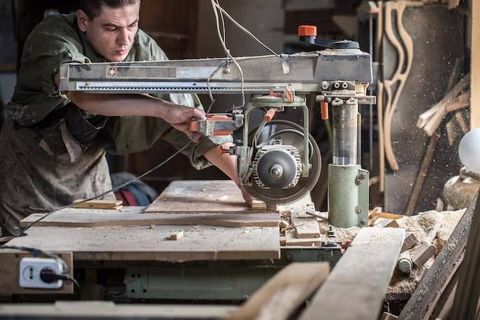
Smaller bandsaws are common in woodworking workshops because they can support multiple cutting tasks within a relatively compact machine arrangement.
Typical applications include:
Timber cutting
Curved component cutting
Resawing
Pattern cutting
Furniture component preparation
Joinery work
Model and craft work
Board processing
Types of Wood Cutting Bandsaws
Bandsaws can be classified according to machine size, blade orientation, feeding arrangement, and intended application.
Vertical Bandsaws
Vertical bandsaws generally have a vertically moving blade section passing through the work table.
They are commonly used for curved cutting, contour work, resawing, and general workshop operations.
Horizontal Bandsaws
Horizontal bandsaws position the blade so that it travels horizontally through the material.
Larger machines can be used for cutting timber sections and other workpieces where horizontal material handling is appropriate.
Stationary Bandsaws
Stationary bandsaws are mounted on a fixed machine frame and are commonly used in workshops and production facilities.
They can provide a stable work area for repeated cutting operations.
Portable Bandsaws
Portable bandsaws are designed for cutting work away from a fixed machine table.
They can be useful for field operations, installation work, and applications where moving the workpiece to a stationary machine is impractical.
Industrial Automatic Bandsaws
Industrial automatic bandsaws can incorporate powered feeding, programmable cutting dimensions, automatic positioning, and production monitoring.
These systems are suited to applications where repeated cutting cycles require coordinated machine operation.
Recent Updates
Modern wood cutting bandsaws increasingly incorporate automation, improved blade guidance, digital controls, dust management, safety systems, and machine monitoring.
Automated Feeding
Automatic feed systems can move timber or boards through the cutting zone at controlled speeds.
This can improve production consistency and reduce the need for manual material movement in repetitive operations.
Digital Controls
Industrial machines can use PLC and HMI systems to control blade speed, feed rate, positioning, cutting sequences, alarms, and other machine functions.
Digital displays can provide operators with information about operating conditions and machine status.
Precision Blade Guidance
Modern blade-guidance systems can use improved guide assemblies and adjustable support arrangements to maintain blade alignment.
Correct blade tracking and tension are important for maintaining cutting accuracy and reducing unnecessary blade movement.
Dust Extraction
Wood cutting generates sawdust and fine airborne particles.
Modern woodworking installations can connect bandsaws to centralized or dedicated dust-extraction systems. Effective extraction can help maintain a cleaner work area and reduce accumulation around machinery.
Machine Monitoring
Sensors can monitor selected parameters such as motor load, blade speed, vibration, temperature, feed movement, and safety-interlock status.
Recorded operating information can support maintenance planning and identification of changes in machine performance.
Improved Safety Systems
Modern bandsaws can include blade guards, emergency stops, interlocked access points, braking systems, workpiece guides, and other protective measures.
BIS's machinery-safety material identifies IS 18057 Part 1:2023 as the common-requirements standard for woodworking machines. BIS also lists IS 3691:1990, based on ISO 7007, for table bandsawing-machine nomenclature and acceptance conditions.
Laws or Policies
Wood cutting bandsaws in India can be affected by machinery-safety, electrical, workplace, fire-safety, and environmental requirements.
Woodworking Machinery Safety
BIS identifies IS 18057 Part 1:2023 — Woodworking Machines Safety, Part 1: Common Requirements within its machinery-safety standards. The applicable requirements depend on the machine configuration and specific woodworking application.
BIS also lists a standard for table bandsawing machines, IS 3691:1990 / ISO 7007, covering nomenclature and acceptance conditions.
Machine Guarding
Bandsaw blades and rotating wheels require suitable guarding and protective arrangements.
Indian factory-safety material includes specific provisions for bandsaw guarding, including enclosure of pulley areas and protection of blade portions other than the necessary cutting section.
The exact guarding arrangement should be evaluated according to the machine design, applicable safety standard, workplace requirements, and risk assessment.
Electrical Safety
Electrical components such as motors, control panels, switches, drives, sensors, and emergency-stop circuits should comply with applicable electrical-safety requirements.
BIS machinery-safety guidance references IS 16504 Part 1 / IEC 60204-1 for electrical equipment of machines.
BIS Certification
BIS states that its certification system is generally voluntary unless compliance is made compulsory for a product through a government notification or Quality Control Order. Therefore, the exact certification requirement for a particular bandsaw should be verified according to its classification and applicable regulatory order.
BIS's Know Your Standard platform can be used to search Indian Standards by standard number or keyword and review amendments and related documents.
Tools and Resources
Wood cutting bandsaw operation involves blades, measurement tools, maintenance equipment, dust-extraction systems, and safety devices.
Bandsaw Blades
Blade selection affects cutting performance.
Important blade characteristics include:
Blade width
Tooth pitch
Tooth geometry
Blade thickness
Material composition
Cutting capacity
Intended wood type
The blade should be compatible with the machine and the intended cutting operation.
Blade Tension and Tracking
Correct blade tension and tracking are important for stable cutting.
Operators should follow the machine manufacturer's specified procedure rather than relying only on visual judgment. Incorrect tension or tracking can affect blade stability and cutting quality.
Measurement Equipment
Common workshop measurement tools include:
Measuring tapes
Steel rules
Vernier calipers
Squares
Angle gauges
Digital measuring instruments
These tools help verify workpiece dimensions and cutting accuracy.
Dust-Extraction Systems
Dust collectors, ducting, filters, separators, and extraction hoods can be used to manage sawdust generated during cutting.
The extraction system should be appropriate for the machine airflow requirements and the material being processed.
Maintenance Equipment
Maintenance activities can include inspection of:
Blade condition
Wheel surfaces
Blade guides
Bearings
Drive belts
Motor
Table alignment
Electrical connections
Guards
Emergency-stop systems
Dust-extraction connections
Maintenance intervals should follow the equipment manufacturer's instructions and the operating environment.
Quality Checks
Wood-cutting quality can be evaluated through:
Cut dimensions
Surface condition
Squareness
Straightness
Kerf width
Repeatability
Blade marks
Workpiece damage
The appropriate checks depend on the finished component and production requirements.
FAQs
What is a wood cutting bandsaw?
A wood cutting bandsaw is a woodworking machine that uses a continuous toothed blade running around wheels to cut timber, boards, panels, and other wood materials.
How does a wood cutting bandsaw work?
The machine drives a continuous blade around rotating wheels while the workpiece is guided through the cutting zone. The blade teeth remove material and create the required straight or curved cut.
What are the main types of wood cutting bandsaws?
Common configurations include vertical bandsaws, horizontal bandsaws, stationary workshop bandsaws, portable bandsaws, and automated industrial bandsaws.
What factors affect bandsaw cutting accuracy?
Important factors include blade selection, blade tension, tracking, guide adjustment, feed rate, workpiece stability, machine alignment, blade condition, and operator technique.
What safety features are used on wood cutting bandsaws?
Typical protective features include blade guards, wheel enclosures, emergency stops, blade guides, access controls, electrical protection, and dust-extraction arrangements. The specific requirements depend on the machine and applicable safety standards.
Conclusion
Wood cutting bandsaws provide flexible cutting capabilities for workshops, furniture production, timber processing, and industrial woodworking. Their continuous blade design supports straight, curved, contour, and resawing operations, while modern machines can incorporate automatic feeding, digital controls, monitoring, dust extraction, and enhanced guarding. Blade selection, machine alignment, tension, tracking, and maintenance all influence cutting performance. In India, woodworking bandsaw installations should be evaluated against applicable machinery-safety, electrical, workplace, and environmental requirements.