Boring Machines: Types, Uses, Technology & Safety Guide
Boring machines are machine tools designed primarily to enlarge, finish, or accurately position existing holes in workpieces.
Unlike drilling, which generally creates a new hole, boring refines a hole that has already been formed.
The process is widely used with metals and other rigid materials where dimensional accuracy, alignment, and surface quality are important. Boring machines are found in industries such as automotive manufacturing, aerospace, construction equipment, energy, heavy engineering, and general metalworking.
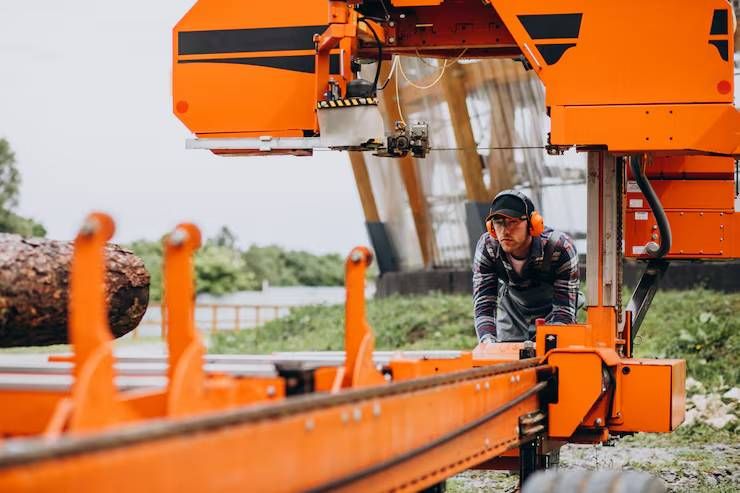
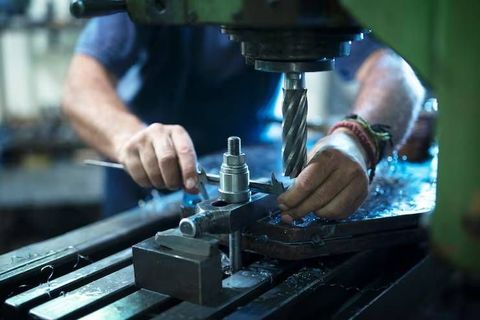
A typical boring operation uses a cutting tool mounted on a spindle. The tool removes a controlled amount of material while the workpiece is securely positioned. Depending on the machine design, the workpiece, spindle, or both can move along different axes.
Common types include:
- Horizontal boring machines
- Vertical boring machines
- CNC boring machines
- Jig boring machines
- Line boring machines
- Precision boring machines
Boring machines can be manually controlled or computer numerical control (CNC) controlled. CNC systems can coordinate multiple machine movements according to programmed instructions, making them useful for repeatable precision machining.
How a Boring Machine Works
The basic boring process follows several stages:
- The workpiece is inspected and securely clamped.
- An existing hole or opening is identified as the machining reference.
- The appropriate boring tool is mounted.
- Spindle speed and feed parameters are selected according to the material and tool.
- The cutting tool enters the existing hole.
- Material is gradually removed from the internal surface.
- Measurements are taken to confirm the required dimensions and alignment.
The final result depends on machine rigidity, tool condition, workpiece stability, cutting parameters, coolant or lubrication practices, and measurement accuracy.
Boring Machine Types and Their Applications
| Machine type | Main characteristic | Typical application |
|---|---|---|
| Horizontal boring machine | Horizontal spindle arrangement | Large industrial components |
| Vertical boring machine | Vertical spindle or work arrangement | Large, heavy workpieces |
| CNC boring machine | Computer-controlled movement | Repeatable precision machining |
| Jig boring machine | High positioning accuracy | Dies, fixtures and precision components |
| Line boring machine | Produces aligned holes along an axis | Engine blocks and large assemblies |
Horizontal boring machines are particularly useful when large workpieces need accurately positioned internal holes. Vertical designs can accommodate components with substantial diameter or weight.
CNC boring machines add programmable movement and automated control. They are often integrated with digital measurement systems, tooling systems, and other manufacturing technologies.
Why Boring Machines Matter in Modern Manufacturing
Accurate holes are essential to many mechanical assemblies. Bearings, shafts, pins, bushings, hydraulic components, and structural connections can depend on correct hole diameter and alignment.
Poorly machined holes can create problems such as:
- Excessive vibration
- Improper component alignment
- Premature wear
- Leakage in hydraulic systems
- Reduced assembly accuracy
- Increased material waste
- Rework caused by dimensional errors
For this reason, industrial machining increasingly focuses on precision, repeatability, process monitoring, and quality control.
Boring machines are especially important for large components that cannot easily be processed using smaller machining equipment. Heavy engineering, transportation equipment, power-generation components, and construction machinery can require substantial machining capacity.
CNC Boring and Precision Machining
CNC technology has changed how many boring operations are planned and controlled. Instead of manually controlling every movement, operators can use digital programs containing coordinates, cutting parameters, tool movements, and machining sequences.
Modern CNC machining can incorporate:
- Digital work coordinates
- Automatic tool changes
- Programmable spindle speeds
- Multi-axis movement
- Tool condition monitoring
- In-process measurement
- Computer-aided manufacturing software
- Production data collection
These technologies can improve repeatability when properly programmed and maintained. However, CNC automation does not eliminate the need for skilled supervision. Operators still need to verify workholding, tooling, program instructions, machine condition, and measurements.
Importance for Different Industries
Boring machines support several industrial sectors.
Automotive manufacturing: Engine blocks, transmission components, steering parts, and other assemblies can require accurately machined holes.
Aerospace manufacturing: Components may require strict dimensional control and traceability because of demanding engineering specifications.
Heavy engineering: Large frames, housings, shafts, and industrial components can require horizontal or vertical boring.
Construction equipment: Excavators, loaders, cranes, and other heavy equipment contain components where accurate bores are important for pins, bushings, and rotating assemblies.
Energy equipment: Turbine-related components, housings, pumps, and other equipment may require accurately aligned internal surfaces.
Recent Developments and Industry Trends
India's machine-tool sector has shown continued expansion. The Indian Machine Tool Manufacturers' Association reported provisional machine-tool production of about ₹14,566 crore in FY 2024–25, up from ₹13,571 crore in FY 2023–24. It also reported machine-tool consumption of about ₹31,781 crore in FY 2024–25.
Government data released in December 2025 recorded machine-tool production at ₹14,286 crore for 2024–25, illustrating the continued importance of this part of India's capital-goods industry.
A significant development occurred on 23 February 2026, when the Office of the Principal Scientific Adviser and Ministry of Heavy Industries held a stakeholder consultation at CMTI, Bengaluru, concerning a proposed Advanced Manufacturing Systems Mission. Discussions included CNC machine tools and controllers, advanced machinery, testing and metrology, robotics, and additive manufacturing.
NITI Aayog's 29 October 2025 advanced-manufacturing roadmap also identified artificial intelligence, machine learning, digital twins, robotics, and advanced materials as important technologies for India's manufacturing development.
These developments point toward greater integration of boring and other machine tools with automation, digital monitoring, robotics, metrology, and data-driven manufacturing.
Manufacturing Data Snapshot
| Indicator | FY 2023–24 | FY 2024–25 |
|---|---|---|
| Machine-tool production | ₹13,571 crore | ₹14,566 crore* |
| Machine-tool consumption | ₹27,265 crore | ₹31,781 crore* |
| Production trend | — | Approx. 7% increase* |
*Provisional figures reported by IMTMA. Government datasets may use different reporting methodologies.
Indian Laws, Standards and Workplace Safety
Boring machines contain rotating spindles, cutting tools, moving axes, electrical systems, and heavy workpieces. Appropriate safeguards and operating procedures are therefore important.
India's Occupational Safety, Health and Working Conditions Code, 2020 came into force on 21 November 2025. The government states that the Code consolidated 13 central labour laws into one framework covering occupational safety, health, and working conditions.
The Occupational Safety, Health and Working Conditions (Central) Rules, 2026 were notified on 8 May 2026 under G.S.R. 345(E).
For machine-tool operations, important safety principles include:
- Guarding moving and rotating parts
- Preventing unintended machine movement
- Using suitable workholding arrangements
- Maintaining emergency stopping controls
- Keeping cutting areas clear
- Following lockout and isolation procedures during maintenance
- Using appropriate eye and personal protective equipment
- Providing operator training
- Inspecting tools, fixtures, electrical systems, and guards
The Bureau of Indian Standards maintains standards relating to machine-tool safety. Its resources include guidance covering machine hazards, risk reduction, guarding, and safety standardization.
BIS also provides a Know Your Standard platform where users can search Indian Standards by IS number or keyword and review related documents and information.
BIS currently lists machine safety requirements and conformity-assessment information for categories including metal-cutting machine tools. The exact regulatory applicability depends on the machine category, applicable notification, and current requirements.
Practical Tools and Resources
Several resources can help engineers, operators, students, and manufacturing planners understand boring-machine operations.
BIS Know Your Standard: Useful for locating relevant Indian Standards and checking standard information.
CMTI resources: The Central Manufacturing Technology Institute is relevant to research, testing, metrology, and advanced manufacturing technologies.
CNC programming software: CAM and CNC simulation tools can help visualize toolpaths and identify programming problems before machining.
Machining calculators: Cutting-speed, spindle-speed, feed-rate, and material-removal calculators can assist with preliminary process planning. Actual parameters should always be verified against machine, tool, material, and manufacturer specifications.
Digital measurement tools: Bore gauges, coordinate measuring machines, digital indicators, and other metrology equipment can help verify diameter, roundness, position, and alignment.
Machine documentation: Operator manuals, maintenance schedules, tooling specifications, electrical diagrams, and safety instructions should be kept accessible to authorized personnel.
Frequently Asked Questions
What is a boring machine used for?
A boring machine is mainly used to enlarge, finish, or accurately align existing holes in a workpiece. It is useful when dimensional accuracy or alignment requirements are higher than those achieved by the initial hole-making operation.
What is the difference between drilling and boring?
Drilling normally creates a new hole using a drill bit. Boring generally works on an existing hole and removes material from its internal surface to improve diameter, alignment, or surface characteristics.
What is a CNC boring machine?
A CNC boring machine uses computer-controlled instructions to coordinate machine movements. It can provide repeatable machining operations when the program, tooling, workholding, and machine setup are correctly prepared.
What materials can be machined using boring machines?
Many boring machines are designed for metals such as steel, cast iron, aluminum, and various alloys. The suitable material range depends on the machine's spindle capacity, tooling, rigidity, cutting parameters, and intended application.
What are the main safety concerns?
Common hazards include rotating tools, moving machine components, sharp chips, unexpected movement, improper workholding, electrical hazards, and contact with cutting fluids. Appropriate guarding, training, inspection, and operating procedures are essential.
Conclusion
Boring machines are important machine tools for producing accurately positioned and dimensionally controlled holes in industrial components. Their applications range from automotive and aerospace manufacturing to heavy engineering, construction equipment, and energy-related equipment.
The technology is evolving from conventional manual machines toward CNC boring, automated tooling, digital measurement, robotics, and connected manufacturing systems. India's recent manufacturing policies and technology initiatives are also placing greater emphasis on advanced machine tools, precision manufacturing, and domestic manufacturing capabilities.