Textile Machinery Innovations: Guide to Modern Technology and Practical Insights
What Are Textile Machinery Innovations? Textile Machinery Innovations refer to the development and application of modern equipment, automation, digital controls, sensors, robotics, and manufacturing techniques used across textile production. These technologies support processes such as spinning, weaving, knitting, dyeing, finishing, printing, fabric inspection, and technical-textile manufacturing.
Traditional textile machinery relied heavily on mechanical systems and manual adjustments. Modern equipment increasingly combines mechanical engineering with electronics, computer controls, sensors, data analysis, and automated process management.
The objective is not simply to make machines faster. Modern textile machinery can also focus on consistent production, controlled material usage, energy management, quality monitoring, worker safety, and the ability to manufacture specialized textile structures.
How Modern Textile Machinery Works
A modern textile production line can contain several interconnected machines. Raw materials move through different stages, with each machine performing a defined operation.
A simplified production sequence can include:
- Fiber preparation: Fibers are opened, cleaned, blended, and prepared for further processing.
- Spinning: Prepared fibers are converted into yarn using spinning equipment.
- Weaving or knitting: Yarn is converted into fabric through controlled mechanical processes.
- Processing: Fabric may undergo dyeing, washing, coating, printing, drying, or finishing.
- Inspection: Cameras, sensors, and measurement equipment can identify selected fabric defects or process variations.
- Packaging and handling: Automated systems can move, roll, fold, or prepare finished textile materials for subsequent operations.
The actual sequence depends on the type of textile being produced. Technical textiles, for example, can require specialized machinery for coating, laminating, nonwoven production, composite formation, or high-performance fiber processing.
Major Types of Textile Machinery
Spinning machinery prepares fibers and converts them into yarn. Modern systems can use automated controls to maintain consistent production conditions.
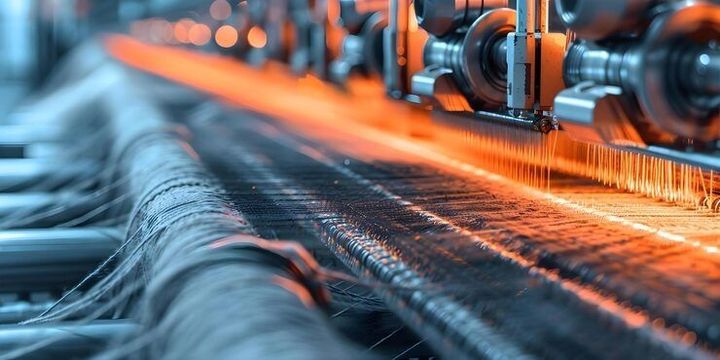
Weaving machinery interlaces yarns to create woven fabrics. Shuttleless looms, including rapier and air-jet systems, are examples of modern weaving equipment.
Knitting machinery forms fabrics by creating interconnected loops. Computer-controlled knitting systems can produce complex structures and patterns.
Nonwoven machinery produces textile structures without conventional weaving or knitting. Processes can include bonding, needling, spinning, and thermal methods.
Dyeing and finishing equipment applies color or functional treatments and can incorporate automated temperature, pressure, flow, and chemical-control systems.
Textile inspection systems use cameras, lighting, sensors, and software to identify selected defects or irregularities during production.
Importance
Improving Process Control
Modern textile machinery can provide more precise control over production variables. Electronic controls and sensors can monitor conditions such as speed, tension, temperature, pressure, humidity, and material movement.
Maintaining suitable operating conditions can help reduce unwanted variation between production batches.
Supporting Automation
Automation can reduce the number of repetitive manual adjustments required during production. Automated material handling, yarn monitoring, machine controls, robotic systems, and computerized inspection can be integrated into textile facilities.
The appropriate level of automation depends on production requirements, machine configuration, workforce skills, material characteristics, and facility design.
Energy and Resource Management
Textile manufacturing can involve substantial electricity, heat, water, compressed air, and process materials. Modern equipment increasingly incorporates systems for monitoring and controlling resource consumption.
Energy-efficient motors, variable-speed drives, heat-recovery systems, optimized process cycles, and automated controls can contribute to more efficient operation.
Technical Textiles
Technical textiles are designed primarily for functional characteristics rather than conventional appearance. They can be used in agriculture, construction, healthcare, transportation, filtration, protective applications, sports, and other fields.
These materials can require specialized machinery capable of processing advanced fibers, composites, coatings, or multilayer structures. India's National Technical Textiles Mission specifically includes indigenous development of machinery and equipment among its objectives.
Quality Monitoring
Textile quality can be affected by yarn tension, fiber properties, machine settings, environmental conditions, and many other variables. Automated inspection systems can help identify visible defects, dimensional variations, color differences, or other selected characteristics.
| Machinery Area | Main Function | Examples of Modern Features |
|---|---|---|
| Spinning | Fiber-to-yarn processing | Electronic controls, sensors |
| Weaving | Fabric formation | Shuttleless looms, automation |
| Knitting | Loop-based fabric formation | Computerized pattern control |
| Nonwoven | Bonded textile structures | Automated web control |
| Dyeing | Color application | Process monitoring and control |
| Finishing | Surface or functional treatment | Automated temperature and flow control |
| Inspection | Quality monitoring | Cameras, sensors, software |
Recent Updates
Greater Use of Automation
Automation continues to influence textile manufacturing through computerized machine controls, sensors, automated material handling, and integrated production systems.
Modern textile facilities can connect individual machines with production-monitoring platforms, allowing operators to observe machine conditions and production information from centralized systems.
Digital Monitoring and Data Analysis
Digital monitoring can collect information such as machine speed, production output, operating temperature, energy consumption, stoppages, and equipment conditions.
Data analysis can help manufacturers understand recurring process variations and identify areas requiring investigation. When combined with appropriate sensors, these systems can also contribute to condition monitoring and maintenance planning.
Indigenous Machinery Development
India has placed particular attention on developing domestic capabilities for advanced textile machinery. The National Technical Textiles Mission supports research and innovation, including indigenous development of machinery, equipment, tools, and testing equipment for technical textiles.
As of late 2025, 168 research projects had been approved under the mission, covering areas including specialty fibers, technical textiles, composites, and machinery-related development.
Modern Weaving Equipment
The Union Budget 2025–26 included changes affecting selected shuttleless textile machinery. Two additional categories of shuttleless looms, including specified rapier and air-jet looms, were placed under a zero basic customs duty provision for textile-industry use.
Such policy changes can influence the adoption and modernization of weaving equipment.
Smart Textile Technologies
Recent textile research increasingly connects machinery with advanced materials and smart textile development. Projects supported through India's National Technical Textiles Mission include areas such as conductive fibers, wearable electronics, photonic fabrics, solar-textile concepts, and advanced composites.
These developments can create new requirements for machinery capable of handling conductive materials, specialty fibers, electronic components, multilayer structures, and other nontraditional textile inputs.
Research and Innovation Programs
India approved the Tex-RAMPS scheme in 2025 with an outlay of ₹305 crore for 2025–26 through 2030–31. The program focuses on research, data systems, innovation, assessment, monitoring, planning, and startup-related development in the textile sector.
Such initiatives indicate a broader shift toward data-supported research and technology development within the textile ecosystem.
Integrated Textile Infrastructure
The PM MITRA program is developing integrated textile and apparel parks with infrastructure covering different stages of the textile value chain. The Ministry of Textiles identifies spinning, weaving, processing, garmenting, textile manufacturing, processing, and printing machinery-related activities within the broader integrated ecosystem.
Laws or Policies
National Technical Textiles Mission
The National Technical Textiles Mission was launched in 2020 with an outlay of ₹1,480 crore for research and development, market development, education and skills, and export-related activities. The mission has also supported research into machinery and equipment for technical textiles.
The mission was extended through March 2026, according to the Ministry of Textiles' 2025 year-end review.
Technology Upgradation
India previously implemented the Amended Technology Upgradation Fund Scheme to encourage modernization through investment in specified textile machinery. In 2025, the Ministry of Textiles stated that the scheme was no longer accepting new cases and was covering committed-liability cases.
This distinction is important when examining current textile machinery policies because earlier programs should not automatically be treated as active programs for new applications.
Quality Control Requirements
Textile machinery and textile products can be subject to applicable quality-control requirements and technical standards. India's textile policy framework has included Quality Control Orders covering selected textile categories.
The specific requirements depend on the machinery, material, product category, and applicable notification. Manufacturers and importers should therefore consult current government notifications and relevant standards before determining compliance requirements.
Technical Standards
The Bureau of Indian Standards develops Indian Standards covering textile materials, testing methods, machinery-related areas, safety, and product characteristics.
Standards can establish common methods for measurement and testing, helping manufacturers and testing organizations evaluate equipment and textile products consistently.
Workplace Safety
Textile machinery can contain rapidly moving components, rotating shafts, needles, cutting systems, heated surfaces, electrical equipment, and other hazards.
Appropriate machine guarding, emergency controls, maintenance procedures, worker training, and personal protective equipment are important parts of safe textile production. Specific requirements depend on the equipment and workplace.
Tools and Resources
Computerized Machine Controls
Modern textile machines commonly use programmable controllers, touch-screen interfaces, electronic sensors, and automated control systems. These tools allow operators to monitor and adjust selected production parameters.
Textile Production Monitoring
Production-monitoring software can collect information from connected machines and display production status, downtime, output, alarms, and selected process variables.
Such systems can help production teams understand how equipment is operating across different stages.
Computer-Aided Textile Design
Computer-aided design tools allow users to develop textile patterns, fabric structures, color arrangements, and other digital specifications before physical production.
These tools can reduce repeated manual preparation and provide digital references for manufacturing systems.
Machine Vision
Machine-vision systems use cameras, lighting, image-processing software, and algorithms to examine textile surfaces. They can identify selected defects such as holes, stains, broken yarns, pattern irregularities, or other visible variations.
The effectiveness of machine vision depends on lighting, camera resolution, material characteristics, software configuration, and the types of defects being examined.
Energy Monitoring Systems
Energy meters and facility-monitoring platforms can measure electricity use by machine, production area, or process. This information can help identify unusual consumption patterns and support energy-management activities.
Textile Research Resources
The Ministry of Textiles, National Technical Textiles Mission, Indian research institutions, standards organizations, and textile technology institutes provide information about materials, machinery, testing, technical textiles, research programs, and manufacturing practices.
These resources are useful for understanding how textile machinery is evolving alongside new materials and production methods.
FAQs
What are Textile Machinery Innovations?
Textile Machinery Innovations are developments in equipment, automation, sensors, software, controls, and manufacturing techniques used to improve or expand textile production capabilities.
How is automation changing textile machinery?
Automation allows machines to perform more production and monitoring tasks through programmed controls, sensors, robotic handling, computerized inspection, and connected software systems.
What technologies are used in modern textile machinery?
Modern equipment can incorporate sensors, programmable controllers, machine vision, robotics, data monitoring, artificial intelligence, variable-speed drives, and automated process controls.
Why are Textile Machinery Innovations important for technical textiles?
Technical textiles can use specialty fibers, composites, coatings, conductive materials, and other advanced structures. Specialized machinery can provide the processing control needed to manufacture these materials.
What is the role of digital technology in textile machinery?
Digital technology connects machine controls, sensors, production data, inspection systems, and analytical software. This can improve visibility into production conditions and support more informed process management.
Conclusion
Textile Machinery Innovations are transforming textile production through automation, digital controls, sensors, machine vision, advanced materials processing, and connected manufacturing systems. Modern machinery supports conventional textiles as well as specialized technical textiles that require precise processing capabilities. India's recent initiatives emphasize indigenous machinery development, technical-textile research, digital innovation, and integrated textile infrastructure. Understanding these technologies helps explain how textile manufacturing is evolving toward more automated, data-supported, and technically specialized production systems.