Solar Panel Cleaning Robots: Explore Technology, Functions, and Applications
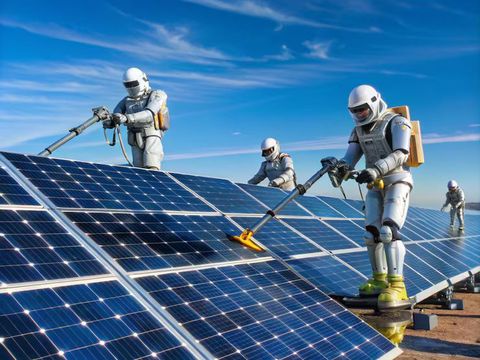
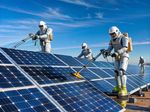
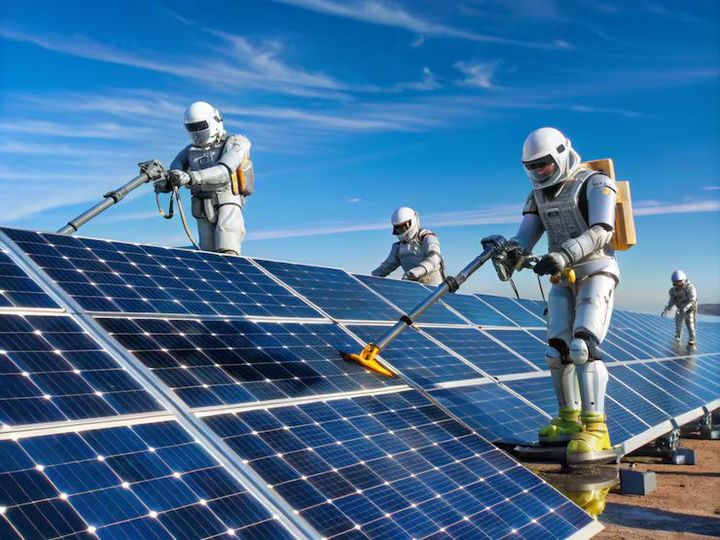
Solar Panel Cleaning Robots are automated machines designed to remove dust, dirt, pollen, bird droppings, and other particles from photovoltaic (PV) modules. They travel across or along rows of solar panels and use brushes, rollers, air, or other cleaning mechanisms to remove accumulated material.
Solar panels need sunlight to generate electricity. When dust and other particles build up on the glass surface, less sunlight can reach the photovoltaic cells. The effect varies according to climate, dust concentration, rainfall, panel angle, surrounding environment, and other conditions. IEA PVPS reported in 2025 that soiling is responsible for an average of about 4–7% of global PV energy losses, although individual locations can experience substantially different levels.
Solar Panel Cleaning Robots have emerged as one approach to managing this problem, particularly at large solar plants where hundreds or thousands of modules may need regular cleaning.
How Solar Panel Cleaning Robots Work
A typical robot moves along a row or across a panel surface while cleaning elements contact the module glass. Depending on its design, the robot may operate automatically according to a programmed schedule or be controlled through a remote system.
A basic cleaning cycle can include:
Positioning: The robot is placed at the beginning of a panel row or designated cleaning area.
Movement: Motors, wheels, tracks, or other mechanisms move the machine across the modules.
Cleaning: Brushes, rollers, microfiber materials, air systems, or other mechanisms remove particles.
Navigation: Sensors or programmed controls help the robot remain within the intended path.
Monitoring: The system can track movement, battery condition, cleaning progress, and selected operating parameters.
Return: Some systems return to a designated starting point or charging location after completing a cleaning cycle.
The exact operating method depends on the robot design and the type of solar installation.
Why Solar Panels Need Cleaning
Solar modules are installed outdoors and are continuously exposed to environmental conditions. Dust can be particularly important in dry and semi-arid areas, while pollen, leaves, bird droppings, industrial particles, and other contaminants can contribute to surface soiling.
Research from India's Department of Science and Technology has highlighted the effect of dust accumulation on solar modules and the need for technologies suited to India's varied environmental conditions.
Cleaning frequency should not be identical for every solar plant. Operators can consider local soiling patterns, rainfall, panel angle, energy-production data, and the physical characteristics of the site.
Importance
Reducing Surface Soiling
The primary function of Solar Panel Cleaning Robots is to reduce the material accumulated on the module surface.
A clean glass surface allows more sunlight to reach the photovoltaic cells. The actual change in electricity generation after cleaning depends on how much soiling was present and the characteristics of the particular installation.
Reducing Water Requirements
Some robotic systems use little or no water. This can be useful at solar installations located in dry regions where large quantities of water may be difficult to manage.
Indian technology-development programs have documented waterless robotic approaches for solar-panel cleaning. For example, the Department of Science and Technology's NIDHI program documented an Indian automatic waterless PV-cleaning robot developed for reducing dependence on manual cleaning and water.
Waterless operation does not mean that every type of dirt can be removed equally well without water. Sticky substances, heavy deposits, or particular environmental contaminants may require different cleaning approaches.
Reducing Manual Access
Large solar farms can contain extensive arrays of panels. Manual cleaning may require workers to move between rows or work around elevated structures.
A robotic system can perform repetitive movement across suitable panel layouts. This can reduce the amount of direct physical access required for routine cleaning, although human inspection and maintenance remain important.
Supporting Regular Cleaning
Automation can make it easier to establish a recurring cleaning pattern. A robot can be programmed or operated according to a defined schedule or according to measured site conditions.
More frequent cleaning is not automatically appropriate. A cleaning plan should consider the amount of soiling, local weather, panel design, robot compatibility, and the overall maintenance strategy.
Main Components
| Component | Main Function | Typical Role |
|---|---|---|
| Drive motors | Move the robot | Panel-to-panel movement |
| Wheels or tracks | Provide surface contact | Robot mobility |
| Cleaning brushes | Remove loose particles | Dry cleaning |
| Rollers | Sweep or wipe surfaces | Continuous cleaning |
| Sensors | Detect position and conditions | Navigation |
| Controller | Processes operating commands | Robot control |
| Battery | Supplies electrical power | Autonomous operation |
| Charging system | Restores battery energy | Repeated operation |
| Frame | Supports robot components | Structural assembly |
| Communication module | Transfers selected data | Remote monitoring |
Recent Updates
Greater Attention to Soiling Measurement
Recent PV research increasingly emphasizes measuring soiling instead of relying only on fixed cleaning schedules. IEA PVPS's 2025 fact sheet discusses on-site sensors, modeling, machine learning, and site-specific cleaning strategies for understanding and mitigating soiling losses.
This approach can help operators determine when cleaning is actually needed. A robot can then become part of a data-driven maintenance process rather than simply running at a fixed interval.
Waterless Robotic Cleaning
Waterless cleaning remains an important area of development, especially for regions with limited water availability.
Indian innovation programs have documented several automated approaches. The Government of India's India Science and Technology portal, for example, lists an Indian solar-panel cleaning robot technology using an automated waterless cleaning method.
Different robots use different mechanical designs, so their suitability depends on panel arrangement, surface condition, slope, and the type of contamination.
Improved Navigation
Modern cleaning robots can use sensors, encoders, programmed routes, and other navigation technologies to maintain their position on a solar array.
More advanced systems can combine sensor information with control software to detect edges, gaps, obstacles, or changes in the panel layout. The exact navigation method varies considerably between robotic designs.
Data-Based Cleaning Decisions
Solar plants increasingly use monitoring systems to track electricity production and environmental conditions. When these data are combined with soiling measurements, operators can identify changes in output that may be associated with accumulated dirt.
Machine learning can also be used for selected prediction and analysis tasks. IEA PVPS identifies advanced modeling and machine learning among approaches being studied for soiling measurement and mitigation.
Integration With Other Cleaning Technologies
Robots are not the only approach to solar-panel cleaning. Manual cleaning, water-based systems, air-based methods, special coatings, and other automated equipment can also be used.
India's ARCI, under the Department of Science and Technology, has developed an easy-to-clean coating intended to reduce dust deposition and make cleaning easier under Indian environmental conditions.
This shows that future solar maintenance can involve a combination of robotic cleaning, surface treatments, monitoring, and conventional inspection.
Laws or Policies
Solar PV Maintenance Framework
There is not one single Indian regulation dedicated specifically to Solar Panel Cleaning Robots. Instead, robotic cleaning equipment operates within the broader framework governing solar PV installations, electrical safety, workplace safety, machinery, and applicable project requirements.
For grid-connected PV systems, IEC 62446-1 provides requirements concerning documentation, commissioning tests, inspection, and system verification. The standard is also reflected in India's standards framework through corresponding BIS adoption.
PV Maintenance Requirements
IEC 62446-2 specifically addresses maintenance of grid-connected PV systems. Its scope includes preventive and corrective maintenance, worker safety, performance-related maintenance, and module cleaning.
This is relevant because robotic cleaning can form part of a broader PV maintenance program rather than being treated as an isolated machine.
MNRE Solar Framework
India's Ministry of New and Renewable Energy maintains regulatory and technical frameworks covering solar PV equipment and projects. The Approved List of Models and Manufacturers framework applies to specified solar PV modules used in government-related projects and other categories identified by the applicable rules.
The framework concerns solar PV modules rather than specifically approving every type of cleaning robot. Robot selection therefore also needs to consider compatibility with the particular PV modules and installation.
Electrical and Workplace Safety
Solar modules can continue producing DC electricity when exposed to sunlight. Robotic cleaning therefore needs to account for electrical hazards, moving machinery, elevated surfaces, weather conditions, and access arrangements.
Government training material for rooftop solar PV maintenance specifically warns against standing or walking on modules and provides precautions concerning cleaning materials and methods.
A robotic system should consequently be evaluated as part of the complete PV installation and workplace safety arrangement.
Project-Specific Requirements
Large solar plants can have project-specific technical specifications covering module cleaning systems, access roads, water arrangements, monitoring equipment, electrical infrastructure, and maintenance procedures.
MNRE-related project documentation demonstrates that module-cleaning systems can form part of broader solar plant planning.
Tools and Resources
Soiling Measurement Systems
Soiling sensors can estimate how much dust or contamination is affecting PV performance. These measurements can help determine whether cleaning is required.
Solar Monitoring Platforms
PV monitoring platforms track parameters such as electricity generation, voltage, current, inverter conditions, and other operating information. Changes in production can provide useful context when evaluating cleaning requirements.
Robot Control Software
Cleaning robots can use control software to define movement patterns, cleaning cycles, operating limits, and selected monitoring functions.
Navigation Sensors
Encoders, proximity sensors, position sensors, cameras, and other technologies can help a robot determine where it is on a solar array.
Battery and Charging Systems
Battery-powered robots require suitable charging arrangements. Depending on the design, charging may occur at a dedicated station, through an automated docking system, or through another electrical arrangement.
Maintenance Checklists
A cleaning-robot maintenance checklist can include:
Brush or roller condition.
Wheel or track condition.
Battery condition.
Sensor operation.
Communication status.
Fasteners and mechanical components.
Robot movement.
Panel-surface compatibility.
Charging-system operation.
Cleaning results.
Regular inspection helps identify mechanical wear or navigation problems before they interfere with planned cleaning cycles.
FAQs
What are Solar Panel Cleaning Robots?
Solar Panel Cleaning Robots are automated machines designed to travel across solar modules and remove dust, dirt, and other surface contaminants using mechanical or other cleaning methods.
How do Solar Panel Cleaning Robots work?
They use motors, wheels or tracks, cleaning components, sensors, controllers, and power systems to move across solar panels and remove accumulated particles. Some models can operate automatically according to programmed routes or schedules.
Do Solar Panel Cleaning Robots use water?
Some robots use water, while others are designed for waterless cleaning. The appropriate method depends on the robot design, panel surface, contamination type, climate, and installation layout.
Where are Solar Panel Cleaning Robots used?
They can be used on utility-scale solar farms, commercial installations, selected industrial facilities, and some rooftop systems where the physical layout is compatible with robotic movement.
Why are Solar Panel Cleaning Robots important?
They can automate repetitive panel-cleaning activities, reduce dependence on manual access, and support cleaning approaches that use little or no water. Their actual usefulness depends on site conditions and robot compatibility.
Conclusion
Solar Panel Cleaning Robots combine mechanical cleaning equipment, motors, sensors, controllers, and navigation technologies to remove accumulated material from photovoltaic modules. Their applications range from large solar farms to selected commercial and rooftop installations, with waterless designs receiving particular attention in areas where water availability is limited. Recent developments are connecting robotic cleaning with soiling measurement, digital monitoring, machine learning, and other PV maintenance technologies. Standards covering PV inspection and maintenance provide a broader framework within which robotic cleaning can be planned and operated.