Ring Spinning Machines: Guide to Types, Components, and Practical Insights
Ring Spinning Machines are textile machines used to convert prepared fibre strands into spun yarn. They are widely associated with cotton spinning but can also be configured for other staple fibres and fibre blends.
The basic process combines drafting, twisting, and winding. A prepared fibre strand enters the machine, is gradually stretched to control its thickness, receives twist from a rotating spindle and traveller arrangement, and is then collected onto a package.
Ring spinning remains an important part of textile manufacturing because it can produce yarn with characteristics suitable for many woven and knitted fabrics. The technology has developed from mechanically controlled frames into highly automated machines incorporating electronic monitoring, precision drives, sensors, and centralized control systems.
ISO 16875:2004 provides an international vocabulary for ring spinning machines used with the cotton spinning method and remains a current confirmed standard.
Where Ring Spinning Fits in Textile Production
Ring spinning normally receives material from earlier preparation stages. A simplified textile spinning sequence can include:
Opening and cleaning: Fibre bales are opened and unwanted material is reduced.
Carding: Fibres are separated, cleaned, and arranged into a more uniform web before forming sliver.
Drawing: Several slivers can be combined and drafted to improve uniformity.
Roving: The fibre strand is reduced in thickness and given a small amount of twist.
Ring spinning: Roving is drafted further, twisted, and formed into yarn.
Winding: Yarn can subsequently be transferred to packages suitable for later processes.
The exact production route depends on the fibre type, yarn specification, mill layout, and downstream fabric application.
How Ring Spinning Machines Work
The process can be understood through three main actions.
Drafting stretches the incoming roving so that the fibres become finer and are controlled into a suitable strand.
Twisting gives the fibre strand strength and cohesion. The spindle rotates the yarn package while the traveller moves around the spinning ring, creating the required twist.
Winding collects the newly formed yarn onto a tube or bobbin as the package builds progressively during operation.
The interaction between these actions determines important yarn characteristics such as linear density, twist level, strength, hairiness, and uniformity.
Importance
Producing Spun Yarn
Ring spinning machines form yarn that can be used in many textile applications. Ring-spun yarn may be used for apparel fabrics, home textiles, knitted materials, woven products, sewing-related applications, and other textile products.
The final yarn characteristics depend on fibre properties, machine settings, drafting conditions, twist, spindle speed, environmental conditions, and other production variables.
Controlling Yarn Characteristics
A spinning frame provides several adjustment possibilities. Drafting arrangements influence fibre control, while spindle speed and traveller selection affect twist and yarn formation.
The relationship between these settings needs to be balanced. A change in one operating parameter can influence yarn quality, production rate, energy use, and machine stability.
Supporting Large-Scale Production
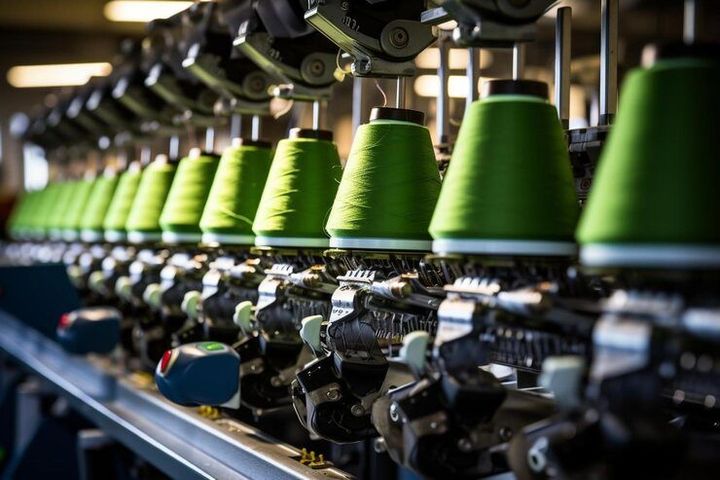
A ring spinning frame can contain many spinning positions arranged along the machine. Each position can process a fibre strand and form yarn simultaneously.
This arrangement allows a single machine installation to produce many yarn ends at the same time. Modern systems can monitor individual positions and identify selected operating abnormalities.
Connecting Fibre Preparation With Fabric Production
The yarn produced by ring spinning becomes an input for later textile processes. Depending on the application, it may proceed to winding, doubling, twisting, weaving, knitting, dyeing, or other stages.
This means the consistency of ring-spun yarn can influence later processing and the characteristics of the resulting textile material.
Main Components
| Component | Main Function | Simple Description |
|---|---|---|
| Drafting system | Controls fibre thickness | Stretches the roving |
| Spindle | Rotates the yarn package | Creates high-speed rotation |
| Ring | Provides the circular running path | Guides the traveller |
| Traveller | Moves around the ring | Helps insert twist |
| Bobbin or tube | Collects yarn | Holds the forming package |
| Roving guide | Positions incoming material | Guides the roving |
| Front rollers | Deliver drafted fibres | Control fibre movement |
| Creel | Holds roving packages | Supplies material |
| Drive system | Powers machine movement | Controls rotating elements |
| Control system | Monitors machine operation | Manages electronic functions |
Recent Updates
Higher Levels of Automation
Modern Ring Spinning Machines increasingly use electronic controls, automated monitoring, and centralized machine management.
Automation can assist with functions such as spindle monitoring, machine stopping, production information, fault detection, doffing, and selected material-handling operations.
The level of automation varies between machine designs and production configurations.
Digital Monitoring
Sensors and electronic systems can collect information about spindle operation, yarn formation, machine speed, temperature, vibration, and selected process conditions.
Digital monitoring can help operators identify abnormal conditions and compare machine performance across different sections of a spinning frame.
Automated Doffing
Doffing refers to removing full yarn packages and preparing the machine for a new production cycle. Automated doffing systems can reduce manual intervention during this repetitive stage.
Automation may also be connected with package transportation systems that move completed packages toward subsequent textile processes.
Energy Management
Spinning machinery contains numerous rotating components, motors, drives, and other electrical systems. Energy consumption has therefore become an important consideration in machine design and textile mill operation.
Modern drive systems can provide more precise control of rotating components. Mill-level monitoring can also help identify differences in energy use between machines, production conditions, and yarn specifications.
Sensor-Based Process Control
Sensors can monitor operating conditions at multiple points within a spinning frame. Data from these systems can support process analysis and help identify changes before they develop into larger production interruptions.
Sensor technology is also increasingly connected with predictive maintenance approaches, where machine data is analyzed to identify patterns associated with equipment condition.
Advanced Spinning Components
The development of rings, travellers, spindles, drafting components, and electronic controls continues to influence ring-spinning performance.
Small changes in component geometry, surface characteristics, materials, and operating settings can affect yarn formation. Component selection therefore remains an important technical consideration in spinning mills.
Digital Textile Manufacturing
Ring spinning is increasingly connected with broader textile-factory digital systems. Production data can be collected from multiple machines and presented through centralized monitoring platforms.
This can provide information about machine status, production quantities, faults, and selected quality indicators across a spinning department.
Laws or Policies
International Machinery Safety
Textile machinery safety is addressed internationally through ISO standards. ISO 11111-1:2016 provides common safety requirements for textile machinery and was reviewed and confirmed in 2026, meaning the standard remains current.
ISO 11111-2:2005 specifically covers safety requirements for spinning preparatory and spinning machines and was last confirmed in 2022. It addresses significant hazards and corresponding safety measures for machinery used in fibre preparation and spinning.
India
India's Bureau of Indian Standards includes IS 17361 Part 2:2020, covering safety requirements for spinning preparatory and spinning machines. BIS also lists standards relating to spinning machinery terminology, ring-spinning components, yarn specifications, and related textile equipment.
BIS's “Know Your Standard” platform allows users to search standards by IS number or keyword and access information such as amendments, related documents, laboratories, and committee information.
United States
In the United States, OSHA's textile requirements under 29 CFR 1910.262 apply to the design, installation, operation, and maintenance of textile machinery and equipment in covered textile plants. The regulation specifically includes ring spinning frames and requires appropriate guarding and interlocks for specified machinery components.
OSHA's general machine-guarding requirements also address hazards associated with rotating parts, power transmission components, and other moving machinery elements.
European Union
The European Union's Machinery Regulation (EU) 2023/1230 establishes health and safety requirements for machinery placed on the EU market or put into operation within its scope. The regulation is scheduled to apply from 20 January 2027, with certain provisions applying earlier.
For manufacturers and textile machinery operators working across international markets, the applicable requirements depend on the country, machine configuration, installation, and intended use.
Tools and Resources
Yarn Testing Instruments
Laboratories can use yarn testing equipment to measure properties such as linear density, tensile strength, elongation, evenness, hairiness, and imperfections.
These measurements help spinning teams compare yarn characteristics with the required specification.
Spindle Monitoring Systems
Spindle-monitoring systems can collect information about individual spinning positions. Such systems may identify stopped spindles, unusual operating conditions, or differences between positions.
This information can help operators locate production abnormalities more quickly.
Yarn Evenness Testers
Yarn evenness instruments measure variations in yarn thickness and can identify different types of irregularities. The results can help technical teams evaluate the effects of fibre preparation, drafting, machine settings, and other production factors.
Twist Measurement Equipment
Twist testers determine the amount and direction of twist present in yarn. Twist is an important characteristic because it influences yarn structure, strength, appearance, and downstream processing behavior.
Maintenance Monitoring
Vibration, temperature, spindle-condition, and drive-monitoring tools can provide information about selected mechanical and electrical components.
Such information can support planned inspection and maintenance activities.
Standards and Technical Documents
ISO standards provide internationally recognized terminology and safety references for textile machinery. BIS provides Indian Standards and related documentation, while national workplace authorities provide country-specific regulatory information.
Manufacturers, engineers, operators, and textile students can use these resources to understand machine terminology, safety requirements, component specifications, and production practices.
FAQs
What are Ring Spinning Machines?
Ring Spinning Machines are textile machines that convert prepared fibre strands, commonly roving, into spun yarn by combining drafting, twisting, and winding processes.
How do Ring Spinning Machines work?
Ring Spinning Machines first draft the incoming fibre strand, then introduce twist through the spindle and traveller arrangement before collecting the yarn onto a package.
What are the main components of Ring Spinning Machines?
Major components include the drafting system, rollers, spindles, rings, travellers, bobbins or tubes, roving guides, drive systems, and electronic control equipment.
What types of yarn can Ring Spinning Machines produce?
Ring spinning can produce yarn from cotton and various staple fibres or blends, depending on machine configuration, fibre properties, and process settings. The resulting yarn can be used in woven, knitted, apparel, home-textile, and other applications.
Why is safety important for Ring Spinning Machines?
Ring spinning machines contain high-speed rotating components and mechanical transmission systems. Appropriate guarding, interlocks, stopping mechanisms, risk assessment, operator training, and applicable machinery standards are therefore important.
Conclusion
Ring Spinning Machines convert prepared fibre strands into yarn through the coordinated actions of drafting, twisting, and winding. Their major components include drafting rollers, spindles, rings, travellers, bobbins, drives, and electronic controls. Modern developments are bringing greater automation, digital monitoring, energy management, sensor-based analysis, and automated material handling to spinning operations. International standards and national regulations also provide important frameworks for machinery safety, terminology, and textile production.