Ribbon Blenders for Industrial Mixing: Guide to Working Principles and Applications
Ribbon Blenders for Industrial Mixing are horizontal batch-mixing machines commonly used to combine dry powders, granules, and other bulk solid materials. Their main mixing chamber is usually a U-shaped trough containing a horizontal shaft fitted with inner and outer helical ribbons.
When the shaft rotates, the two ribbon sets move material in different directions. The outer ribbon generally moves material toward the center while the inner ribbon moves it toward the ends. This creates continuous circulation through the material and helps distribute different ingredients throughout the batch.
Ribbon blenders are also known as ribbon mixers. They are found across food processing, pharmaceuticals, chemicals, agriculture, construction materials, nutraceuticals, minerals, detergents, and other powder-processing industries.
Main Parts of a Ribbon Blender
A typical machine contains several important components.
Mixing trough: The horizontal vessel holds the materials during blending. Its U-shaped profile supports circulation around the rotating agitator.
Ribbon agitator: The inner and outer helical ribbons create the primary mixing movement. Their dimensions, pitch, clearance, and arrangement influence material circulation.
Central shaft: The shaft supports the ribbons and transfers rotational movement from the drive system.
Motor and gearbox: These components provide controlled rotation and transmit mechanical power to the shaft.
Discharge valve: A lower opening allows the mixed material to leave the trough after the batch is complete.
Top cover and access points: These allow loading, inspection, cleaning, and maintenance while helping contain material during operation.
Some designs can also include jackets for heating or cooling, spray systems for controlled liquid addition, special seals, dust-control connections, and different discharge arrangements.
How the Mixing Process Works
The basic process can be understood through several stages:
Loading: Dry powders or granules enter the mixing trough.
Ribbon rotation: The motor rotates the shaft and attached ribbons.
Counter-current movement: Inner and outer ribbons move material in opposite axial directions.
Circulation: Material is repeatedly folded, displaced, and redistributed throughout the trough.
Blend development: Continued movement gradually reduces concentration differences between ingredients.
Discharge: The completed mixture exits through the designated discharge opening.
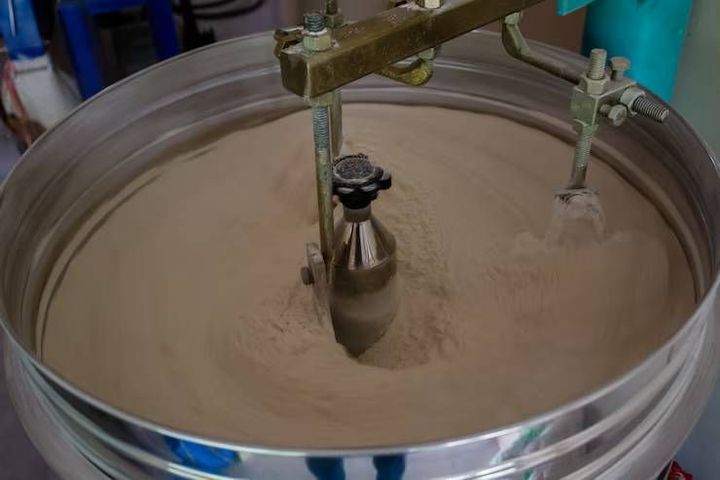
Ribbon blenders primarily use convective mixing. Unlike some other mixer designs, the material is mechanically moved through the vessel rather than being primarily suspended in an air-like fluidized state.
Importance
Consistent Powder Blending
Many industrial products contain several ingredients that need to be distributed throughout a batch. Examples include flour mixtures, powdered food ingredients, pharmaceutical excipients, fertilizers, pigments, detergents, and construction materials.
The opposing movement created by the ribbon arrangement helps transport material across different regions of the trough. Mixing performance depends on material characteristics, machine geometry, loading level, rotation conditions, and required blend uniformity.
Handling Different Solid Materials
Ribbon blenders can be configured for a broad range of powders and granules. Materials can vary significantly in particle size, density, flow characteristics, moisture content, and sensitivity to mechanical handling.
This means that a blender designed for one formulation may not automatically produce the same results with another. Testing and process evaluation are important when changing materials.
Batch Processing
Ribbon blenders are commonly used for batch production. A defined quantity of ingredients is loaded, mixed for a specified process period, and then discharged.
Batch operation makes it possible to maintain separate formulations or material combinations within the same production environment. The actual batch sequence depends on the manufacturing process.
Liquid Addition
Some ribbon blender designs can introduce small quantities of liquid during mixing through spray nozzles or other controlled feed arrangements.
For example, a dry powder may receive a small liquid addition while the ribbons continue circulating the material. The suitability of this approach depends on viscosity, quantity, particle characteristics, and the intended final product.
Key Design Characteristics
| Feature | Function | Typical Consideration |
|---|---|---|
| U-shaped trough | Holds the material | Volume and geometry |
| Inner ribbon | Moves material toward ends | Axial circulation |
| Outer ribbon | Moves material toward center | Counter-flow |
| Shaft | Supports agitator | Mechanical strength |
| Gearbox | Controls shaft movement | Load and operating conditions |
| Discharge valve | Removes finished material | Product retention |
| Jacket | Transfers heat or cooling | Temperature-sensitive processes |
| Spray system | Adds liquid | Controlled distribution |
| Seals | Protect shaft openings | Material containment |
| Access cover | Provides inspection access | Cleaning and maintenance |
Recent Updates
More Attention to Hygienic Design
Food, pharmaceutical, and nutraceutical manufacturers increasingly place emphasis on machine surfaces, internal accessibility, seals, discharge geometry, and cleaning procedures.
Equipment used for hygienic processing may require materials and construction methods appropriate for the product and applicable manufacturing requirements. EHEDG resources, for example, address hygienic equipment design for food-processing environments.
Improved Discharge Design
Residual material can create challenges when different batches are processed in sequence. Modern blender configurations therefore pay attention to trough geometry, discharge-valve placement, ribbon clearance, and internal accessibility.
The objective is to reduce retained material and make cleaning and batch changeover more manageable.
Automated Material Handling
Ribbon blenders can be integrated with weighing systems, conveyors, feeders, storage vessels, dust collectors, and control systems.
An automated line may measure individual ingredients, transfer them into the blender, run the programmed mixing sequence, and move the completed batch to the next stage. The exact arrangement depends on the production process.
Sensor-Based Monitoring
Industrial mixers can be connected to sensors that monitor selected operating conditions such as motor load, temperature, vibration, shaft movement, or other process parameters.
Data from these sensors can help operators identify changes in equipment behavior and monitor process conditions.
Greater Process Control
Modern industrial mixing systems increasingly use programmable controls to manage operating sequences. Controls may coordinate loading, mixing, liquid addition, discharge, and interlocking functions.
The level of automation varies from manually operated machines to integrated production lines with centralized control systems.
Dust-Control Considerations
Powder processing requires particular attention to dust containment. Certain finely divided materials can become combustible when dispersed in air under suitable conditions.
OSHA identifies mixers and blenders among processing equipment that may need consideration in combustible-dust risk management. Its guidance discusses dust accumulation, static electricity, grounding, ventilation, and explosion protection measures.
This is especially important when processing materials such as certain food powders, plastics, metals, chemicals, wood-derived powders, or other combustible substances.
Laws or Policies
Occupational Safety Requirements
Industrial mixing equipment is subject to workplace safety requirements that vary by country and application. Employers and equipment integrators generally need to assess hazards associated with moving machinery, electrical systems, dust, pressure, temperature, chemicals, and maintenance activities.
In the United States, OSHA provides workplace safety requirements and guidance relevant to machinery and combustible dust hazards. Its combustible-dust materials specifically address processing equipment such as mixers and blenders.
Food and Pharmaceutical Manufacturing
Ribbon blenders used in food or pharmaceutical production may be subject to additional requirements concerning materials in contact with products, contamination control, cleaning, process validation, and manufacturing environments.
In the United States, food manufacturers may need to consider FDA requirements under the Federal Food, Drug, and Cosmetic Act and applicable parts of Title 21 of the Code of Federal Regulations. Pharmaceutical applications can involve additional requirements depending on the product and manufacturing process.
European Machinery Requirements
Industrial mixing machinery placed on the European market needs to be assessed against applicable European legislation and harmonized standards.
The European Union's Machinery Regulation (EU) 2023/1230 establishes requirements for machinery and related products and is scheduled to apply from January 2027, replacing the Machinery Directive framework for products within its scope.
Manufacturers and integrators should determine which legislation applies to the specific machine, configuration, and intended market.
ATEX Considerations
Where combustible dust or potentially explosive atmospheres may occur, European ATEX requirements can become relevant.
ATEX concerns equipment and protective systems intended for use in potentially explosive atmospheres. The appropriate classification depends on the material, dust characteristics, process conditions, and hazardous-area assessment.
Risk Assessment
A ribbon blender should be evaluated as part of the complete production system. Important considerations can include:
Moving shafts and ribbons
Access to rotating components
Electrical equipment
Dust generation
Static electricity
Cleaning procedures
Material temperature
Chemical exposure
Emergency stopping
Maintenance access
Interlocking and guarding
Applicable standards and regulations depend on the country, industry, equipment configuration, and material being processed.
Tools and Resources
Mixing Trials
Laboratory or pilot-scale mixing trials can help determine whether a ribbon design is suitable for a particular material combination.
Trials may examine blend uniformity, mixing duration, loading level, liquid distribution, material degradation, and discharge behavior.
Particle-Size Analysis
Particle-size measurement can help identify differences between ingredients. Large differences in particle size may influence segregation and mixing behavior.
Understanding particle characteristics can therefore support process development.
Bulk-Density Measurement
Bulk density describes how much mass occupies a given volume under defined conditions. Differences in bulk density between ingredients can influence how materials move within a blender.
This measurement can be useful when selecting equipment and evaluating blend behavior.
Moisture Measurement
Moisture content can affect powder flow, adhesion, agglomeration, and mixing behavior. Moisture measurement can therefore be relevant when processing food ingredients, chemicals, minerals, and other powders.
Motor-Load Monitoring
Monitoring motor load can provide information about the mechanical demand placed on the mixing system. Sudden changes may indicate changes in material condition, loading, or mechanical operation.
Motor data should be interpreted together with other process information rather than used as the only indicator of machine condition.
Regulatory and Technical Resources
International manufacturers and operators can consult organizations such as ISO, IEC, OSHA, FDA, the European Commission, and industry-specific bodies for applicable technical and regulatory information.
The appropriate resource depends on the country where the equipment is installed, the industry, the material being processed, and the machine's configuration.
FAQs
What are Ribbon Blenders for Industrial Mixing?
Ribbon Blenders for Industrial Mixing are horizontal batch machines that use inner and outer helical ribbons to circulate powders, granules, and other bulk materials in opposing directions.
How does a ribbon blender work?
A motor rotates a shaft carrying inner and outer ribbons. The ribbons move material in different directions, creating continuous axial and radial circulation that gradually distributes the ingredients throughout the batch.
What materials can ribbon blenders mix?
Ribbon blenders are commonly used for dry powders, granules, and selected semi-dry materials. Applications include food ingredients, pharmaceutical powders, fertilizers, pigments, detergents, minerals, and construction materials.
What industries use ribbon blenders?
Ribbon blenders are used in food processing, pharmaceuticals, chemicals, agriculture, nutraceuticals, construction materials, minerals, cosmetics, and other powder-processing industries.
Are ribbon blenders suitable for combustible powders?
They can be used with some combustible powders, but the application requires appropriate hazard assessment and protective measures. Dust characteristics, concentration, ignition sources, grounding, ventilation, equipment design, and explosion protection need to be considered. OSHA provides specific guidance concerning combustible dust hazards.
Conclusion
Ribbon Blenders for Industrial Mixing use counter-directional ribbon movement to circulate powders and granules inside a horizontal trough. Their applications extend across food, pharmaceutical, chemical, agricultural, mineral, and construction-material processing. Modern systems increasingly incorporate automated controls, improved discharge arrangements, sensors, hygienic construction, and dust-management measures. Safe and effective operation depends on matching the blender design with the material characteristics, process requirements, workplace conditions, and regulations applicable to the intended market.