Packaging Machinery Trends: Learn the Basics, Innovations, and Key Resources
What Is Packaging Machinery? Packaging Machinery Trends describe the changing technologies, equipment designs, automation methods, materials, and digital systems used to package products. Packaging machinery can perform tasks such as filling, weighing, sealing, labeling, wrapping, coding, cartoning, case packing, palletizing, and inspection.
Packaging equipment is used across food and beverages, pharmaceuticals, cosmetics, consumer goods, chemicals, electronics, agriculture, and industrial products. The machinery selected for a facility depends on the product characteristics, package format, material, production volume, hygiene requirements, and applicable regulations.
Modern packaging systems increasingly combine mechanical equipment with sensors, programmable controls, machine vision, robotics, software, and data collection.
How Packaging Machinery Works
A packaging line usually consists of several machines arranged according to the sequence required for a particular product. Individual machines may perform separate tasks, or multiple functions can be combined within an integrated system.
A general packaging workflow includes:
- Product preparation: Products are measured, sorted, or prepared for packaging.
- Filling or loading: The product is placed into a pouch, bottle, carton, tray, box, or another container.
- Closing: Containers are sealed, capped, folded, glued, or otherwise closed.
- Labeling: Product information, identification codes, or labels are applied.
- Inspection: Sensors or cameras can check selected packaging characteristics.
- Coding: Batch information, dates, barcodes, or other identifiers may be printed.
- Case packing: Individual packages can be arranged into larger transport containers.
- Palletizing: Robotic or automated equipment can organize cases onto pallets.
- Data recording: Production information can be collected for monitoring and traceability.
The sequence varies according to the product and package design.
Main Types of Packaging Machinery
Filling machines measure and place liquids, powders, granules, pastes, or solid products into containers.
Form-fill-seal machines form packaging material, fill the package, and seal it within a connected production process.
Cartoning machines place products into cartons and close them using folding or other mechanisms.
Labeling machines apply labels to containers or packages at controlled positions.
Wrapping machines use flexible films or other materials to surround products or groups of products.
Case packing equipment organizes individual packages into larger boxes or cases.
Palletizing systems arrange cases or packages onto pallets for handling and transportation.
Inspection systems use sensors, cameras, weighing equipment, or other technologies to check selected package characteristics.
Importance
Consistent Packaging Processes
Packaging machinery can perform repeated operations with programmed settings and controlled movements. This can help maintain consistency in filling, sealing, labeling, coding, and package handling.
Consistency is particularly important when package dimensions, weights, seals, or identification information must meet specified requirements.
Automation
Automation is a major part of modern Packaging Machinery Trends. Machines can communicate with programmable controllers, sensors, robotic systems, and production software.
Automated systems can reduce repetitive manual handling and provide operators with information about machine status, production activity, alarms, and process conditions.
Product Protection
Packaging helps protect products from physical damage, moisture, oxygen, contamination, light, and other environmental factors, depending on the package design.
Machinery must therefore be compatible with the characteristics of both the product and its packaging material. Incorrect filling, sealing, or handling can affect package integrity.
Hygiene and Safety
Food, beverage, pharmaceutical, and other sensitive products can require controlled packaging environments. Machinery design may incorporate accessible cleaning areas, suitable materials, controlled product contact surfaces, and systems that limit contamination risks.
The appropriate hygiene requirements depend on the product category and applicable regulations.
Resource Management
Modern packaging equipment can incorporate controls that monitor material use, energy consumption, compressed air, machine speed, and production interruptions.
These measurements can help facilities understand how packaging processes operate and identify areas where resource use can be examined.
Packaging Line Components
| Machinery Type | Main Function | Common Application |
|---|---|---|
| Filling Machine | Measures and fills products | Bottles, pouches, containers |
| Sealing Machine | Closes packages | Flexible and rigid packaging |
| Labeling Machine | Applies labels | Bottles, cartons, containers |
| Cartoning Machine | Loads and closes cartons | Consumer products |
| Wrapping Machine | Covers products | Bundles and pallet loads |
| Case Packer | Loads shipping cases | Food and consumer goods |
| Palletizer | Arranges cases | Distribution operations |
| Vision Inspection | Checks selected features | Package and label inspection |
Recent Updates
AI and Machine Vision
Artificial intelligence and machine vision are increasingly being incorporated into packaging inspection systems. Cameras can capture package images while software examines selected characteristics such as label placement, package appearance, codes, seals, or other visible conditions.
AI-based systems can potentially distinguish complex visual patterns, although their reliability depends on image quality, training data, lighting, product variation, and system configuration.
Robotics
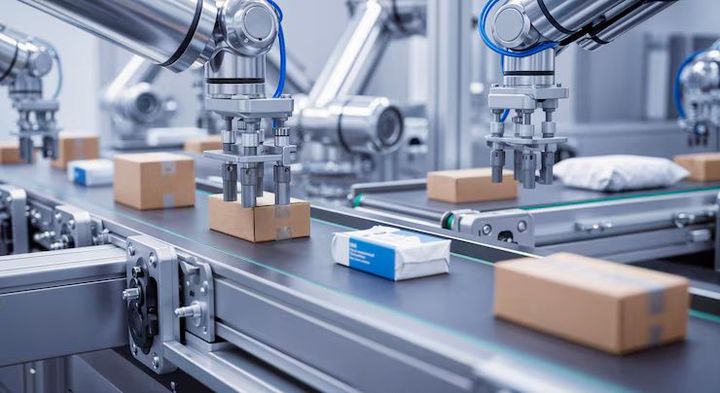
Robotic systems are increasingly used for picking, packing, sorting, case handling, and palletizing. Robots can perform repetitive movements and can be integrated with conveyors, cameras, sensors, and production-control systems.
Collaborative robots can also be designed for particular tasks where human workers and robotic equipment operate within defined safety arrangements.
Connected Packaging Lines
Industrial Internet of Things technologies allow packaging machines to collect and exchange operational data. Information can include machine status, production counts, cycle times, temperature, pressure, alarms, and equipment conditions.
Connected systems can provide centralized dashboards and historical records that help production teams understand machine performance.
Digitalization in Indian Manufacturing
India's manufacturing sector is increasingly adopting digital technologies such as artificial intelligence, Internet of Things systems, robotics, cloud computing, and digital twins.
NITI Aayog's 2025 advanced-manufacturing roadmap identified AI, machine learning, digital twins, robotics, and advanced materials among technologies that can influence India's manufacturing capabilities.
These technologies are relevant to Packaging Machinery Trends because modern packaging lines can incorporate many of the same digital manufacturing systems.
Sustainable Packaging Equipment
Packaging machinery is also adapting to changes in packaging materials and sustainability goals. Equipment may need to handle lightweight films, recyclable structures, paper-based formats, mono-material packaging, or redesigned containers.
Machinery changes can include improved material handling, more precise sealing, automated adjustment systems, and controls that reduce unnecessary material consumption.
Smart Maintenance
Sensor-based equipment monitoring is becoming more common in automated packaging lines. Temperature, vibration, motor current, pressure, and other signals can provide information about machine condition.
When analyzed over time, these measurements can support condition monitoring and help maintenance teams investigate unusual equipment behavior.
Higher Production Flexibility
Packaging lines increasingly need to handle multiple package sizes, formats, and product variants. Automated format changes, programmable settings, modular machinery, and recipe-based controls can help equipment adapt to different production requirements.
This flexibility is particularly relevant where product portfolios change frequently.
Laws or Policies
Legal Metrology Requirements
In India, packaged commodities are subject to requirements under the Legal Metrology framework. Packaging can involve declarations relating to information such as quantity, manufacturer or packer details, and other prescribed particulars.
The Department of Consumer Affairs administers the Legal Metrology system and publishes rules and notifications concerning packaged commodities.
Packaging machinery used for filling and labeling therefore needs to support accurate quantity measurement and appropriate package information where these requirements apply.
Food Packaging Requirements
Food packaging operations in India are regulated through the Food Safety and Standards Authority of India framework. Requirements can cover packaging materials, food-contact materials, labeling, hygiene, and related matters.
Packaging equipment used in food operations should be appropriate for the product, packaging material, processing environment, and applicable FSSAI requirements.
Pharmaceutical Packaging
Pharmaceutical packaging is subject to additional regulatory requirements because packaging can affect product identification, protection, stability, and traceability.
Machinery used in pharmaceutical production may incorporate controlled environments, inspection systems, serialization-related technologies, and documented production processes depending on the product and regulatory requirements.
Plastic Waste Management
India's Plastic Waste Management Rules and subsequent amendments provide a framework for managing plastic packaging waste and extended producer responsibility.
The regulatory environment has increased attention toward packaging design, plastic waste collection, recycling, and material management. Packaging machinery may therefore need to accommodate changes in package materials and formats.
Workplace Safety
Packaging machinery can involve conveyors, rotating components, cutters, sealing systems, heated surfaces, pneumatic equipment, electrical systems, and robotic movements.
Facilities should use appropriate machine guarding, emergency controls, maintenance procedures, worker training, and safety practices based on the machinery and workplace conditions.
Standards
Indian and international standards can provide technical guidance for packaging materials, machinery safety, testing, labeling, measurement, and package performance.
Standards are particularly useful when packaging systems involve food contact, pharmaceutical products, export requirements, or specialized industrial applications.
Tools and Resources
Packaging Line Monitoring
Production-monitoring software can display information such as machine status, production counts, downtime, alarms, and selected operating parameters.
These systems can provide a centralized view of connected packaging equipment.
Machine Vision Systems
Machine-vision equipment combines cameras, lighting, image-processing software, and analytical algorithms. It can be configured to inspect labels, codes, package position, visible defects, and other defined characteristics.
Weighing and Measurement Systems
Checkweighers, load cells, flow meters, and other measurement devices can monitor product quantity during packaging. Their configuration depends on whether the product is liquid, powder, granulated, or solid.
Barcode and Code Verification
Barcode readers and vision-based code verification systems can check printed identification information. These systems are relevant to traceability, inventory management, and regulated product packaging.
Robotics
Robotic arms and automated handling systems can perform tasks such as picking products, loading cartons, arranging cases, and palletizing.
Digital Twin and Simulation Tools
Simulation and digital-twin platforms can represent packaging lines digitally. They can help teams examine equipment layouts, production flows, machine interactions, and selected operating scenarios before physical changes are implemented.
Government and Standards Resources
The Ministry of Consumer Affairs, FSSAI, Bureau of Indian Standards, Ministry of Environment, Forest and Climate Change, and other relevant government bodies publish regulations, standards, notifications, and technical information related to packaging.
These resources can help organizations understand applicable requirements and technical terminology.
FAQs
What are Packaging Machinery Trends?
Packaging Machinery Trends include developments in automation, robotics, machine vision, artificial intelligence, connected equipment, digital monitoring, flexible machinery, and systems designed for changing packaging materials.
How is AI used in packaging machinery?
AI can support applications such as visual inspection, anomaly detection, process analysis, predictive equipment monitoring, and production-data analysis. The specific capability depends on the system and available data.
What types of packaging machinery are commonly used?
Common equipment includes filling machines, sealing systems, labeling machines, cartoners, wrappers, case packers, palletizers, conveyors, inspection systems, and coding equipment.
Why is machine vision important in packaging?
Machine vision can automatically examine selected visual characteristics of packages, labels, codes, seals, and product positioning. It can provide continuous inspection at appropriate points in a production line.
How are Packaging Machinery Trends changing manufacturing?
Packaging Machinery Trends are moving toward greater automation, connected equipment, robotics, digital monitoring, AI-assisted inspection, flexible production systems, and improved control of materials and energy.
Conclusion
Packaging Machinery Trends reflect the wider transformation of manufacturing through automation, robotics, artificial intelligence, sensors, machine vision, and connected production systems. Modern packaging equipment can support filling, sealing, labeling, inspection, handling, and palletizing while providing greater access to production information. Regulatory requirements in India also influence machinery selection, especially for food, pharmaceuticals, packaged commodities, plastics, and workplace safety. Understanding these technologies and requirements provides useful context for the continuing development of modern packaging operations.