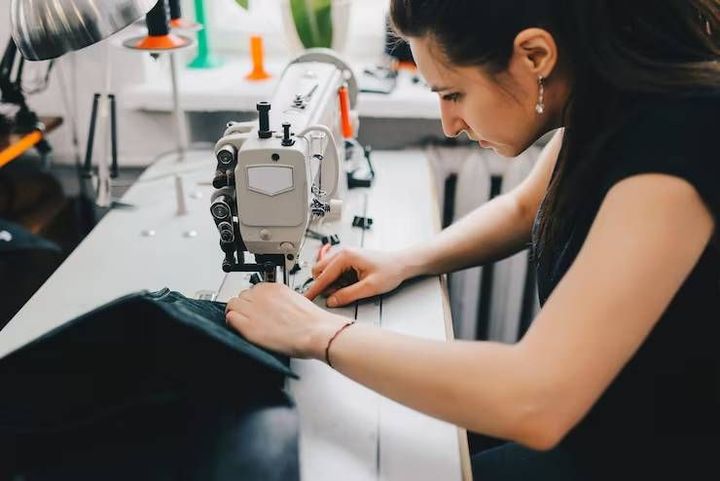
Overlock Sewing Machines: Discover How They Work and Important Facts
Overlock Sewing Machines are specialized sewing machines designed to stitch fabric edges while trimming excess material and enclosing the raw edge with thread. They are widely used in garment manufacturing, tailoring, apparel workshops, home sewing, and textile production.
An overlock machine is also commonly called a serger in some countries. The terminology can vary by region, but the basic principle is similar: multiple threads work together to create an edge-finishing stitch around the fabric.
Unlike a conventional lockstitch machine, which generally uses a needle and bobbin thread to form a straight seam, an overlock machine uses one or more needles together with loopers. The combination allows it to form stitches around the fabric edge.
How Overlock Sewing Machines Work
The working process involves several coordinated movements.
First, the fabric is placed under the presser foot. The feed mechanism moves the material forward at a controlled rate.
As the fabric moves, one or more needles pass through the material. At the same time, loopers move around the needle threads and form loops that wrap around the fabric edge.
Many overlock machines also contain a built-in cutting mechanism. A knife trims excess fabric immediately before the edge is enclosed by the thread.
A simplified sequence is:
Fabric feeding: Feed dogs move the fabric forward.
Needle movement: Needles carry thread through the fabric.
Looper movement: Loopers form and interconnect thread loops.
Edge trimming: A knife can remove excess fabric.
Thread wrapping: Threads surround the raw edge.
Stitch formation: The combined threads create the finished overlock seam.
The exact sequence varies according to machine construction and stitch configuration.
Main Components
Needles penetrate the fabric and carry needle threads through the material.
Loopers form thread loops beneath and around the fabric edge. They are a major difference between overlock machines and many conventional sewing machines.
Feed dogs move fabric through the machine. Their movement can be adjusted on some machines to accommodate different materials and sewing effects.
Presser foot holds the fabric against the feed mechanism during stitching.
Upper and lower knives trim the fabric edge on machines equipped with an integrated cutting system.
Thread tension controls regulate the amount of tension applied to individual threads. Correct adjustment helps create a balanced stitch.
Differential feed allows the front and rear feed mechanisms to move at different rates. This can help manage stretching or gathering in fabrics such as knits.
Importance
Finishing Fabric Edges
One of the main functions of an overlock machine is finishing raw fabric edges. Without edge finishing, some woven fabrics can gradually unravel when cut.
An overlock stitch wraps thread around the edge, helping contain loose fibers while creating a neat seam appearance.
Sewing Stretch Fabrics
Overlock machines are widely associated with knitted and stretch fabrics. Their stitch structures can accommodate fabric movement and are frequently used for garments made from jersey, knit, athletic, and similar materials.
The appropriate stitch depends on the fabric, thread, garment construction, and intended seam characteristics.
Combining Sewing and Trimming
Many overlock machines perform several operations during one pass. The machine can feed the fabric, trim the edge, and form the overlock stitch in a coordinated sequence.
This integrated process can simplify edge-finishing operations in garment production.
Supporting Garment Construction
Overlock machines can be used for side seams, sleeve seams, hems, edge finishing, and other garment-construction tasks.
In industrial production, specialized machines may be configured for particular operations, fabric weights, production speeds, or stitch structures.
Common Applications
| Application | Typical Use |
|---|---|
| Apparel | Seams and edge finishing |
| Knitwear | Stretch-fabric seams |
| Sportswear | Construction of flexible garments |
| Children's clothing | Edge finishing and seam construction |
| Home sewing | Garment and textile projects |
| Textile workshops | Repetitive seam operations |
| Industrial production | High-volume garment assembly |
| Decorative edging | Selected fabric-finishing applications |
Recent Updates
More Electronic Controls
Modern overlock machines increasingly incorporate electronic controls, programmable settings, digital displays, and electronically controlled motors.
These features can make it easier to adjust selected machine parameters and monitor operating conditions. Industrial models can integrate electronic controls into larger production systems.
Improved Differential Feed
Differential-feed mechanisms continue to play an important role in machines intended for fabrics with different stretch characteristics.
By changing the relative movement of feed sections, operators can reduce unwanted waviness or intentionally create gathering effects. The appropriate setting depends on the fabric and stitch configuration.
Automatic Thread Functions
Some modern machines include features that assist with thread handling, needle positioning, thread cutting, or tension adjustment.
The extent of automation differs substantially between household, semi-industrial, and industrial models.
Energy-Efficient Motor Systems
Electronic motor technology has become increasingly relevant to modern sewing equipment. Servo and electronically controlled motor systems can provide more precise speed control than some older motor arrangements.
Industrial sewing environments can also integrate machines with centralized monitoring and production-control systems.
Connected Textile Manufacturing
Large textile operations are increasingly using digital production systems to monitor machine activity, production information, quality indicators, and equipment conditions.
An overlock machine can form one part of a larger production line that includes cutting equipment, sewing machines, inspection systems, pressing equipment, and packaging equipment.
Updated Standards and Terminology
International standardization remains important for sewing-machine terminology, safety, performance, and testing. ISO/TC 148 covers standardization related to sewing machines, including classification, terminology, safety, performance, and test methods.
ISO 4915 provides a classification and terminology system for stitch types used in hand and machine sewing, while ISO 4916 covers the classification and terminology of stitched seams. These standards help create consistent technical language across textile manufacturing.
Laws or Policies
International Safety Frameworks
Safety requirements for sewing machinery vary by country and application. International standards can provide technical references for manufacturers, integrators, workplaces, and equipment users.
ISO 10821 addresses safety requirements for industrial sewing machines, units, and systems. It covers machinery-related safety considerations relevant to industrial sewing environments.
ISO 11111-1 establishes common safety requirements for textile machinery and was reviewed and confirmed in 2026, meaning the referenced edition remains current.
Electrical Safety
Modern overlock machines may contain motors, electronic controls, switches, sensors, lighting systems, and other electrical components.
Electrical safety requirements differ between regions and can depend on voltage, machine design, workplace conditions, and applicable national regulations. Manufacturers and workplaces should follow the requirements applicable in their jurisdiction.
Product Standards
National standards organizations may establish requirements covering sewing-machine construction, performance, testing, terminology, and safety.
In India, the Bureau of Indian Standards maintains standards for sewing machines and related components. BIS's sewing-machine compendium describes Indian Standards covering different types of sewing equipment and related components.
BIS also maintains a searchable “Know Your Standard” platform where users can search standards by product name or standard number.
Workplace Safety
Factories and workshops should consider guarding, electrical protection, needle safety, moving parts, lighting, noise, maintenance, operator training, and emergency procedures.
The applicable requirements depend on national and regional workplace legislation. Textile manufacturers operating internationally may therefore need to consider multiple regulatory frameworks.
Tools and Resources
Thread Selection Guides
Thread selection depends on fabric type, stitch structure, machine configuration, needle size, and intended seam characteristics.
Polyester threads are commonly used for many garment applications, while other thread types can be selected for particular materials and performance requirements.
Needle Guides
Needle size and point type should correspond to the fabric and thread combination. Lightweight woven materials, heavy fabrics, knits, and technical textiles can require different needle specifications.
The machine manufacturer's documentation should be consulted for compatible needle systems.
Differential Feed Controls
Differential-feed adjustment is particularly useful when working with fabrics that stretch, contract, or require controlled gathering.
Testing the setting on a fabric sample can help determine how the material responds before production sewing begins.
Thread Tension Guides
Each thread path can influence the final stitch appearance. Balanced tension generally keeps the stitch structure positioned correctly around the fabric edge.
If loops appear too loose, too tight, or unevenly distributed, operators may need to check threading, needle condition, tension settings, and machine timing.
Maintenance Resources
Routine maintenance can include cleaning lint from accessible areas, checking needles, inspecting knives, applying lubrication where specified, and following the machine manufacturer's maintenance schedule.
Industrial equipment may also require periodic technical inspection and component replacement.
International Standards Resources
ISO publications provide terminology and safety references for sewing and textile machinery. National standards bodies can provide additional requirements for specific markets.
For users working internationally, checking both international standards and local regulations can help clarify applicable technical requirements.
FAQs
What are Overlock Sewing Machines?
Overlock Sewing Machines are specialized machines that create edge-finishing stitches around fabric while many models simultaneously trim excess material.
How do Overlock Sewing Machines work?
Overlock Sewing Machines use needles, loopers, feed mechanisms, and often cutting knives to move fabric, form interconnected thread loops, and finish the fabric edge.
How many threads do Overlock Sewing Machines use?
Common configurations include three-thread, four-thread, and five-thread arrangements. Some machines can also support additional stitch configurations depending on their design.
Can Overlock Sewing Machines sew stretch fabrics?
Yes. Overlock Sewing Machines are widely used with knitted and stretch materials. Differential feed and appropriate stitch settings can help manage fabrics that expand or contract during sewing.
What is the difference between an overlock machine and a regular sewing machine?
A regular sewing machine commonly forms a lockstitch using a needle and bobbin, while an overlock machine uses needles and loopers to create stitches around the fabric edge. Many overlock machines can also trim the edge during stitching.
Conclusion
Overlock Sewing Machines combine needles, loopers, feed mechanisms, thread controls, and cutting systems to create finished fabric edges and specialized seams. They are used across household sewing, tailoring, garment production, knitwear, sportswear, and industrial textile operations. Recent developments include electronic controls, improved feed mechanisms, automated functions, digitally connected production systems, and continued attention to machinery safety. Understanding stitch structures, machine components, fabric characteristics, and applicable standards helps explain how overlock technology fits into modern textile manufacturing.