Industrial Evaporation Systems for Efficient Liquid Processing
Industrial evaporation systems are used to remove water or other volatile components from liquid streams through controlled heating and vapor separation.
The process can increase the concentration of dissolved materials, reduce liquid volume, and support the recovery or treatment of process streams.
These systems are used across chemical processing, food and beverage production, pharmaceuticals, wastewater treatment, minerals processing, and other industries. Different evaporator configurations are selected according to liquid characteristics, required concentration, heat sensitivity, energy requirements, and operating conditions.
What Are Industrial Evaporation Systems?
An industrial evaporation system transfers heat to a liquid until part of the liquid changes into vapor. The vapor is then separated from the remaining concentrated liquid.
The system can operate under atmospheric pressure, elevated pressure, or vacuum conditions. Vacuum operation can lower the boiling temperature, which can be useful when processing heat-sensitive materials.
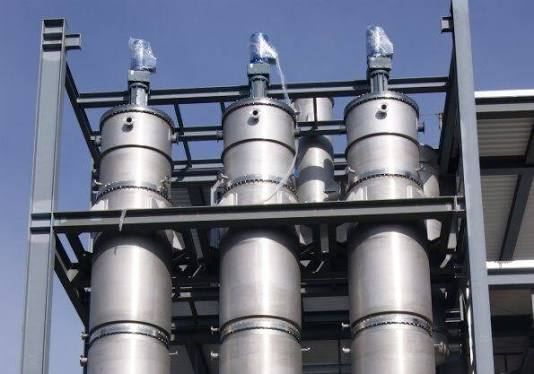
A complete evaporation system may include an evaporator, heat exchanger, vapor separator, circulation pump, condenser, vacuum equipment, feed system, controls, and condensate collection equipment.
How Industrial Evaporation Systems Work
The evaporation process generally follows several stages.
1. Feed Preparation
The liquid feed enters the system after any required filtration, screening, or pretreatment.
Feed characteristics such as concentration, temperature, viscosity, suspended solids, and chemical composition can influence system operation.
2. Preheating
The feed may be preheated using steam, hot water, thermal fluid, or recovered heat. Preheating reduces the additional heat required inside the main evaporation stage.
3. Heat Transfer
The liquid passes through a heat-transfer surface where thermal energy is supplied. The heating medium may be steam, hot water, thermal oil, combustion-derived heat, or another suitable source.
4. Vapor Formation
As the liquid absorbs sufficient heat, part of the volatile component evaporates. In water-based systems, water changes from liquid to vapor.
5. Vapor-Liquid Separation
The resulting vapor is separated from the concentrated liquid using a separator or evaporator body. Separation prevents excessive liquid carryover into downstream equipment.
6. Concentrate Removal
The concentrated liquid is discharged or circulated for further evaporation depending on the required final concentration.
7. Vapor Condensation
In many systems, the vapor is directed to a condenser where it changes back into liquid. The resulting condensate may be collected for reuse, further treatment, or disposal.
Main Types of Industrial Evaporation Systems
Falling Film Evaporators
In falling film systems, liquid flows as a thin film along the internal surface of heated tubes.
The thin film provides a relatively large heat-transfer area and can support rapid evaporation. These systems are commonly used for liquids that can flow readily through the tubes.
Rising Film Evaporators
Rising film evaporators use vapor formation to move liquid upward through heated tubes. The resulting vapor-liquid mixture exits toward a separation chamber.
They can be applied to certain low-viscosity liquids and specific evaporation conditions.
Forced Circulation Evaporators
Forced circulation systems use a pump to circulate liquid through the heat exchanger at a controlled rate.
This configuration can be suitable for concentrated, viscous, or crystallizing liquids because circulation helps maintain flow through the heating surface.
Multiple-Effect Evaporators
Multiple-effect systems use vapor generated in one evaporation stage as the heating source for another stage.
This arrangement can reduce the amount of external heating energy required compared with a single-effect system under suitable operating conditions.
Vacuum Evaporators
Vacuum evaporation reduces the boiling temperature of the liquid. This can be useful for heat-sensitive materials or applications where lower-temperature evaporation is desirable.
Comparison of Evaporation System Types
| Evaporator Type | Main Operating Principle | Typical Application |
|---|---|---|
| Falling film | Liquid flows as a thin film | Low-viscosity liquid concentration |
| Rising film | Vapor lifts liquid through tubes | Selected low-viscosity feeds |
| Forced circulation | Pumped liquid circulation | Concentrated or difficult liquids |
| Multiple effect | Vapor reused between stages | Energy-conscious processing |
| Vacuum | Reduced boiling temperature | Heat-sensitive materials |
Main Components of Industrial Evaporation Systems
Heat Exchanger
The heat exchanger transfers thermal energy from the heating medium to the process liquid.
Evaporator Body
The evaporator provides the environment where liquid heating and vapor generation occur.
Vapor Separator
The separator separates vapor from concentrated liquid and helps limit liquid carryover.
Circulation Pump
Circulation pumps move process liquid through the system. They are particularly important in forced circulation configurations.
Feed Pump
The feed pump transfers incoming liquid into the evaporation system at the required flow and pressure.
Condenser
A condenser removes heat from vapor and converts it back into liquid. The condensate may be collected for reuse or additional treatment.
Vacuum System
Vacuum pumps, ejectors, or other equipment can reduce system pressure when low-temperature evaporation is required.
Control System
Controllers monitor and regulate temperature, pressure, liquid level, flow, vacuum, and other process parameters.
Factors Affecting Evaporation Performance
Feed Concentration
The concentration of dissolved material affects boiling behavior, viscosity, heat transfer, and the final evaporation rate.
Temperature
Higher temperature differences can increase heat transfer, but excessive temperatures may affect heat-sensitive materials or cause unwanted reactions.
Pressure
Operating pressure changes the boiling point of the liquid. Vacuum operation can allow evaporation at lower temperatures.
Viscosity
As a liquid becomes more concentrated, its viscosity may increase. Higher viscosity can reduce circulation and heat-transfer performance.
Scaling
Mineral deposits or other solids can accumulate on heat-transfer surfaces. Scaling reduces heat transfer and can increase maintenance requirements.
Foaming
Some liquids can produce foam during evaporation. Excessive foam may cause liquid carryover and affect downstream equipment.
Applications of Industrial Evaporation Systems
Wastewater Treatment
Evaporation can concentrate dissolved materials in selected industrial wastewater streams and reduce the volume of liquid requiring further handling.
Chemical Processing
Chemical manufacturers can use evaporation to concentrate solutions, recover solvents or water, and prepare materials for subsequent processing.
Food and Beverage Processing
Evaporation is used to concentrate products such as milk, fruit juices, extracts, syrups, and other liquid foods.
Pharmaceutical Processing
Evaporation can support concentration and solvent-removal processes where carefully controlled temperature and pressure conditions are required.
Minerals Processing
Evaporators can concentrate mineral-containing solutions and support recovery or treatment processes.
Industrial Liquid Recovery
Some facilities use evaporation to separate water from dissolved or suspended materials and recover selected liquid streams.
Automation and Process Monitoring
Modern industrial evaporation systems can use temperature sensors, pressure transmitters, flow meters, level sensors, conductivity instruments, and automated control systems.
Controllers can adjust heating-medium flow, feed rate, circulation, vacuum level, and concentrate discharge according to configured process conditions.
Continuous monitoring can also help identify changes in heat-transfer performance, pressure, temperature, concentration, or equipment operation.
Energy Management
Evaporation requires substantial thermal energy because a phase change must occur. System design therefore places significant emphasis on heat recovery and efficient heat transfer.
Multiple-effect evaporation can reuse vapor generated in one stage as a heating source for another stage. Mechanical vapor recompression and thermal vapor recompression are additional approaches that can reduce external steam requirements in suitable installations.
Preheating incoming feed with recovered heat can also reduce the energy required during the main evaporation process.
Maintenance of Industrial Evaporation Systems
Regular maintenance helps maintain heat-transfer performance and stable operation. Heat-transfer surfaces should be inspected for scale, fouling, corrosion, and deposits.
Pumps, valves, seals, condensers, vacuum equipment, sensors, and control components should also be inspected according to operating conditions and equipment requirements.
Cleaning procedures should be selected according to the process liquid and construction materials. Monitoring pressure drop and heat-transfer behavior can help identify developing fouling problems.
Safety Considerations
Industrial evaporation systems can operate with high temperatures, pressure or vacuum, chemicals, and pressurized steam. Appropriate isolation procedures should be followed before maintenance.
Operators should verify pressure conditions before opening vessels, piping, or heat exchangers. Vacuum equipment and pressure-rated components should be inspected according to applicable procedures.
Where hazardous chemicals or vapors are involved, appropriate ventilation, containment, monitoring, and personal protective equipment should be used.
Frequently Asked Questions
What is the purpose of an industrial evaporation system?
An industrial evaporation system removes water or another volatile component from a liquid to increase concentration, reduce liquid volume, or support recovery and treatment processes.
What are the main types of industrial evaporators?
Common types include falling film, rising film, forced circulation, multiple-effect, and vacuum evaporators.
Why are multiple-effect evaporators used?
Multiple-effect systems can reuse vapor from one stage as a heating source for another stage, which can reduce external thermal energy requirements under suitable operating conditions.
What factors affect evaporation performance?
Feed concentration, temperature, pressure, viscosity, scaling, foaming, heat-transfer characteristics, and circulation rate can all influence evaporation performance.
Where are industrial evaporation systems used?
They are used in wastewater treatment, chemical processing, food and beverage production, pharmaceutical processing, minerals processing, and other liquid-concentration applications.
Conclusion
Industrial evaporation systems provide a controlled method for concentrating liquids, reducing water content, and supporting liquid recovery or treatment. Their operation combines heat transfer, vapor formation, vapor-liquid separation, concentrate handling, and, in many cases, vapor condensation.
Falling film, rising film, forced circulation, multiple-effect, and vacuum configurations address different feed characteristics and process requirements. Selecting an appropriate system requires consideration of temperature, pressure, viscosity, concentration, scaling potential, energy requirements, and desired final conditions.
Effective automation, heat recovery, water treatment, regular cleaning, equipment inspection, and appropriate safety procedures can help maintain stable evaporation processes.