Humanoid Robots: Explore Essential Basics and Key Information
What Are Humanoid Robots? Humanoid Robots are machines designed with a body structure that resembles important aspects of the human form. A typical humanoid may have a head-like sensor area, a torso, two arms, two hands, and two legs. The human-like structure is intended to help these machines interact with environments originally designed for people.
Unlike traditional industrial robots that may remain fixed in one location, humanoid robots are generally designed for greater mobility and flexible interaction. They combine mechanical systems, sensors, computers, actuators, artificial intelligence, and software to perceive surroundings and perform physical actions.
The field connects several areas of engineering and computing, including robotics, machine learning, computer vision, control systems, mechanical engineering, electronics, and human-machine interaction.
How Humanoid Robots Work
A humanoid robot typically uses multiple sensors to understand its surroundings. Cameras can provide visual information, while depth sensors, microphones, force sensors, inertial measurement units, and joint-position sensors can provide additional information.
The robot's control system processes these inputs and determines how its body should respond. Motors and actuators then move the joints according to the calculated instructions.
A simplified operating cycle includes:
- Perception: Sensors collect information about objects, people, surfaces, sounds, and movement.
- Interpretation: Computing systems process the incoming information.
- Planning: Software determines an appropriate sequence of actions.
- Movement: Motors and actuators move the robot's joints.
- Feedback: Sensors continuously report the result of each movement.
- Adjustment: The control system modifies movements when the environment changes.
Main Components
Humanoid Robots contain many interconnected components. Actuators provide movement, while batteries provide electrical power for mobile operation. Cameras and other sensors help the robot understand its environment.
A computing platform runs control software and artificial intelligence models. Mechanical joints, gears, motors, structural frames, communication systems, and safety mechanisms complete the physical system.
Importance
Human-Oriented Environments
A major reason for developing Humanoid Robots is that many workplaces and buildings are already designed around human dimensions. Door handles, stairs, shelves, tools, vehicles, and workstations commonly assume that a person will interact with them.
A robot with two arms and two legs may therefore be able to work within environments without requiring every physical feature to be redesigned specifically for automation.
Manufacturing
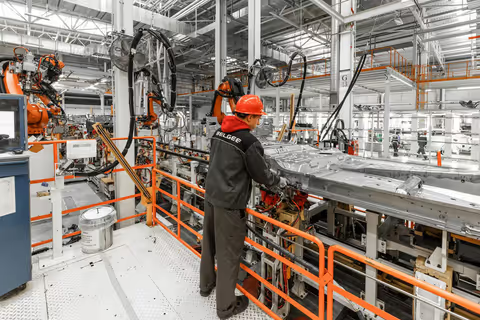
Humanoid Robots are being explored for manufacturing activities that involve repetitive physical movements, material handling, inspection, and interaction with existing equipment.
The potential application depends on factors such as payload, balance, precision, operating duration, safety requirements, and the complexity of the workplace.
Warehousing and Logistics
Warehouses contain many activities involving movement, lifting, sorting, and transporting objects. Humanoid designs could potentially operate in spaces where shelves, doors, carts, and tools have been designed around human workers.
However, reliable navigation, object recognition, battery endurance, and safe interaction remain important technical challenges.
Healthcare and Assistance
Humanoid forms can also be studied for environments where communication and physical interaction are important. Potential applications include rehabilitation research, assistance with selected tasks, educational activities, and interaction with people.
Medical applications require particularly careful validation because physical or automated actions can directly affect human safety.
Research and Education
Humanoid robots provide a platform for studying walking, balance, dexterous manipulation, computer vision, artificial intelligence, and human-robot interaction.
Universities and research laboratories can use robotic platforms to test algorithms in real-world environments rather than relying only on computer simulations.
Important Technical Challenges
Humanoid Robots remain complex systems. Walking on two legs requires continuous balance adjustments, while manipulating objects requires coordination between vision, movement, force, and hand control.
Other challenges include battery capacity, heat management, mechanical durability, navigation, safe human interaction, reliable perception, and the ability to perform tasks consistently.
| Component | Main Function | Example Technologies |
|---|---|---|
| Sensors | Understand surroundings | Cameras, depth sensors, microphones |
| Actuators | Produce movement | Electric motors, hydraulic systems |
| Control system | Coordinate actions | Real-time controllers, algorithms |
| AI system | Interpret and plan | Machine learning, vision models |
| Power system | Supply energy | Batteries, power electronics |
| Mechanical frame | Support the robot | Lightweight structures, joints |
| Communication | Exchange information | Wireless and wired networks |
Recent Updates
Increasing Interest in Physical AI
Recent robotics development has increasingly connected artificial intelligence with physical machines. This approach is sometimes described as embodied AI or physical AI, where AI systems learn to interpret environments and produce actions through a physical body.
The International Federation of Robotics published a 2025 paper examining the development of humanoid robots and the gap between their current capabilities and their potential applications. Its 2026 materials also highlight artificial intelligence in robotics as an important development area.
More Attention to Industrial Applications
Humanoid Robots are increasingly being evaluated for industrial environments, particularly tasks involving repetitive handling, movement, and interaction with existing workspaces.
This interest is part of a wider expansion in industrial robotics. The International Federation of Robotics reported that 542,000 industrial robots were installed globally in 2024, with Asia accounting for 74% of new installations. Traditional industrial robots remain much more established than humanoid systems, but the broader robotics ecosystem provides technologies and infrastructure relevant to humanoid development.
India's Robotics Roadmap
India has been developing a broader strategic approach to robotics. In February 2026, the Office of the Principal Scientific Adviser convened a Technology Advisory Group meeting to discuss the ecosystem and a strategic roadmap for robotics in India.
The discussions included humanoid and quadruped robots, tactile perception, haptics, embodied AI, domestic components, workforce development, standards, and deployment challenges.
AI and Robotics Research
India's National Mission on Interdisciplinary Cyber-Physical Systems supports work in areas including artificial intelligence, machine learning, robotics, autonomous systems, Internet of Things technologies, cybersecurity, and related fields.
The mission has established 25 Technology Innovation Hubs at academic institutions, with activities covering technology development, human-resource development, entrepreneurship, and international collaboration.
Emerging Deep-Tech Funding
India's Research, Development and Innovation Scheme was introduced to strengthen private-sector research in strategic and emerging areas. Robotics is included among the deep-technology fields covered by the initiative, alongside areas such as artificial intelligence, quantum technologies, biotechnology, and space technology.
These developments indicate that humanoid robotics is increasingly being considered within a larger ecosystem involving AI, advanced manufacturing, sensors, computing, and deep-tech research.
Laws or Policies
India's Robotics Strategy
India released a draft National Strategy on Robotics for public consultation in 2023. The proposed strategy identified manufacturing, agriculture, healthcare, and national security as strategic areas and discussed research, innovation, domestic capabilities, workforce development, and governance.
The draft strategy is useful for understanding India's policy direction, although a draft document should not be treated as equivalent to a comprehensive binding law.
Artificial Intelligence Governance
Humanoid Robots increasingly depend on AI for perception, planning, speech interaction, and decision-making. Consequently, AI governance can become relevant when a robot uses AI systems in situations involving people or sensitive information.
India released its AI Governance Guidelines in November 2025. The framework promotes safe, responsible, and inclusive AI adoption and uses a risk-based approach while relying on existing laws and sector-specific oversight.
Data Protection
Humanoid Robots can potentially collect visual, audio, location, or other information while operating around people. Where personal data is processed digitally, applicable data-protection requirements may become relevant.
Organizations deploying such systems should consider data minimization, appropriate security controls, access management, retention practices, and other obligations under India's digital personal-data framework.
Workplace Safety
Robots operating around people require appropriate safety controls. Depending on the environment, considerations can include emergency stopping, collision detection, restricted operating zones, speed limitations, physical safeguards, risk assessment, and human supervision.
The exact requirements can differ according to the industry, equipment, workplace, and intended activity. Applicable technical standards and occupational safety rules should therefore be evaluated for each deployment.
Research and Skill Development
India's technology missions also place emphasis on developing technical skills related to robotics and emerging technologies. In 2026, the Ministry of Skill Development and Entrepreneurship reported initiatives covering emerging skills such as artificial intelligence, machine learning, and robotics.
Tools and Resources
Robotics Simulation Platforms
Simulation environments allow researchers to create virtual robots, environments, sensors, and tasks. They can be used to test movement algorithms and control systems before deploying them on physical machines.
Simulation is particularly useful for walking, navigation, manipulation, and reinforcement-learning research.
Computer Vision Tools
Computer vision software helps robots identify objects, estimate depth, track movement, and interpret scenes. Cameras combined with machine-learning models can provide information needed for navigation and manipulation.
Robot Operating Frameworks
Robotics frameworks provide libraries and tools for connecting sensors, controllers, simulation systems, and robotic hardware. They can help researchers develop and test modular robotic applications.
Digital Twin Systems
Digital twins create computer-based representations of physical machines or environments. They can help engineers study robot movement, equipment interaction, and operational scenarios before physical deployment.
Research and Standards Resources
Government research programs, academic institutions, robotics organizations, and international standards bodies provide technical information on robotics, AI, safety, and automation.
The International Federation of Robotics maintains research and information resources covering industrial robotics, artificial intelligence, humanoid robots, workplace robotics, and related developments.
FAQs
What are Humanoid Robots?
Humanoid Robots are machines designed with a human-like body structure, commonly including a torso, two arms, and two legs. They combine mechanical systems, sensors, computing, control software, and artificial intelligence.
How do Humanoid Robots work?
Humanoid Robots collect information through sensors, process that information using computing systems, plan actions, and control motors and actuators to move. Feedback from sensors allows the robot to adjust its movements as conditions change.
Where can Humanoid Robots be used?
Potential applications include manufacturing, warehouses, research laboratories, education, healthcare research, inspection, and environments designed around human movement. Practical use depends on technical capability and safety requirements.
What makes Humanoid Robots difficult to develop?
Walking balance, dexterous hand movement, perception, battery endurance, reliable AI, mechanical durability, navigation, and safe interaction with people are major challenges. Combining all these capabilities into one reliable system is technically demanding.
Are Humanoid Robots used in India?
India has an expanding robotics research and development ecosystem. Government initiatives include the National Mission on Interdisciplinary Cyber-Physical Systems and ongoing work toward a strategic robotics roadmap, while recent government discussions have specifically included humanoid robotics and embodied AI.
Conclusion
Humanoid Robots combine mechanical engineering, sensors, artificial intelligence, computing, and control systems in a human-like physical form. Their potential applications include manufacturing, logistics, research, healthcare-related activities, and other environments designed around people. Current developments are increasingly focused on embodied AI, industrial applications, tactile perception, safety, and reliable physical interaction. In India, robotics research, AI governance, deep-tech programs, and strategic planning are contributing to the broader development of this field.