Collaborative Robots (Cobots): Explore Essential Basics and Key Information
What Are Collaborative Robots (Cobots)? Collaborative Robots (Cobots) are robotic systems designed to work in environments where people and robots may share tasks or workspace. Unlike traditional industrial robots that are commonly separated from people by physical barriers, cobot applications can use safety functions that allow controlled interaction between humans and robotic equipment.
The word “collaborative” describes the way the robot is used within an application rather than simply describing a particular robot shape. A collaborative system includes the robot, control system, tools, sensors, work area, operating procedures, and safety measures. ISO describes collaborative robotics as an approach in which automatically operated robot systems can share a workspace with humans.
Cobots are commonly associated with manufacturing, assembly, material handling, inspection, packaging, laboratory activities, and other repetitive industrial tasks.
How Cobots Work
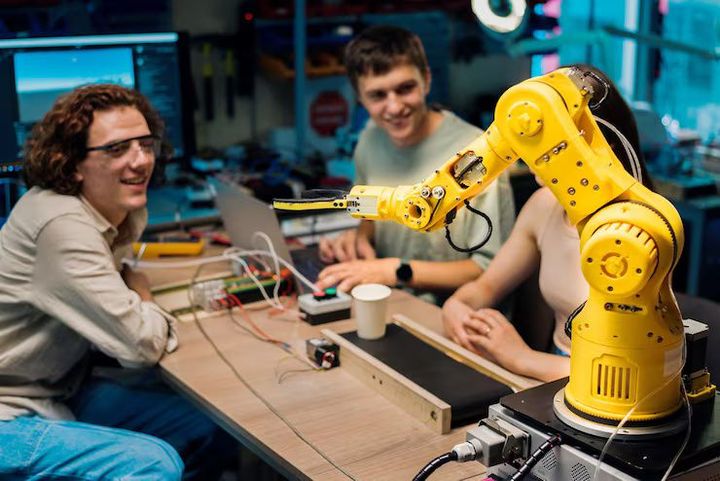
A cobot typically consists of several connected components that work together.
- Robotic arm: Provides controlled movement across multiple joints.
- Controller: Processes commands and manages robot motion.
- End effector: A tool attached to the robot arm, such as a gripper, suction device, screwdriver, or welding tool.
- Sensors: Detect selected forces, positions, speeds, contact conditions, or objects.
- Software: Defines movements, sequences, inputs, outputs, and operating parameters.
- Safety system: Monitors conditions and can initiate a controlled stop when required.
An operator may program a cobot through a graphical interface, teach selected positions manually, or use programming software. The exact method depends on the robot model and application.
Common Cobot Applications
Collaborative robots can perform a wide range of repetitive or controlled tasks.
Assembly applications may involve placing components together, fastening parts, or transferring small components between workstations.
Machine tending involves loading and unloading parts from equipment such as CNC machines.
Material handling can include moving components, sorting objects, transferring containers, or positioning items.
Inspection can use cameras and other sensors to examine dimensions, surface characteristics, labels, or assembly conditions.
Packaging and palletizing applications can involve arranging products or containers according to predefined patterns.
Laboratory automation can involve repetitive handling and movement of samples or equipment where the application has been appropriately designed and validated.
Importance
Supporting Human-Robot Collaboration
Collaborative Robots (Cobots) are designed around the idea that robots and people can contribute different capabilities to the same workflow. Robots can repeat programmed movements consistently, while people can handle tasks requiring judgment, adaptation, visual interpretation, and problem-solving.
The actual level of interaction depends on the application. A cobot should not automatically be considered safe for direct human contact simply because it is marketed as collaborative.
Handling Repetitive Tasks
Repetitive industrial activities can require frequent movement of components or repeated positioning of tools. Cobots can perform programmed sequences for such tasks while people supervise, prepare materials, conduct inspections, or handle activities requiring flexibility.
This can be particularly relevant in production environments where processes change regularly.
Flexible Automation
Traditional automation can sometimes require substantial physical integration around a fixed process. Cobots can be configured for a variety of tasks and may be relocated between work areas when the application permits.
Their relatively compact designs can make them suitable for selected workstations where floor space is limited.
Supporting Ergonomics
Some repetitive activities involve frequent lifting, reaching, positioning, or manipulation. A properly designed robotic application can take over selected repetitive motions and allow workers to concentrate on other activities.
Ergonomic improvements depend on the complete workflow rather than the robot alone. Poorly designed human-robot interaction can introduce new physical or operational risks.
Main Characteristics
| Characteristic | Description | Typical Role |
|---|---|---|
| Force monitoring | Detects selected force conditions | Interaction control |
| Speed monitoring | Controls movement speed | Risk reduction |
| Position sensing | Tracks robot movement | Motion control |
| Vision | Identifies objects or conditions | Inspection and guidance |
| End effector | Performs the physical task | Gripping or processing |
| Software | Defines operating sequences | Programming |
| Safety controls | Respond to unsafe conditions | Protective functions |
Recent Updates
Updated Industrial Robot Safety Standards
A significant recent development is the publication of ISO 10218-1:2025 and ISO 10218-2:2025. Part 1 addresses safety requirements for industrial robots, while Part 2 addresses industrial robot applications and robot cells, including integration, commissioning, operation, maintenance, and decommissioning.
These updated standards are relevant to cobot systems because safety depends on both the robot itself and the complete application in which it is integrated.
Development of Collaborative Safety Guidance
ISO/TS 15066:2016 remains an important reference for collaborative industrial robot systems. It provides safety requirements and guidance for collaborative operation and covers approaches such as safety-rated monitored stop, hand guiding, speed and separation monitoring, and power and force limiting.
ISO has also begun work on ISO/AWI 15066-1, a new project concerning collaborative safety, physical contact with robots, and biomechanical thresholds and data. The project was registered in 2025 and remains under development.
Artificial Intelligence and Cobots
Artificial intelligence is increasingly connected with robotics through machine vision, object recognition, motion planning, and adaptive control.
India's Ministry of Electronics and Information Technology identifies robotics, computer vision, artificial intelligence, machine learning, and related technologies as areas of emerging technology development. Its robotics strategy material also describes the convergence of AI, sensors, feedback systems, and robotics.
AI does not automatically make a cobot collaborative or safe. Any AI-enabled capability still needs appropriate engineering, validation, risk assessment, and safety controls.
Easier Programming and Deployment
Modern cobots increasingly use graphical programming interfaces, hand-guiding functions, reusable movement sequences, and configurable tools.
These features can reduce the complexity involved in setting up selected applications. However, programming simplicity does not remove the need for application-specific safety evaluation.
Vision and Sensor Integration
Cameras, force sensors, proximity sensors, and other detection technologies can expand what cobots can perceive and respond to.
Vision systems can help identify object positions, inspect components, or guide robotic movements. Force sensing can help a robot detect changes during gripping, assembly, or physical interaction.
Laws or Policies
Indian Standards for Industrial Robots
India has developed standards aligned with international robotics safety frameworks. BIS documentation identifies Indian standards covering industrial robots, robot systems and integration, and collaborative robots. A BIS draft from 2024 also described revisions intended to align Indian industrial-robot safety requirements with the updated ISO 10218 framework.
The Indian standards framework is therefore relevant when organizations design, integrate, operate, or assess robotic systems.
Collaborative Robot Safety
Earlier Indian standards included IS 17193:2019, which was identical to ISO/TS 15066:2016 for collaborative robots. BIS documentation also indicates that newer revisions of the industrial-robot safety framework incorporate collaborative-robot safety requirements.
The applicable requirements depend on the robot, application, workplace, machinery, and risk profile.
Risk Assessment
A cobot installation should be evaluated as a complete system. The assessment can consider the robot's speed, force, payload, movement, tooling, workpiece, surrounding machinery, operator position, foreseeable misuse, and possible contact conditions.
Protective measures can include safety-rated monitoring, controlled speed, separation monitoring, emergency stops, protective devices, and appropriate workspace design.
BIS Standards Resources
The Bureau of Indian Standards provides a “Know Your Standard” platform where users can search Indian Standards by number or keyword and access related standard information. The platform was updated in 2026 and can help users identify applicable standards for particular technologies.
BIS also explains that certification requirements vary by product and that some products are brought under mandatory conformity requirements by government notification. Therefore, the presence of an Indian Standard does not by itself mean every related product requires the same certification process.
Tools and Resources
Robot Programming Software
Cobot programming environments allow users to define movements, positions, speeds, sequences, inputs, and outputs. Many systems provide graphical interfaces that help users create programs without writing extensive conventional code.
Simulation Software
Simulation tools can represent robotic workspaces and programmed movements before physical operation. They can help evaluate reach, collision possibilities, cycle sequences, and workstation layouts.
Machine Vision
Vision systems use cameras and image-processing software to identify objects, positions, surface conditions, or other visual characteristics.
Force and Torque Sensors
Force and torque sensors measure physical loads acting on a robot or tool. They can support applications such as controlled assembly, insertion, polishing, and contact-sensitive operations.
End Effectors
The end effector determines how the robot interacts with a workpiece. Common examples include:
- Grippers: Hold and move components.
- Vacuum tools: Lift suitable objects through suction.
- Screwdrivers: Perform controlled fastening.
- Welding tools: Support selected joining processes.
- Inspection tools: Hold cameras or measurement devices.
- Custom tools: Designed for specialized applications.
Safety Assessment Resources
Safety standards, risk-assessment methods, technical manuals, manufacturer documentation, and workplace procedures can help teams evaluate a cobot application.
ISO 10218-1:2025 and ISO 10218-2:2025 provide current international references for industrial robot and robot-application safety. ISO/TS 15066 remains an important collaborative-robot reference while its successor work is being developed.
FAQs
What are Collaborative Robots (Cobots)?
Collaborative Robots (Cobots) are robotic systems designed for applications where humans and robots may share tasks or workspace under appropriately engineered safety conditions.
How do Collaborative Robots (Cobots) work?
Collaborative Robots (Cobots) use robotic arms, controllers, sensors, software, and end effectors to perform programmed movements and tasks. Their safety functions can monitor selected operating conditions.
Are cobots completely safe around people?
No robot should be considered automatically safe simply because it is called a cobot. Safety depends on the complete application, risk assessment, tooling, speed, force, workspace, programming, and protective measures.
Where are Collaborative Robots (Cobots) used?
They are used in areas such as assembly, machine tending, material handling, inspection, packaging, laboratory automation, and selected manufacturing activities.
What standards apply to Collaborative Robots (Cobots)?
Important references include ISO 10218-1:2025, ISO 10218-2:2025, and ISO/TS 15066. India also has corresponding BIS standards and frameworks related to industrial and collaborative robotics.
Conclusion
Collaborative Robots (Cobots) combine robotic movement, sensors, software, and safety technologies to support tasks in environments where people and robots may work in related areas. Their applications include assembly, inspection, material handling, machine tending, and other repetitive activities. Recent developments in AI, machine vision, sensor technology, and updated international robot safety standards are expanding the technical capabilities of collaborative robotics. In India, BIS standards and emerging robotics initiatives provide an important framework for understanding the technology and its safe integration.