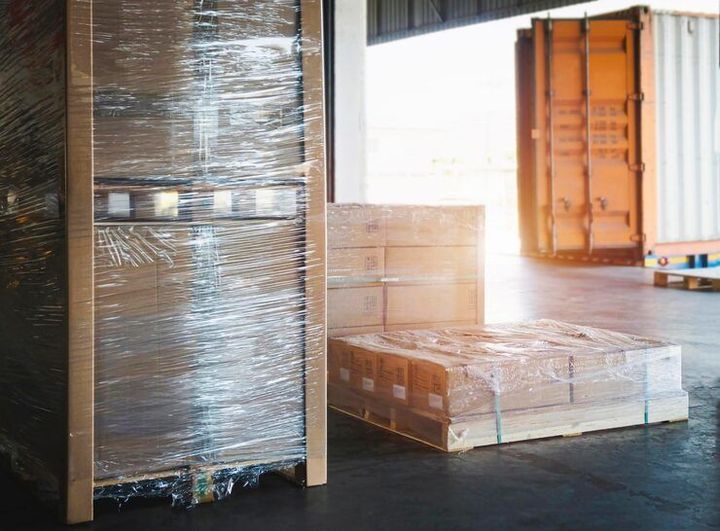
Stretch Wrapping Machines for Pallets: Guide to Automation and Key Details
Stretch Wrapping Machines for Pallets are automated or semi-automated packaging machines designed to secure palletized loads with stretch film. The film is wrapped around boxes, containers, bags, cartons, or other products arranged on a pallet to help keep the load together during storage and transportation.
A typical machine rotates the pallet or moves a film carriage around the load while applying controlled film tension. Depending on the machine design, the pallet may remain stationary while a rotating arm or ring moves around it.
These machines are used across manufacturing, food and beverage, pharmaceuticals, chemicals, consumer products, agriculture, automotive, paper, textiles, and logistics. Their main purpose is to create a consistent wrapped load while reducing repetitive manual wrapping activities.
How Pallet Stretch Wrapping Works
The basic process involves several stages.
Load positioning: A completed pallet is placed on the machine's turntable, conveyor, or wrapping area.
Film attachment: Stretch film is attached to the pallet or load at the beginning of the cycle.
Film movement: The machine moves the film around the load according to programmed settings.
Film tension: The film carriage controls how much the film is stretched as it is applied.
Vertical movement: The carriage travels upward and downward to cover the required load height.
Top and bottom wraps: Additional film layers can be applied around selected areas for load stability.
Film cutting: Automated systems can cut and secure the film at the end of the cycle.
Load discharge: The wrapped pallet moves to the next stage through a conveyor or is removed using material-handling equipment.
The exact sequence varies according to machine configuration and packaging requirements.
Main Machine Types
Turntable wrapping machines rotate the pallet while the film carriage travels vertically. They are commonly used for relatively stable pallet loads.
Rotary-arm machines keep the pallet stationary while an arm carrying the film moves around the load. This arrangement can be suitable for unstable, lightweight, or tall loads.
Ring wrapping machines use a rotating ring to move the film around the pallet. They can support continuous automated packaging lines.
Robotic wrapping machines use a mobile robotic unit that travels around the pallet while applying stretch film. They can provide flexibility where fixed equipment is difficult to install.
Semi-automatic machines require an operator for selected steps such as positioning the load and attaching the film, while the wrapping cycle itself is automated.
Fully automatic systems can integrate pallet movement, film application, cutting, sealing, and transfer into a connected packaging line.
Importance
Improving Load Stability
A properly wrapped pallet can help hold individual packages together and reduce movement during handling. Stable loads are particularly important when pallets are moved by forklifts, pallet trucks, conveyors, trucks, ships, or automated warehouse systems.
The wrapping pattern, film tension, number of layers, and characteristics of the load all influence stability.
Reducing Repetitive Manual Handling
Manual pallet wrapping can involve repeated bending, reaching, walking around loads, and pulling stretch film. Workplace safety authorities have identified manual stretch wrapping as an activity that can involve awkward postures and physical strain. Automation can reduce some of these repetitive movements.
The extent of reduction depends on machine configuration and how pallets enter and leave the wrapping area.
Supporting Consistent Packaging
Manual wrapping can vary between operators. Automated machines can follow programmed settings for rotation speed, film tension, carriage movement, and wrapping cycles.
This consistency can be useful when large numbers of pallets need similar packaging patterns.
Integration With Material Handling
Modern wrapping equipment can connect with conveyors, palletizers, weighing systems, barcode readers, warehouse systems, and other packaging equipment.
A connected line can move a pallet from production through wrapping and toward storage or dispatch with fewer manual transfers.
Important Machine Characteristics
| Feature | Main Function | Typical Importance |
|---|---|---|
| Turntable | Rotates the pallet | Common wrapping arrangement |
| Film carriage | Holds and dispenses film | Controls film application |
| Pre-stretch system | Stretches film before application | Improves film utilization |
| Tension control | Regulates film force | Supports load stability |
| Photoelectric sensor | Detects load height | Controls carriage movement |
| Control panel | Sets wrapping parameters | Operator control |
| Automatic cutter | Cuts film | Completes wrapping cycle |
| Conveyor | Moves pallets | Line integration |
| Safety system | Detects selected hazards | Machine protection |
Recent Updates
Greater Packaging Automation
Packaging operations are increasingly connecting pallet wrapping equipment with automated conveyors, robotic palletizers, warehouse systems, and other end-of-line equipment.
Recent industry analysis identifies integration with conveyors, robotic palletizers, warehouse execution platforms, remote diagnostics, and digital data exchange as important developments in stretch wrapping equipment.
This approach changes pallet wrapping from an isolated machine into part of a larger material-handling system.
Advanced Film Control
Modern machines can use pre-stretch mechanisms and electronic tension controls to regulate how film is applied to a load.
Pre-stretch means the film is mechanically stretched before it reaches the pallet. The appropriate setting depends on film characteristics, load shape, product weight, and required containment.
Automatic Load Detection
Sensors can detect pallet height, load dimensions, and selected characteristics during the wrapping cycle. This allows the machine to adjust carriage movement or wrapping parameters according to programmed rules.
Photoelectric sensors and similar technologies can also help identify whether a pallet is correctly positioned before a cycle begins.
Digital Monitoring
Connected wrapping machines can collect information about cycle counts, film usage, machine status, alarms, and operating conditions.
Digital monitoring can help production teams identify interruptions and compare machine performance across packaging lines.
Sustainability Considerations
Packaging operations are increasingly examining film consumption, material efficiency, recyclability, and waste reduction.
Machine settings can influence how much stretch film is applied to each pallet. Using appropriate film tension and wrapping patterns can help avoid unnecessary material use while maintaining the required load stability.
The film itself also matters. Different formulations and thicknesses have different mechanical characteristics, so machine settings need to match the selected material.
Integrated Packaging Lines
Fully automated packaging lines may combine palletizing, wrapping, labeling, weighing, scanning, conveying, and warehouse transfer.
This type of integration can reduce repeated pallet movement and allow information from several machines to be coordinated through industrial control systems.
Flexible Robotic Wrapping
Mobile robotic wrappers are another development in pallet packaging. Instead of requiring every pallet to reach a fixed turntable, a robotic wrapper can travel around selected loads.
This can be useful in facilities where pallet positions change or where fixed machinery would require significant layout changes.
Laws or Policies
International Machinery Safety
Stretch wrapping machines contain moving components, rotating mechanisms, electrical systems, sensors, film carriages, and automated controls. Their design therefore needs to consider machinery safety throughout the machine life cycle.
ISO 12100 provides general principles for machinery risk assessment and risk reduction. The standard describes methods for identifying hazards, evaluating risks, reducing risks, and documenting the assessment. ISO states that the current ISO 12100:2010 edition was reviewed and confirmed in 2022.
Pallet Wrapping Machine Safety
EN 415-6 is a specific European packaging-machine safety reference covering pallet wrapping machines. Its scope includes stretch-film pallet wrapping machines, mobile stretch-film wrappers, semi-automatic self-driving wrapping machines, and related packaging equipment. It addresses areas including design, installation, commissioning, operation, adjustment, maintenance, and cleaning.
Organizations operating in different regions should identify the standards and regulatory requirements applicable to their specific machine and market.
India Machinery Requirements
India has introduced a broader Machinery and Electrical Equipment Safety framework. The 2025 amendment to the Machinery and Electrical Equipment Safety (Omnibus Technical Regulation) Order, 2024 states that the regulation applies from September 1, 2026 to machines and electrical equipment listed in its first schedule. The framework references Indian Standards including IS 16819:2018, which corresponds to ISO 12100:2010. BIS is identified as the certification and enforcement authority under the order.
BIS also identifies machinery used for filling, closing, sealing, labeling, packing, or wrapping among machinery categories covered under its Scheme X framework. The exact applicability depends on the equipment and relevant regulatory provisions.
Workplace Safety
Machine guarding, emergency stopping, access control, electrical protection, operator training, and risk assessment are important considerations around automated pallet wrappers.
A wrapping machine should be evaluated together with conveyors, pallet handling equipment, forklifts, sensors, and surrounding work areas because hazards can arise from the complete production system rather than from the wrapper alone.
Tools and Resources
Machine Control Systems
A programmable control system manages wrapping sequences, rotation speed, carriage movement, film tension, wrap counts, and other operating parameters.
Modern control panels may store different programs for different pallet dimensions or packaging patterns.
Film Measurement Tools
Film thickness, width, stretch characteristics, and tensile properties influence wrapping performance. Measurement and quality-control tools can help packaging teams maintain consistent material specifications.
Load Stability Testing
Load-stability testing can evaluate whether wrapped pallets remain intact during handling and transportation. Testing approaches vary according to product type, pallet configuration, transport conditions, and applicable standards.
Barcode and Identification Systems
Barcode scanners and identification systems can connect pallet information with wrapping programs. For example, a system may identify a product category and select a corresponding wrapping recipe.
Conveyor Systems
Powered conveyors can automatically move pallets into and out of the wrapping area. Roller conveyors, chain conveyors, and other designs may be selected according to pallet dimensions, weight, and line layout.
Machine Monitoring Platforms
Monitoring systems can record cycle counts, alarms, operating status, film usage, and selected machine conditions. These records can support production analysis and equipment planning.
Safety Documentation
Machine manuals, risk assessments, technical drawings, operating procedures, safety standards, and inspection records are important resources for a pallet wrapping installation.
ISO 12100 provides a general risk-assessment framework, while regional standards such as EN 415-6 can provide more specific guidance for pallet wrapping machinery.
FAQs
What are Stretch Wrapping Machines for Pallets?
Stretch Wrapping Machines for Pallets are automated or semi-automated machines that apply stretch film around palletized loads to help stabilize packages during storage and transportation.
How do Stretch Wrapping Machines for Pallets work?
The machine moves stretch film around a pallet while controlling film tension, carriage movement, and the number of wraps. Depending on the design, either the pallet rotates or a wrapping arm or ring moves around the load.
What are the main types of pallet wrapping machines?
Common types include turntable, rotary-arm, ring, robotic, semi-automatic, and fully automatic wrapping machines. Selection depends on pallet dimensions, load stability, throughput requirements, available space, and line integration.
Why is automation used for pallet wrapping?
Automation can reduce repetitive manual wrapping movements, provide consistent wrapping patterns, and connect pallet wrapping with conveyors and other packaging equipment. Workplace safety guidance also recognizes automated wrapping as one approach for reducing manual handling exposure.
What safety standards apply to pallet wrapping machines?
Applicable requirements depend on the country and machine configuration. ISO 12100 provides general machinery risk-assessment principles, while EN 415-6 specifically addresses safety aspects of pallet wrapping machines within its scope.
Conclusion
Stretch Wrapping Machines for Pallets automate the application of stretch film around palletized loads and can form an important part of modern packaging and logistics systems. Turntable, rotary-arm, ring, robotic, semi-automatic, and fully automatic configurations provide different approaches for different operating environments. Recent developments include improved film control, digital monitoring, robotic movement, conveyor integration, and material-efficiency features. International machinery-safety principles and regional regulations remain important when designing, installing, and operating automated pallet wrapping equipment.