Sleep-Centric Bedroom Design: Guide to Layout, Lighting, and Practical Insights
Sleep-centric bedroom design is an approach to arranging a bedroom around conditions that support comfortable and consistent nighttime rest. It considers the position of the bed, lighting, temperature, noise, ventilation, furniture placement, colors, materials, window coverings, and access to everyday items.
Unlike a bedroom designed mainly around appearance or storage, this approach gives greater attention to the physical environment during the evening and overnight period. The goal is to create a space where visual distractions, unnecessary noise, excessive light, and inconvenient furniture arrangements are reduced.
How the Design Approach Developed
Bedroom design has traditionally considered factors such as furniture, decoration, available floor area, and personal style. Growing interest in indoor environmental quality has expanded attention toward factors such as artificial light exposure, room temperature, air movement, noise, and electronic devices.
Sleep-centric bedroom design brings these considerations together within one room. It does not require a particular architectural style. A small apartment bedroom, family bedroom, hotel room, or large residential bedroom can all apply the same basic principles.
Main Elements of Sleep-Centric Bedroom Design
Several elements work together to shape the bedroom environment:
Layout: Furniture is positioned to maintain clear movement paths and reduce unnecessary visual clutter.
Bed placement: The bed is usually positioned where it has sufficient clearance and where doors, windows, lighting, and other furniture can be used conveniently.
Lighting: Ambient, task, and low-level evening lighting can be arranged for different activities.
Window control: Curtains, blinds, shutters, or other coverings can regulate daylight and nighttime outdoor light.
Temperature: Heating, cooling, insulation, and ventilation influence the thermal environment.
Noise control: Furniture arrangement, building materials, curtains, rugs, and acoustic treatments can influence sound levels.
Air quality: Ventilation and appropriate indoor-air management help maintain the room environment.
Technology: Screens, charging equipment, speakers, and other electronic devices can be arranged to reduce nighttime distractions.
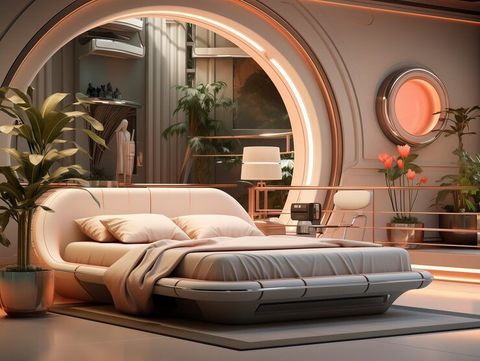
A simple example is a bedroom where the bed is placed away from a busy doorway, bright overhead lighting is replaced by lower evening illumination, blackout curtains control outside light, and frequently used items are kept within easy reach.
Importance
Why Sleep-Centric Bedroom Design Matters
The bedroom environment can influence comfort and nighttime routines. Light, noise, temperature, and room conditions are among the environmental factors commonly considered in sleep research.
The American Academy of Sleep Medicine and Sleep Research Society recommend that adults regularly obtain at least seven hours of sleep per night, while individual needs can vary. A bedroom cannot guarantee a particular sleep outcome, but environmental planning can address several common sources of disturbance.
Layout and Furniture Planning
A practical layout begins with the available floor area. The bed normally occupies the largest amount of space, so its position affects circulation and the placement of other furniture.
Clear pathways can make it easier to enter and leave the room without moving furniture. Storage furniture should also be positioned so drawers and doors can open without blocking walkways.
Useful layout considerations include:
Bed clearance: Maintain enough space around the bed for normal movement and maintenance.
Door access: Ensure doors can open without hitting the bed or large furniture.
Window access: Keep ventilation and window-opening mechanisms accessible where possible.
Storage placement: Place frequently used storage where it can be reached without creating clutter.
Electrical access: Consider the location of outlets when positioning lamps, charging equipment, and other devices.
Lighting for Different Times of Day
Lighting is one of the most important elements of sleep-centric bedroom design because light exposure interacts with the body's circadian system, which helps regulate the sleep-wake cycle.
During daytime hours, natural daylight can provide useful environmental illumination. In the evening, lower-intensity lighting can make the room visually calmer than strong overhead illumination.
A layered lighting arrangement can include:
Ambient lighting: General room illumination for normal activities.
Task lighting: Focused light for reading, dressing, or other activities.
Accent lighting: Low-level illumination used for visual atmosphere.
Night lighting: A dim light positioned so it does not strongly illuminate the entire room.
Temperature, Air, and Noise
Thermal comfort can affect how a bedroom feels during the night. Heating, cooling, ventilation, insulation, bedding materials, and clothing all influence the personal environment around the sleeper.
Noise is another important consideration. External traffic, household activity, mechanical equipment, and electronic sounds can interrupt quiet periods.
Furniture placement alone cannot eliminate major noise sources, but carpets, curtains, upholstered furniture, acoustic materials, sealed windows, and building construction can influence sound transmission and room acoustics.
Comparing Bedroom Design Elements
| Design Element | Main Function | Common Design Approach | Practical Consideration |
|---|---|---|---|
| Bed layout | Defines the main sleeping area | Central or balanced placement | Maintain movement space |
| Lighting | Supports different activities | Layered lighting | Use lower evening illumination |
| Window covering | Controls outdoor light | Curtains, blinds, shutters | Consider daytime and nighttime use |
| Storage | Reduces visible clutter | Built-in or freestanding units | Keep access clear |
| Temperature control | Supports thermal comfort | HVAC, fans, insulation | Adjust according to climate |
| Noise control | Reduces environmental disturbance | Curtains, rugs, acoustic materials | Identify major noise sources |
| Technology | Provides convenience | Organized charging and controls | Reduce unnecessary nighttime distractions |
| Ventilation | Supports indoor-air management | Windows or mechanical systems | Follow building requirements |
Recent Updates
Smart Lighting and Automated Controls
From 2024 through 2026, residential technology has continued moving toward connected lighting, sensors, smart thermostats, automated curtains, and centralized home controls. These systems can allow lighting intensity, color characteristics, temperature, and window coverings to be adjusted according to time or programmed routines.
For bedrooms, automation can be configured to gradually reduce illumination in the evening or switch off selected lighting at a scheduled time. The practical value depends on the system, room design, and personal routine rather than the technology alone.
Circadian-Aware Lighting
Lighting technology is increasingly designed around the changing characteristics of daylight. Tunable lighting systems can adjust brightness and color characteristics during different periods of the day.
The WELL Building Standard, developed for buildings with a focus on human health and well-being, includes provisions addressing lighting and occupant experience. Its lighting concepts have helped increase awareness of how indoor lighting can be planned around daytime and evening conditions.
Smart Sensors and Environmental Monitoring
Connected sensors can monitor variables such as temperature, humidity, carbon dioxide concentration, light levels, and noise. These measurements can help identify environmental patterns that may otherwise be difficult to notice.
A sensor does not automatically improve the room. Its main function is measurement, allowing occupants or building systems to identify conditions that may require adjustment.
Sustainable Bedroom Materials
Recent interior design trends also include greater attention to energy consumption, material durability, indoor environmental quality, and responsible sourcing. Energy-efficient lighting, improved insulation, efficient heating and cooling equipment, and durable furniture can influence long-term bedroom operation.
These choices should be considered alongside local climate, building design, material composition, maintenance requirements, and applicable regulations.
Laws or Policies
Building and Electrical Requirements
Bedroom design is affected by local building regulations, particularly when changes involve electrical wiring, ventilation, windows, structural elements, heating and cooling systems, or permanent construction.
There is no single worldwide bedroom-design law. Requirements differ by country, state, province, city, and building type.
Electrical modifications may require compliance with local electrical codes and, in some jurisdictions, inspection or approval by a qualified authority.
Indoor Environmental Standards
International standards can provide frameworks for indoor environmental conditions. ISO 7730 addresses thermal environments and methods for evaluating thermal comfort, while ASHRAE standards provide guidance used in building design and indoor environmental management.
These standards do not mean that every bedroom must meet identical conditions. Their application depends on building type, jurisdiction, project requirements, and the specific standard being referenced.
Accessibility Considerations
Accessibility requirements may apply when a bedroom is part of an accessible residential or public accommodation environment. Requirements can address door widths, circulation areas, controls, accessible routes, and maneuvering space.
The Americans with Disabilities Act applies to covered facilities in the United States, while European countries and other jurisdictions have their own accessibility requirements. Residential rules can differ from public-building requirements.
Tools and Resources
Room Planning Software
Digital room-planning applications can help users test furniture positions before moving physical items. Many tools allow users to enter room dimensions and experiment with bed positions, wardrobes, desks, lighting, and circulation routes.
Lighting Planning Tools
Lighting calculators and manufacturer photometric data can help estimate illumination levels. Professional lighting software can model how fixtures distribute light across a room.
For ordinary bedroom planning, the main objective is usually to identify suitable fixture locations and avoid excessive glare rather than create a highly complex lighting model.
Environmental Sensors
Temperature, humidity, light, carbon dioxide, and noise sensors can provide measurable information about bedroom conditions. Data collected over several days can reveal whether a room experiences repeated temperature changes, excessive outdoor light, or recurring noise.
Standards and Building Resources
Useful resources include national building authorities, electrical-code organizations, accessibility authorities, energy-efficiency programs, and international standards organizations.
For professional projects, designers and building professionals can consult applicable local codes and recognized standards before making permanent structural, electrical, ventilation, or accessibility changes.
FAQs
What is sleep-centric bedroom design?
Sleep-centric bedroom design arranges the bedroom around nighttime comfort and environmental conditions. It considers layout, lighting, temperature, noise, ventilation, storage, window coverings, and technology.
How does sleep-centric bedroom design use lighting?
Sleep-centric bedroom design can use layered lighting, with brighter illumination for daytime activities and lower-level lighting during evening routines. Automated or tunable lighting can provide additional control.
What layout is suitable for sleep-centric bedroom design?
A suitable layout provides comfortable bed placement, clear walking paths, accessible storage, convenient lighting controls, and practical access to doors and windows. The appropriate arrangement depends on room dimensions and furniture requirements.
Can smart technology be used in sleep-centric bedroom design?
Yes. Smart lighting, thermostats, curtains, environmental sensors, and automated controls can be incorporated into sleep-centric bedroom design. Their usefulness depends on correct configuration and the needs of the occupants.
Does bedroom design guarantee better sleep?
No. Bedroom design cannot guarantee a particular sleep result. It can, however, help manage environmental factors such as light, temperature, noise, clutter, and convenience that may influence nighttime comfort.
Conclusion
Sleep-centric bedroom design focuses on creating a bedroom environment around comfort, practical movement, lighting, temperature, noise, ventilation, and nighttime routines. Modern approaches increasingly incorporate smart controls, environmental sensors, tunable lighting, and energy-conscious materials. Building regulations, accessibility requirements, and recognized environmental standards can also influence design decisions. A carefully planned bedroom combines physical layout with controllable environmental conditions while recognizing that individual sleep needs vary.