Roll Bonding Machines: Explore Types, Processes, and Industrial Applications
Roll Bonding Machines are industrial rolling systems used to join two or more metal layers through controlled pressure between rollers. Unlike fusion welding, the metals can be joined in a solid state without completely melting the materials.
The process can produce clad sheets, laminated metals, bimetal strips, composite plates, and specialized panels. Combining different metals allows manufacturers to create materials with a combination of properties such as strength, corrosion resistance, conductivity, thermal performance, and formability.
Roll bonding can be performed under cold, warm, or hot conditions depending on the materials and required product characteristics. Surface preparation, rolling reduction, temperature, speed, and post-processing all influence the resulting bond.
How Roll Bonding Works
The process generally begins with two or more metal sheets, plates, or strips. Their mating surfaces are cleaned to remove contaminants and oxide layers because surface condition has an important influence on bonding.
The prepared materials are then aligned and brought together before entering the roll stand. Large rollers apply pressure while reducing the combined thickness of the material.
During deformation, oxide layers and hardened surface regions can break apart, allowing fresh metal surfaces to come into close contact. A metallurgical bond then develops at the interface.
Depending on the production method, the bonded material may subsequently undergo heat treatment, additional rolling, cutting, forming, inspection, or surface finishing.
Main Types of Roll Bonding Machines
Cold roll bonding machines perform the bonding operation without deliberate heating during the main rolling pass. They are suitable for material combinations that can undergo sufficient plastic deformation under pressure.
Hot roll bonding machines use elevated temperatures during the rolling operation. Heating can improve material ductility and assist bonding between selected metal combinations.
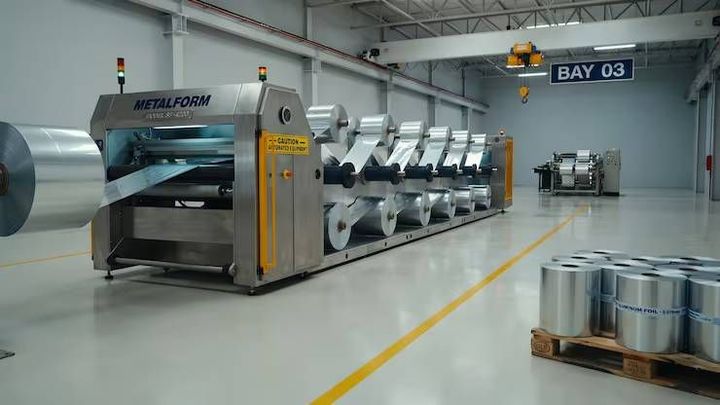
Continuous roll bonding lines process metal strips from coils through multiple stages such as cleaning, alignment, rolling, cooling, and finishing. They are suitable for continuous production of long metal products.
Plate roll bonding systems handle larger sheets or plates. Multiple layers can be assembled into a pack and processed through a hot rolling mill to create clad plate.
Accumulative roll bonding systems repeatedly stack and roll material. This technique is studied for producing laminated structures, refined grain structures, and advanced metal composites.
Importance
Combining Different Metal Properties
One of the main purposes of roll bonding is to combine characteristics that are difficult to obtain from one metal alone.
For example, a corrosion-resistant alloy can be bonded to a structural steel base. The resulting clad material can provide a protective surface while retaining the mechanical characteristics of the backing material.
TWI identifies pressure vessels, tanks, machine tools, aircraft structures, refrigeration equipment, and other applications among areas where clad materials can be used.
Heat Exchanger Production
Roll bonding is particularly important in some heat exchanger designs. Two aluminum sheets can be bonded together while selected areas remain unbonded according to a printed pattern. The unbonded sections can later be expanded to create internal channels for fluid movement.
Such roll-bonded panels are used in areas including refrigeration, automotive thermal systems, and solar-related heat-transfer applications.
Material Efficiency
A composite product can place a specialized metal only where its properties are needed. A relatively thin cladding layer may provide corrosion or thermal characteristics while another metal forms the main structural portion.
This layered approach is one reason roll bonding is relevant to engineered metal products.
Electrical and Thermal Applications
Different metal combinations can provide useful combinations of electrical conductivity, mechanical strength, thermal behavior, and corrosion resistance.
Clad materials can therefore be incorporated into selected electrical components, heat-transfer systems, connectors, structural parts, and other engineered products.
Industrial Production
Roll bonding can be integrated with coil handling, surface preparation, heating, rolling, cooling, cutting, forming, and inspection equipment.
| Machine Component | Main Function | Important Parameter |
|---|---|---|
| Roll stand | Applies rolling pressure | Roll force |
| Work rolls | Deform and join layers | Diameter and surface condition |
| Uncoiler | Feeds strip material | Strip tension |
| Heating unit | Raises material temperature | Temperature control |
| Alignment guides | Maintain layer position | Tracking accuracy |
| Thickness system | Monitors material gauge | Thickness tolerance |
| Cooling system | Controls material temperature | Cooling rate |
| Inspection system | Checks product condition | Surface and dimensional quality |
Recent Updates
Advanced Laminated Materials
Research continues to examine roll bonding for combinations involving aluminum, magnesium, copper, steel, nickel-based materials, and other alloys. These studies include laminated structures and materials with refined microstructures.
Accumulative roll bonding is also being investigated for producing advanced layered materials with controlled mechanical characteristics.
Improved Process Monitoring
Modern rolling systems can integrate sensors and digital controls for monitoring rolling force, strip tension, temperature, speed, thickness, and alignment.
Continuous measurement can provide process information that helps engineers identify changes during production and maintain consistent operating conditions.
Laser Roll Cladding
Laser-assisted roll cladding represents a newer development related to conventional roll bonding. In this approach, a laser heats the joining surfaces near the roll gap while mechanical pressure from the rollers creates the joint.
Fraunhofer IWS describes research involving bimetallic strips, wires, metallic sandwich structures, and difficult material combinations such as aluminum-copper and aluminum-iron systems.
Heat Exchanger Development
Roll bonding remains an active technology for producing flat heat-transfer panels with internal channels. Research continues to examine aluminum alloy combinations, channel patterns, manufacturing sequences, and applications across automotive, refrigeration, and solar systems.
Digital Inspection
Machine vision, dimensional measurement, surface monitoring, and process-data collection are increasingly integrated into metal-processing lines.
These systems can help identify visible surface defects, thickness variation, alignment problems, and other production conditions without relying entirely on manual inspection.
Laws or Policies
International Machinery Safety
Roll Bonding Machines contain rotating rolls, shafts, drive systems, heating equipment, electrical controls, and material-handling mechanisms. These features create hazards that need to be addressed through machine design, guarding, risk assessment, emergency controls, maintenance procedures, and operator training.
ISO 12100 provides general principles for machinery risk assessment and risk reduction and can serve as a broad reference for machine designers.
European Union Machinery Requirements
Regulation (EU) 2023/1230 establishes health and safety requirements for machinery and related products placed on the European Union market. Its consolidated version was updated in 2026 and addresses machinery design, construction, and protection of users.
The exact requirements applicable to a roll bonding machine depend on its design, intended use, integration, and market conditions.
United States Workplace Safety
In the United States, OSHA maintains machinery-guarding requirements covering hazards associated with industrial equipment.
For example, OSHA 29 CFR 1910.216 includes requirements for mills and calenders in the rubber and plastics industries, including safety controls around operating rolls. Other OSHA machinery-guarding provisions can apply according to the equipment and industrial activity.
National Requirements
Countries outside the European Union and United States have their own machinery, workplace safety, electrical, environmental, and industrial requirements.
Organizations using roll bonding equipment internationally therefore need to identify the rules applicable to the specific country, facility, machine configuration, and production activity.
Tools and Resources
Rolling Force Monitoring
Load cells and force sensors can measure the pressure applied during rolling. Changes in force can provide useful information about material behavior and process conditions.
Temperature Measurement
Thermocouples, infrared sensors, and other instruments can monitor material and equipment temperatures during hot roll bonding.
Temperature control is particularly important when bonding conditions depend on elevated heat.
Thickness Measurement
Laser, X-ray, and other gauge-measurement technologies can monitor sheet or plate thickness during production. The appropriate system depends on material type, thickness, production speed, and measurement requirements.
Surface Inspection
Camera-based inspection systems can examine surfaces for scratches, contamination, dents, edge defects, and other visible conditions.
Metallurgical Testing
Laboratories can examine the bonded interface through microscopy, hardness testing, tensile testing, peel testing, shear testing, and other methods selected according to the material and product specification.
Process Simulation
Engineering simulation can be used to study material deformation, temperature distribution, stress, and flow during rolling. This can help engineers understand how changes in process parameters may influence the finished material.
Technical Documentation
Machine manuals, engineering drawings, material datasheets, technical standards, process specifications, and national regulations provide important references for roll bonding operations.
FAQs
What are Roll Bonding Machines?
Roll Bonding Machines are industrial rolling systems that join two or more metal layers by applying controlled pressure through rollers under cold, warm, or hot processing conditions.
How does roll bonding work?
Prepared metal surfaces are brought together and passed through rollers. Pressure and plastic deformation disrupt surface oxide layers and bring fresh metal surfaces into close contact, allowing a solid-state metallurgical bond to form.
What metals can be roll bonded?
Aluminum, steel, copper, magnesium, nickel alloys, and other metals can be processed through suitable roll bonding methods. The practical combination depends on material properties, surface preparation, temperature, rolling reduction, and metallurgical compatibility.
What are Roll Bonding Machines used for?
They are used to produce clad plates, laminated metals, bimetal strips, heat exchanger panels, electrical materials, structural components, and other engineered metal products.
What is the difference between cold and hot roll bonding?
Cold roll bonding uses pressure and deformation without deliberate heating during the primary bonding stage. Hot roll bonding uses elevated temperature to improve material deformation and support bonding between selected metals.
Conclusion
Roll Bonding Machines use controlled rolling pressure to join layers of metal and create composite materials with combined properties. Cold, hot, continuous, plate, and accumulative approaches can be selected according to material characteristics and production requirements. Current developments include improved process monitoring, advanced laminated materials, digital inspection, specialized heat exchanger production, and laser-assisted roll cladding. Roll bonding therefore remains relevant across thermal, electrical, chemical-processing, structural, and other industrial applications.