Industrial 3D Printing: Guide to Technologies, Processes, and Practical Insights
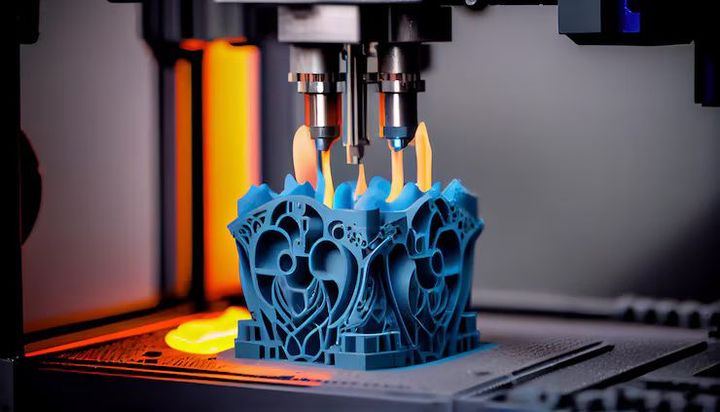
What Is Industrial 3D Printing? Industrial 3D Printing is a manufacturing approach that creates physical components from digital three-dimensional designs. Instead of removing material from a larger block, additive manufacturing builds an object progressively, usually one layer at a time.
The technology is also known as additive manufacturing. ISO and ASTM describe additive manufacturing as a process based on adding material to create three-dimensional geometries.
Industrial 3D Printing is different from many desktop printing applications because industrial systems are designed for controlled manufacturing environments. They can work with polymers, metals, ceramics, composites, and other specialized materials depending on the printing technology.
How the Process Works
The process generally begins with a computer-aided design (CAD) model. The digital model is prepared for a particular printer and divided into thin layers by specialized software.
The printer then deposits, melts, fuses, cures, or binds material according to the selected technology. After printing, the component may undergo additional operations such as support removal, heat treatment, surface finishing, machining, inspection, or other quality checks.
A typical workflow includes:
- Digital design: A three-dimensional model defines the intended geometry.
- Design preparation: Software checks orientation, supports, build parameters, and other manufacturing requirements.
- Material preparation: The selected feedstock is prepared according to the printing technology.
- Layer formation: The machine creates successive layers to produce the physical component.
- Post-processing: Additional operations improve geometry, surface characteristics, or material properties.
- Inspection: Measurements and testing can be used to assess whether the finished component meets defined requirements.
Main Industrial Technologies
Industrial 3D Printing includes several process categories. Material extrusion pushes heated material through a nozzle to form successive layers and is commonly associated with polymer-based production.
Powder bed fusion uses an energy source to selectively fuse regions of a powder layer. It can be applied to polymers and metals, depending on the specific process.
Vat photopolymerization uses light to selectively cure liquid photopolymer material. This approach can produce detailed components and is used in applications requiring fine features.
Binder jetting deposits a binding material onto selected regions of a powder bed. The printed component may then require additional processing to achieve its intended properties.
Directed energy deposition feeds material into a focused energy source while material is deposited onto a surface. It can be used for metal component production, repair, and adding material to existing structures.
Importance
Design Flexibility
One of the major characteristics of Industrial 3D Printing is its ability to create geometries that can be difficult to manufacture through conventional methods.
Internal channels, lattice structures, curved surfaces, and consolidated assemblies can sometimes be incorporated directly into a digital design. This allows engineers to consider geometry and function together during product development.
Rapid Prototyping
Industrial additive manufacturing can support the development of prototypes before a design enters larger-scale production. Engineers can create physical representations, examine fit and form, and identify design issues through testing.
Changes can then be incorporated into the digital model before another physical version is produced. This iterative approach can be useful in engineering, aerospace, automotive, medical-device development, and industrial equipment.
Production of Complex Components
Traditional manufacturing may require several operations to produce a complicated component. Additive manufacturing can sometimes create several geometric features within a single build.
This does not mean that every component is suitable for 3D printing. Production decisions depend on material requirements, geometry, dimensional tolerances, production volume, machine capability, and post-processing needs.
Lightweight Structures
Industrial 3D Printing can create lattice structures and topology-optimized components. These approaches allow engineers to place material where it contributes to a component's intended function while reducing material in less critical regions.
Aerospace and automotive applications can use such approaches when weight, strength, thermal behavior, or part consolidation are important considerations.
Distributed Digital Manufacturing
Because additive manufacturing relies heavily on digital design files and software-controlled equipment, production information can be transferred electronically between compatible facilities.
This creates possibilities for distributed manufacturing and localized production. However, digital file security, intellectual property protection, machine qualification, material consistency, and inspection procedures remain important considerations.
| Technology | Common Materials | Main Characteristics |
|---|---|---|
| Material extrusion | Polymers, composites | Material deposited through a nozzle |
| Powder bed fusion | Metals, polymers | Powder selectively fused using energy |
| Vat photopolymerization | Photopolymers | Liquid resin selectively cured |
| Binder jetting | Metals, ceramics, sand | Binder selectively applied to powder |
| Directed energy deposition | Metals | Material added with focused energy |
| Material jetting | Photopolymers, waxes | Small material droplets selectively deposited |
Recent Updates
More Formal Quality Requirements
Recent developments in Industrial 3D Printing increasingly focus on process qualification, material characterization, inspection, and data management. ISO/ASTM 52920:2023 establishes qualification principles and requirements for industrial additive manufacturing processes and production sites.
ISO/ASTM 52927:2024 also addresses characteristics and corresponding test methods for additive manufacturing parts. It identifies quality characteristics for feedstock and components and provides guidance for testing.
These standards reflect a broader movement toward repeatable and documented manufacturing processes.
Process Monitoring and Digital Data
Process monitoring is becoming increasingly important for industrial metal printing. Sensors, cameras, thermal measurements, and other inspection methods can produce large amounts of manufacturing data.
ISO/ASTM 52953:2025 establishes principles for registering data acquired through process monitoring and quality control for certain metal laser powder bed fusion applications. The standard covers information from sources such as thermal sensors, cameras, X-ray computed tomography, and coordinate measuring machines.
This development supports greater attention to traceability and data-based quality assessment.
Growth of Qualification Frameworks
Additional standards have recently addressed machine qualification, operator qualification, powder management, material data, environmental considerations, and other aspects of additive manufacturing.
For example, ISO/ASTM TS 52949:2025 addresses installation, operational, and performance qualification for electron-beam powder bed fusion equipment used with metals.
Such frameworks help manufacturers establish clearer procedures for machine operation and production validation.
Developments in India
India released its National Strategy on Additive Manufacturing in 2022 through the Ministry of Electronics and Information Technology. The strategy focuses on developing domestic capabilities across machines, materials, software, design, research, and skills.
Government documents have also described initiatives connected with National Additive Manufacturing Centres and regional capabilities. A MeitY annual report describes the National Additive Manufacturing Centre West initiative at Ganpat University in Gujarat as part of efforts to strengthen additive manufacturing adoption and training.
The broader Indian approach includes collaboration among government, industry, academia, research organizations, and technology developers.
Laws or Policies
India's National Strategy on Additive Manufacturing
India's National Strategy on Additive Manufacturing provides a policy framework for developing the country's additive manufacturing ecosystem. It addresses domestic capabilities in machines, materials, software, products, research, and workforce development.
A 2024 Lok Sabha response reiterated the strategy's objectives and described efforts involving industry, academia, and government. It also identified areas such as electronics, photonics, medical devices, and agricultural and food processing.
Standards and Technical Requirements
Industrial 3D Printing equipment and components may be subject to different technical standards depending on the industry, material, machine, and intended application.
The Bureau of Indian Standards provides a searchable platform for Indian Standards, including documents, amendments, testing information, and related material.
International standards from ISO and ASTM are also widely relevant to additive manufacturing terminology, design, qualification, testing, materials, and production processes.
Product-Specific Regulation
Applications involving aircraft components, medical devices, automotive systems, electrical equipment, pressure-containing components, or other regulated products can have additional requirements.
A printed component should therefore be assessed according to the regulations and technical standards applicable to its intended use. A general 3D-printing specification does not automatically establish suitability for a regulated application.
Intellectual Property and Digital Files
Industrial 3D Printing relies on digital models, manufacturing parameters, material information, and machine instructions. These files may contain important intellectual property.
Organizations using additive manufacturing should consider appropriate controls for design files, access permissions, version management, cybersecurity, and authorized production. Digital protection is especially relevant when manufacturing information moves between multiple facilities or external partners.
Tools and Resources
CAD Software
Computer-aided design software is central to Industrial 3D Printing. CAD programs allow engineers and designers to create, modify, and analyze three-dimensional models before manufacturing.
Designers may also use specialized generative-design and topology-optimization tools to explore alternative geometries.
Slicing and Build-Preparation Software
Build-preparation software converts a digital model into instructions that an additive manufacturing system can interpret. Depending on the technology, the software may control layer thickness, support structures, orientation, scanning patterns, exposure parameters, or deposition paths.
Correct preparation is important because digital settings can influence the resulting component.
Simulation Tools
Simulation software can help predict thermal behavior, deformation, residual stresses, material flow, or other process characteristics.
Simulation does not replace physical testing, but it can help engineers identify potential issues before manufacturing.
Measurement and Inspection Equipment
Industrial production can use coordinate measuring machines, optical scanners, computed tomography, surface measurement equipment, and other inspection technologies.
These tools can compare manufactured components with digital models and help assess dimensional accuracy, internal features, surface conditions, and selected material characteristics.
Standards Databases
ISO, ASTM, and BIS resources can help engineers identify terminology, specifications, qualification frameworks, and testing approaches relevant to additive manufacturing. ISO's additive manufacturing catalogue contains standards covering processes, materials, design, qualification, data, safety, and testing.
FAQs
What is Industrial 3D Printing?
Industrial 3D Printing is an additive manufacturing approach that creates components from digital designs by adding material progressively. It can use metals, polymers, ceramics, and other specialized materials.
How does Industrial 3D Printing work?
Industrial 3D Printing usually begins with a digital CAD model. Software prepares the model for a particular machine, which then forms the component layer by layer through processes such as extrusion, powder fusion, resin curing, binding, or directed energy deposition.
Which materials are used in Industrial 3D Printing?
Industrial systems can use polymers, metals, ceramics, composites, photopolymers, powders, filaments, and other specialized feedstocks. The appropriate material depends on the printing technology and intended component properties.
What industries use Industrial 3D Printing?
Industrial 3D Printing is used across aerospace, automotive, medical technology, electronics, tooling, energy, research, architecture, and industrial equipment. The specific application depends on technical requirements and regulatory conditions.
What are the main challenges of Industrial 3D Printing?
Important challenges include process repeatability, material consistency, dimensional accuracy, post-processing, machine qualification, inspection, digital-file protection, and workforce skills. These factors become particularly important when printed components must meet strict technical requirements.
Conclusion
Industrial 3D Printing combines digital design, specialized materials, software, automated equipment, and controlled manufacturing processes to create three-dimensional components. Technologies such as material extrusion, powder bed fusion, vat photopolymerization, binder jetting, and directed energy deposition support different industrial applications. Recent developments are placing greater emphasis on qualification, testing, process monitoring, data management, and standardized production practices. In India, the National Strategy on Additive Manufacturing provides a policy framework for developing domestic capabilities across machines, materials, software, research, and skills.