Engine Assembly Machines: Discover Automation Systems, Assembly Methods, and Technologies
Engine assembly machines are industrial systems designed to help assemble the different components of an engine into a complete and functional unit.
They are used in automotive manufacturing plants, engine production facilities, machinery factories, and other industrial environments where engines are produced in controlled stages.
A modern engine contains many precisely fitted components, including the cylinder block, crankshaft, pistons, connecting rods, cylinder head, valves, camshaft, bearings, oil pump, and various seals. Engine assembly machinery helps manufacturers position, fasten, inspect, and test these components with consistent procedures.
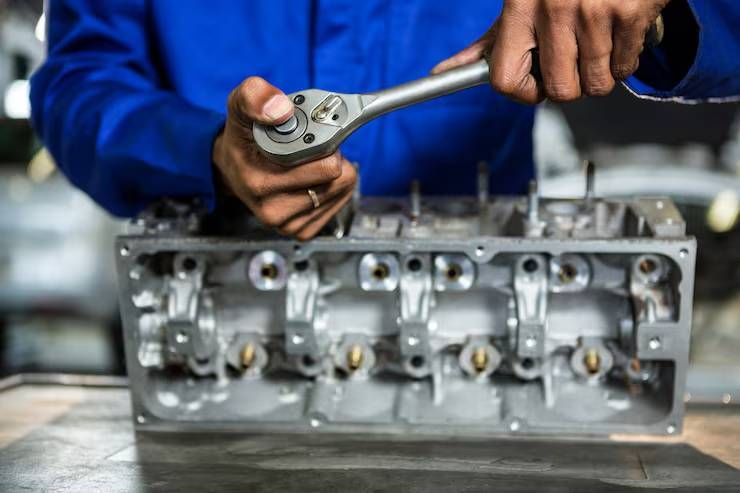
The level of automation can vary considerably. Some production lines use semi-automatic equipment in which operators perform several assembly steps, while highly automated engine assembly lines use robotics, programmable logic controllers (PLCs), sensors, machine vision, torque monitoring, and digital production records.
Typical engine assembly equipment includes:
- Engine block assembly machines
- Crankshaft assembly systems
- Piston and connecting rod assembly machines
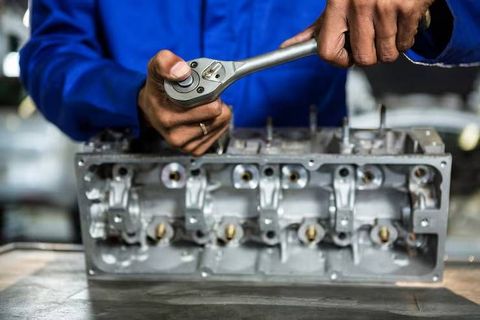
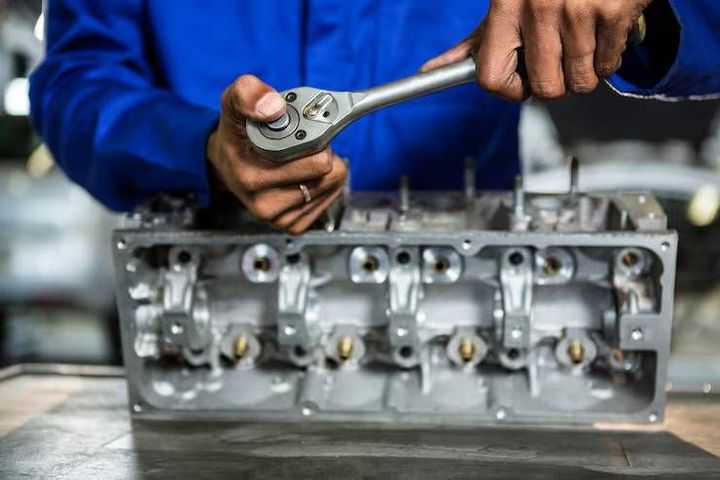
- Cylinder head assembly equipment
- Valve assembly machines
- Automated torque tightening systems
- Bearing installation equipment
- Leak testing machines
- Engine testing equipment
- Machine vision inspection systems
- Conveyor and material-handling systems
The main purpose is to create a controlled production process in which components are assembled according to defined specifications and inspection requirements.
Why Engine Assembly Machinery Matters
Engine assembly machines are important because engine manufacturing requires accuracy, repeatability, traceability, and controlled handling of components. Even small variations in fastening torque, component position, clearance, or sealing can affect engine performance and reliability.
Industrial engine assembly equipment helps address these challenges by controlling specific production parameters.
For example, automated torque systems can record tightening values during assembly. Vision inspection systems can identify incorrect component placement or missing parts. Sensors can monitor pressure, position, temperature, and other process conditions.
These capabilities are particularly relevant to high-volume automotive manufacturing, where production processes must remain consistent across large numbers of engines.
Engine assembly machinery also supports the growing use of data-driven manufacturing. Production equipment can connect with manufacturing execution systems (MES), enterprise resource planning (ERP) platforms, quality databases, and industrial Internet of Things (IIoT) systems.
| Machine Type | Typical Function | Common Technology |
|---|---|---|
| Crankshaft Assembly Machine | Positions and installs crankshaft components | Servo systems, sensors |
| Piston Assembly Machine | Installs pistons and connecting rods | Pneumatic or servo actuation |
| Valve Assembly Machine | Positions and secures valve components | Robotics, vision systems |
| Torque Assembly System | Controls fastener tightening | Digital torque monitoring |
| Leak Testing Machine | Detects leakage in sealed systems | Pressure or vacuum testing |
| Vision Inspection System | Checks components and assembly | Industrial cameras and AI |
For manufacturers, the overall objective is not simply faster assembly. A well-designed production system also supports quality control, process documentation, operator safety, and maintenance planning.
Recent Developments in Engine Assembly Technology
Engine manufacturing is changing as automotive production moves toward greater automation, digital monitoring, electrification, and advanced powertrain technologies.
One important development is the increasing use of intelligent inspection. Machine vision systems can examine components and assembly stages without relying entirely on manual inspection. Artificial intelligence can also be used in selected manufacturing environments to identify patterns associated with defects or process variation.
Robotics is another important area. Robotic systems can perform repetitive handling, component positioning, fastening, dispensing, and inspection tasks. Collaborative robots, or cobots, can be used for certain operations where people and automated equipment work within the same production environment.
Digital traceability is also becoming more important. Modern assembly equipment can associate process information with an individual engine or production batch. Records may include torque values, test results, component identification, and inspection results.
India's automotive manufacturing policy has also continued to emphasize advanced automotive technology and domestic manufacturing. The Ministry of Heavy Industries reported in March 2025 that the Production Linked Incentive (PLI) scheme for automobiles and auto components covers 19 advanced automotive technology vehicle categories and 103 advanced automotive technology components.
A December 2025 parliamentary response stated that 82 applicants had been approved under the PLI-Auto scheme as of November 30, 2025, with multiple manufacturing facilities producing advanced automotive technology products.
These developments can influence the design of automotive production facilities, including the integration of automation, inspection, electronics, and digitally controlled manufacturing systems.
Another trend is the coexistence of conventional internal-combustion engine production with electric powertrain manufacturing. Although electric vehicles do not require traditional engines, conventional engines remain relevant across passenger vehicles, commercial vehicles, agricultural machinery, construction equipment, and other applications.
Indian Laws, Standards and Policies
Engine assembly machinery used in India can be affected by several areas of regulation, including automotive standards, industrial safety requirements, machinery standards, environmental requirements, and government manufacturing programs.
The Automotive Industry Standards (AIS) framework maintained by the Ministry of Road Transport and Highways includes standards covering vehicle testing and conformity procedures. For example, AIS-137 includes test methods, testing equipment, and related procedures for type approval and conformity-of-production testing for vehicles under Bharat Stage VI emission requirements.
These requirements are relevant to engine and powertrain manufacturers because production and testing processes must support applicable vehicle compliance procedures.
Industrial workplace safety is another consideration. India's Occupational Safety, Health and Working Conditions Code, 2019 contains provisions concerning the safety responsibilities associated with articles designed, manufactured, imported, or installed for use in factories. It also addresses the need to minimize risks to worker health and safety.
Machinery regulation has also seen recent changes. The Ministry of Heavy Industries recorded amendments to the Machinery and Electrical Equipment Safety (Omnibus Technical Regulation) framework during 2025, followed by a withdrawal notification dated January 16, 2026.
This illustrates why manufacturers and engineering teams should check the latest regulatory position rather than relying on older machinery-compliance information.
Government industrial programs can also influence manufacturing investment. The PLI-Auto scheme has a budgetary outlay of ₹25,938 crore for FY2022-23 through FY2026-27 and is intended to encourage domestic manufacturing of advanced automotive technology products.
For engine assembly machine manufacturers and automotive production planners, applicable requirements can therefore extend beyond the machine itself to workplace safety, electrical systems, vehicle testing, documentation, quality control, and sector-specific standards.
Tools and Resources for Engine Assembly
Several technical and digital resources can help engineers, production planners, maintenance teams, and students understand or manage engine assembly processes.
CAD and engineering design software: Computer-aided design tools are used to develop machine layouts, fixtures, assembly stations, tooling, and component interfaces.
PLC programming platforms: PLC software is used to control automated assembly sequences, sensors, motors, actuators, and safety functions.
Torque monitoring systems: Digital torque tools and controllers can record fastening values and help verify that assembly operations follow defined specifications.
Machine vision software: Industrial vision platforms can inspect component presence, orientation, dimensions, markings, and assembly conditions.
MES platforms: Manufacturing execution systems connect production activities with quality, traceability, scheduling, and production records.
OEE calculators: Overall Equipment Effectiveness calculators help production teams evaluate availability, performance, and quality.
BIS resources: The Bureau of Indian Standards provides information on Indian Standards and conformity-related resources relevant to industrial equipment.
Ministry of Heavy Industries: Government information about automobile manufacturing schemes, PLI-Auto developments, and related industrial programs can be found through the Ministry's official resources. The ministry's PLI-Auto information also includes updates to scheme guidelines and manufacturer lists.
Common Engine Assembly Machine Applications
Engine assembly machines can be configured for different production requirements.
In passenger vehicle manufacturing, automated stations may be arranged in sequence from block preparation through final engine testing. Commercial vehicle engines may require larger handling systems because of their greater dimensions and weight.
For two-wheelers, compact assembly equipment may be designed around smaller engines and shorter production cycles. Agricultural and industrial engines can require different fixtures, lifting arrangements, fastening systems, and testing procedures.
A typical automated engine assembly sequence may include:
- Component identification
- Engine block preparation
- Bearing installation
- Crankshaft installation
- Piston and connecting rod assembly
- Cylinder head installation
- Fastener tightening
- Fluid or sealant application
- Sensor and accessory installation
- Leak testing
- Functional or end-of-line testing
The exact sequence depends on engine architecture, production volume, component design, and quality requirements.
Frequently Asked Questions
What are engine assembly machines used for?
Engine assembly machines are used to automate or assist with operations such as component positioning, fastening, pressing, inspection, testing, and material handling during engine production.
What is an automated engine assembly line?
An automated engine assembly line is a connected production system in which machines, conveyors, robots, sensors, controllers, and inspection equipment perform defined assembly operations with limited manual intervention.
Which technologies are commonly used in engine assembly equipment?
Common technologies include PLCs, servo motors, robotics, pneumatic systems, torque monitoring, machine vision, sensors, barcode or RFID identification, and manufacturing data systems.
Why is torque control important in engine assembly?
Many engine components must be fastened within specified torque or tightening conditions. Controlled torque helps maintain consistent assembly and provides production data for quality verification.
Are engine assembly machines used only for conventional engines?
No. Related assembly technologies can also be adapted for components used in hybrid powertrains, electric powertrains, transmissions, and other automotive systems. The equipment configuration depends on the component and manufacturing process.
Conclusion
Engine assembly machines form an important part of modern industrial manufacturing. They help organize complex assembly operations involving numerous components that must be positioned, fastened, inspected, and tested consistently.
Automation, robotics, machine vision, digital traceability, and connected manufacturing systems are increasingly shaping engine production. At the same time, automotive manufacturing is evolving alongside electric mobility and advanced vehicle technologies.
In India, engine assembly and automotive manufacturing are influenced by vehicle standards, workplace safety requirements, machinery regulations, and government manufacturing initiatives. Recent policy developments, including updates to the PLI-Auto program and machinery safety regulations, show why production planners and engineering teams need current regulatory information.