Drip Irrigation Systems: Guide to Irrigation Methods
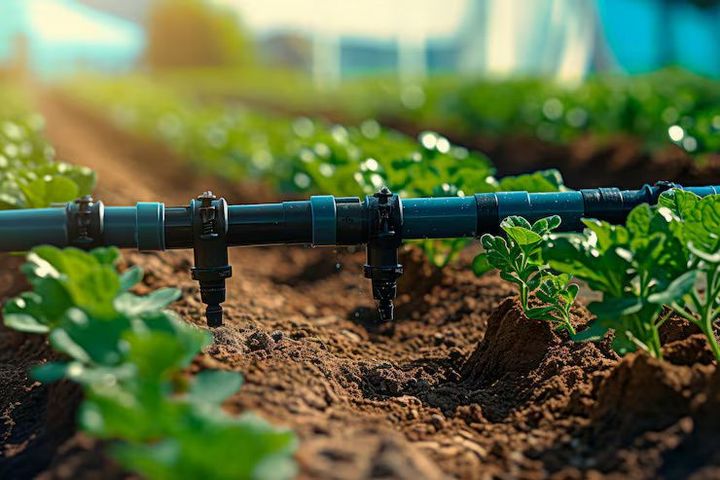
Drip Irrigation Systems are micro-irrigation arrangements designed to deliver water gradually and directly to the root zone of crops. Instead of distributing water across the entire field surface, the system uses a network of pipes, laterals, fittings, and emitters to apply controlled quantities of water near individual plants or crop rows.
Drip irrigation is widely used for agricultural and horticultural crops where controlled water application is important. It can be used for vegetables, fruits, flowers, plantations, sugarcane, cotton, and various row crops.
The basic arrangement normally consists of a water source, pump, filtration unit, mainline, sub-main lines, laterals, emitters, valves, pressure-control components, and sometimes fertigation equipment.
How Drip Irrigation Works
A typical drip irrigation sequence is:
Water Source → Pump → Filter → Mainline → Sub-main → Laterals → Emitters → Crop Root Zone
Water is first moved from the source through the pumping and filtration arrangement. Filters help reduce suspended particles that could block the narrow passages inside emitters.
The filtered water then travels through the mainline and sub-main network before entering smaller lateral pipes. Emitters installed along the laterals release water at controlled rates.
The application pattern depends on emitter spacing, discharge characteristics, operating pressure, soil properties, crop spacing, and irrigation scheduling.
Main Types of Drip Irrigation Systems
| Type | Main Characteristic | Typical Application |
|---|---|---|
| Surface drip irrigation | Laterals remain above the soil | Row crops and horticulture |
| Subsurface drip irrigation | Laterals are placed below the soil surface | Selected field crops |
| Online emitter system | Emitters are attached separately | Orchards and plantations |
| Inline emitter system | Emitters are integrated into laterals | Closely spaced crops |
| Pressure-compensating drip | Maintains relatively consistent emitter discharge across pressure variation | Sloping or larger fields |
| Non-pressure-compensating drip | Discharge varies with operating pressure | Simpler irrigation layouts |
| Gravity-fed drip | Uses available elevation and low pressure | Small-scale applications |
| Automated drip irrigation | Uses sensors, controllers, and valves | Precision irrigation |
Importance
Controlled Water Application
Drip irrigation allows water to be delivered close to the crop root zone. This can reduce unnecessary wetting of areas between crop rows and support more controlled irrigation scheduling.
BIS describes micro-irrigation as a water-efficient irrigation approach and identifies drip irrigation as one of the systems covered by Indian Standards for irrigation equipment and components.
Water-Use Efficiency
Because water is applied gradually near the crop, drip irrigation can help reduce losses associated with uncontrolled surface distribution. The actual efficiency depends on system design, soil conditions, weather, emitter performance, filtration, pressure management, and irrigation scheduling.
The PMKSY Per Drop More Crop framework focuses on improving water-use efficiency at the farm level through precision and micro-irrigation technologies.
Fertigation
Drip systems can be integrated with fertigation equipment to apply dissolved nutrients through irrigation water. This enables water and nutrient application to be coordinated with crop requirements.
A suitable filtration and injection arrangement is important because dissolved or suspended materials can affect emitter performance.
Crop and Field Management
Drip systems can be adapted to different crop spacing and field layouts. Adjustable lateral spacing and emitter arrangements allow irrigation systems to be designed around plant rows, orchard layouts, greenhouse beds, and other agricultural configurations.
Reduced Surface Wetting
Since water is concentrated around the root zone, the soil surface between crop rows may receive less water than with conventional surface irrigation. This characteristic can influence weed growth, soil moisture distribution, and field accessibility.
Application in Water-Stressed Areas
Micro-irrigation has particular relevance in areas where irrigation water must be carefully managed. PMKSY guidelines identify water-scarce, water-stressed, and critical groundwater areas as important areas for micro-irrigation development.
Recent Updates
Drip irrigation technology continues to develop through improved pipe materials, emitter designs, filtration, automation, sensors, fertigation, and digital irrigation management.
Updated Irrigation Lateral Standards
A significant recent development is IS 12786:2024 — Irrigation Equipment — Polyethylene Pipes for Irrigation Laterals — Specification, the first revision of the earlier standard.
The 2024 standard addresses polyethylene pipes used as irrigation laterals and includes requirements related to materials, dimensions, hydraulic characteristics, tensile properties, environmental stress cracking, and other characteristics.
BIS laboratory information also shows active testing arrangements for IS 12786:2024, including hydraulic characteristics, dimensions, tensile strength, elongation, environmental stress cracking, and carbon-related material characteristics.
Improved Emitters
Emitter technology continues to focus on consistent water discharge, clogging resistance, pressure management, and longer operational performance.
Different emitter designs can be selected according to crop spacing, field dimensions, pressure conditions, and water quality.
Better Filtration
Filtration remains one of the most important parts of a drip irrigation system because emitters contain relatively small water passages.
BIS technical material identifies filtration as an important consideration and notes that filters help protect drip emitters from impurities that can cause clogging.
Modern arrangements can include screen filters, disc filters, media filters, hydrocyclones, and combinations of these systems.
Automation and Sensors
Automated drip irrigation systems can combine solenoid valves, controllers, soil-moisture sensors, flow meters, pressure sensors, and weather information.
These systems can help regulate irrigation schedules according to soil moisture, crop requirements, environmental conditions, and predefined operating parameters.
Fertigation Integration
Modern systems increasingly integrate fertigation equipment with irrigation networks. Nutrient dosing can be controlled through injection units and monitoring equipment.
Proper water-quality management and filtration remain important when fertigation is used because chemical compatibility and suspended material can affect components and emitters.
Digital Irrigation Management
Digital controllers and connected monitoring systems can provide information about flow, pressure, irrigation duration, soil moisture, and water application.
Such systems can support data-based irrigation scheduling and help identify abnormalities such as leakage, pressure variation, or unexpected changes in water flow.
Integration With Renewable Energy
Pressurized irrigation requires energy for pumping. Solar-powered pumping systems can be integrated with drip irrigation in suitable locations, particularly where grid access or conventional energy arrangements are limited.
PMKSY guidelines also identify the potential integration of solar energy with pressurized irrigation systems.
Laws or Policies
Drip irrigation systems in India are influenced by agricultural development programs, irrigation practices, technical standards, water-management policies, and applicable state-level implementation requirements.
PMKSY — Per Drop More Crop
The Pradhan Mantri Krishi Sinchayee Yojana (PMKSY) includes the Per Drop More Crop component, which focuses on improving water-use efficiency through precision and micro-irrigation.
The PMKSY framework identifies drip irrigation as a micro-irrigation technology in which water is delivered to the crop root zone through emitters installed across mains, sub-mains, and laterals.
IS 12786:2024
IS 12786:2024 establishes requirements for polyethylene pipes used as irrigation laterals. The updated standard is an important reference for the materials and performance characteristics of these pipes.
IS 10799
IS 10799:1999 — Irrigation Equipment — Design, Installation and Field Evaluation of Micro Irrigation Systems — Code of Practice provides guidance related to the design, installation, and evaluation of micro-irrigation systems.
The BIS training material identifies provisions concerning emitter spacing, filtration, water treatment for clogging prevention, and cleaning procedures.
Other Micro-Irrigation Standards
BIS has developed a wider group of standards covering micro-irrigation components such as emitters, pipes, filters, valves, fertigation units, and related design and maintenance practices.
The BIS Know Your Standard portal can be used to search current Indian Standards by IS number or keyword and review related documents, amendments, notifications, and testing information.
Tools and Resources
A complete drip irrigation system combines hydraulic, filtration, control, and water-application components.
| Tool or Component | Function |
|---|---|
| Water source | Provides irrigation water |
| Pump | Pressurizes and moves water |
| Mainline | Carries water from the source |
| Sub-main | Distributes water to field sections |
| Lateral pipe | Carries water along crop rows |
| Dripper/Emitter | Releases controlled water flow |
| Screen filter | Removes suspended particles |
| Disc filter | Provides fine filtration |
| Media filter | Helps remove organic and suspended material |
| Hydrocyclone | Separates selected heavier particles |
| Pressure regulator | Controls operating pressure |
| Pressure gauge | Indicates line pressure |
| Flow meter | Measures water flow |
| Air-release valve | Helps manage trapped air |
| Flush valve | Supports lateral cleaning |
| Fertilizer injector | Introduces dissolved nutrients |
| Fertigation tank | Holds nutrient solution |
| Solenoid valve | Controls individual irrigation sections |
| Irrigation controller | Automates irrigation schedules |
| Soil-moisture sensor | Measures soil moisture |
| Weather sensor | Provides environmental information |
| Flow sensor | Monitors water movement |
| Pressure sensor | Tracks pressure conditions |
| Control panel | Manages electrical and automated functions |
Filtration Systems
Filtration is essential because small emitter passages can become blocked by suspended solids, algae, chemical precipitates, or other contaminants.
The filtration arrangement should be selected according to irrigation-water quality and the characteristics of the emitters being used.
Pipe and Lateral Systems
Mainlines and sub-mains transport water across the field, while laterals distribute it along crop rows. Polyethylene is widely used for irrigation laterals, and IS 12786:2024 provides current Indian requirements for this component category.
Emitters
Emitters control the rate at which water leaves the lateral. Inline and online emitter arrangements are common, while pressure-compensating designs can help maintain more consistent discharge under changing pressure conditions.
Pressure Management
Pressure affects emitter discharge and system uniformity. Pressure regulators, gauges, valves, and appropriately designed pipe networks help maintain operating conditions within the intended range.
Automation
Controllers can divide a field into irrigation zones and operate valves according to programmed schedules. Advanced systems can incorporate sensor inputs for soil moisture, pressure, flow, and weather conditions.
Maintenance Resources
Routine maintenance generally includes filter cleaning, lateral flushing, emitter inspection, pressure checks, leak detection, valve inspection, and monitoring of water quality.
The BIS micro-irrigation training material specifically includes design, installation, operation, maintenance, testing, and conformity-related information for irrigation components and systems.
FAQs
What is a Drip Irrigation System?
A Drip Irrigation System is a micro-irrigation arrangement that delivers controlled quantities of water near the root zone through pipes and emitters.
How does drip irrigation work?
Water passes through a pump and filtration system before moving through mainlines, sub-mains, and laterals. Emitters then release water gradually near individual plants or crop rows.
What are the main components of drip irrigation?
The main components include a water source, pump, filters, mainlines, sub-mains, laterals, emitters, valves, pressure-control equipment, and sometimes fertigation and automation systems.
What is the role of filtration in drip irrigation?
Filtration removes suspended particles and other materials that could block emitter passages. Proper filtration and regular cleaning are important for maintaining uniform water application.
Which Indian Standard covers irrigation lateral pipes?
IS 12786:2024 covers polyethylene pipes intended for irrigation laterals. It is the first revision of the earlier IS 12786 standard.
Conclusion
Drip Irrigation Systems provide a controlled method of delivering water close to crop root zones through a network of pipes, filters, valves, and emitters. Modern systems increasingly combine improved irrigation materials with fertigation, automation, sensors, digital monitoring, and solar-powered pumping. In India, PMKSY supports micro-irrigation through its Per Drop More Crop framework, while BIS standards provide technical references for irrigation components and system practices.