Coffee Roasting Machines: Guide to Types, Operation, and Processing Technology
Coffee Roasting Machines are industrial or commercial processing systems used to heat green coffee beans and transform them into roasted coffee. Roasting changes the beans' color, aroma, flavor characteristics, texture, moisture content, and chemical composition through controlled heating.
Green coffee beans are relatively hard and have a pale green appearance before roasting. When exposed to controlled heat, they gradually lose moisture and undergo chemical reactions that create the familiar brown color and aromatic compounds associated with roasted coffee.
Roasting requires careful control because temperature, heating rate, airflow, roasting duration, bean quantity, and cooling conditions can influence the final result. Different coffee varieties and processing methods may also require different roasting profiles.
How Coffee Roasting Works
A typical roasting cycle consists of several stages.
Loading: Green coffee beans are introduced into the roasting chamber. The initial bean temperature is usually lower than the temperature of the roasting system.
Heating: Heat transfers from the machine into the beans. Moisture begins to evaporate as the beans become progressively hotter.
Color development: The beans change from green to yellow, light brown, and darker brown as roasting progresses.
Chemical reactions: Reactions involving sugars, amino acids, and other compounds contribute to aroma and flavor development.
Roast development: The operator controls the later part of the roasting profile to reach the intended roast characteristics.
Discharge: The roasted beans leave the roasting chamber when the selected endpoint is reached.
Cooling: Rapid cooling reduces further heat exposure and stabilizes the roasted beans.
Main Components
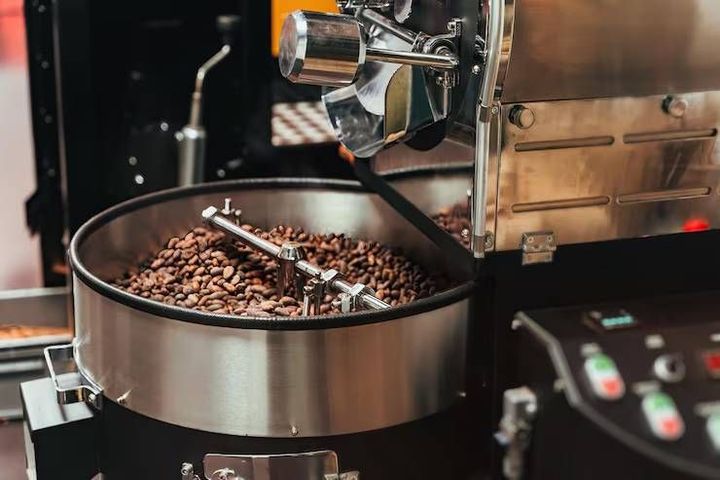
Coffee Roasting Machines generally contain several important components:
Roasting chamber: Holds and heats the coffee beans.
Heating system: Generates the thermal energy required for roasting.
Airflow system: Controls hot-air movement and removes moisture and roasting gases.
Agitation mechanism: Keeps beans moving for more consistent heat exposure.
Temperature sensors: Monitor bean or air temperature.
Control system: Manages temperature, airflow, timing, and other parameters.
Cooling tray or chamber: Rapidly removes heat after roasting.
Chaff collection system: Separates lightweight coffee skin particles produced during roasting.
The exact arrangement depends on the machine design and capacity.
Importance
Developing Coffee Characteristics
Roasting is one of the most influential stages in coffee processing. The same green coffee can produce noticeably different characteristics depending on the roasting profile.
Temperature and time influence the balance between acidity, sweetness, bitterness, aroma, body, and other sensory characteristics. Roasters therefore use specific profiles to produce consistent batches.
Supporting Batch Consistency
Modern roasting machines use temperature sensors, airflow controls, automated burners or electrical heating systems, and programmable controls to repeat selected roasting profiles.
Consistency is particularly important when multiple batches need similar characteristics. Digital controls can record roasting parameters and provide historical information for comparison.
Improving Process Control
A roasting machine allows operators to control variables that would be difficult to manage through simple heating methods. These include heat input, airflow, drum speed, exhaust conditions, and cooling rate.
Some systems can display temperature curves in real time, allowing operators to observe how a batch progresses through different stages.
Managing Roasting By-Products
Roasting produces chaff, smoke, gases, and volatile organic compounds. Chaff is lightweight and combustible, so appropriate collection and handling are important.
The International Coffee Organization notes that roasting can have environmental effects related to energy use and emissions. Natural-gas-fired systems can generate carbon monoxide and carbon dioxide, while roasting also produces volatile compounds and other emissions.
Major Machine Types
| Machine Type | Heating Approach | Common Characteristics |
|---|---|---|
| Drum roaster | Heated rotating drum | Controlled batch roasting |
| Fluid-bed roaster | Heated moving air | Strong airflow and rapid heat transfer |
| Hot-air roaster | Heated air circulation | Air-based bean heating |
| Sample roaster | Small-scale heating | Testing and profile development |
| Continuous roaster | Continuous material flow | High-volume processing |
| Electric roaster | Electrical heating | Electrically generated heat |
| Gas roaster | Gas-fired heating | Direct or indirect thermal heating |
Recent Updates
Digital Roasting Controls
Modern Coffee Roasting Machines increasingly use digital control systems to monitor temperature, airflow, timing, and other operating parameters.
Some systems can store roasting profiles and compare current batches with previous records. This creates a more structured approach to process monitoring and can reduce dependence on manual observation alone.
Automation and Sensors
Automation can control heating and airflow according to programmed parameters. Sensors can continuously measure selected conditions and transmit information to the machine controller.
Automated systems can also connect roasting data with production records, allowing operators to review batch information and identify differences between roasting cycles.
Energy and Emission Management
Energy consumption and roasting emissions have become important technical considerations. The International Coffee Organization identifies energy use and emissions as significant environmental aspects of coffee roasting.
Modern equipment can incorporate improved insulation, heat recovery concepts, airflow management, afterburning or emission-control equipment, and more precise heating controls. The appropriate approach depends on machine design, fuel type, local environmental requirements, and production scale.
Electric Heating Systems
Electrical roasting systems are gaining attention in applications where operators want to use electricity as the primary heat source. Electric systems can provide direct electronic control of heating power and may integrate with digital automation platforms.
Their environmental impact depends partly on how the electricity is generated. Therefore, replacing one energy source with another does not automatically produce the same environmental result in every location.
Connected Roasting Equipment
Connected machines can transmit operating information to computers, tablets, or centralized production systems. Data can include temperature curves, batch duration, airflow settings, energy information, and machine status.
Connectivity can support production records, process analysis, maintenance planning, and quality monitoring.
Improved Chaff and Emission Handling
Roasting equipment increasingly incorporates dedicated systems for collecting chaff and managing exhaust gases. Chaff accumulation requires attention because the material is lightweight and combustible.
Emission-control equipment can include cyclones, filtration systems, afterburners, or other technologies depending on the roasting system and local requirements.
Laws or Policies
Food Safety Requirements
Coffee roasting is part of the food-processing sector, so businesses must follow applicable food-safety requirements in the jurisdiction where the facility operates.
Requirements can cover hygienic processing areas, equipment cleanliness, food-contact materials, contamination prevention, storage, traceability, and labeling.
In the United States, food facilities can fall under requirements administered by the U.S. Food and Drug Administration. In the European Union, food businesses operate within a framework that includes general food law and hygiene requirements.
International Food Standards
The Codex Alimentarius framework provides internationally recognized food standards and guidance developed by the Food and Agriculture Organization and World Health Organization. These materials are widely used as references by countries when developing food regulations.
Coffee-specific requirements can differ between jurisdictions, particularly for labeling, contaminants, additives, packaging, and product definitions.
India as an Example
For facilities operating in India, the Food Safety and Standards Authority of India regulates food safety requirements under the national food-law framework. FSSAI maintains regulations covering food-business licensing, food-product standards, labeling, contaminants, and related areas.
FSSAI's food standards define roasted coffee as properly cleaned green coffee roasted to a brown color with its characteristic aroma. The framework also establishes requirements for roasted and ground coffee.
Recent Indian regulatory activity has also included changes concerning labeling requirements for coffee-chicory mixtures, showing that coffee-related food rules can evolve over time.
Environmental and Workplace Requirements
Roasting facilities may also be subject to environmental rules concerning air emissions, fuel combustion, waste handling, noise, and workplace conditions.
The exact requirements depend on the country, region, facility size, fuel system, and production process. Operators should therefore consult the relevant environmental and workplace authorities before installing or modifying industrial roasting equipment.
Tools and Resources
Roast Profile Software
Roasting software can display temperature curves and allow operators to record important process parameters. Profiles can be compared across batches to identify changes in roasting behavior.
Temperature Measurement Systems
Thermocouples and other temperature sensors provide information about air temperature, bean temperature, or equipment conditions. Accurate measurement is important because roasting decisions depend heavily on thermal changes.
Moisture and Density Measurement
Green coffee characteristics can vary between origins and processing methods. Moisture meters and density measurements can provide additional information when evaluating incoming green beans and preparing roasting profiles.
Color Measurement
Coffee color measurement instruments can help classify roasted beans according to their visual darkness. Such measurements can supplement sensory evaluation and process records.
Chaff Collection Equipment
Cyclones, collection containers, and related systems can capture chaff from the roasting process. Proper collection reduces accumulation around the roasting area and supports safer housekeeping.
Exhaust and Emission Equipment
Depending on local requirements and machine configuration, roasting facilities may use exhaust ducts, filtration systems, cyclones, thermal treatment equipment, or other emission-control technologies.
Quality Evaluation Tools
Roasted coffee can be evaluated through visual inspection, aroma assessment, grinding tests, brewing tests, and structured sensory evaluation. These methods help connect machine settings with the characteristics of the finished coffee.
FAQs
What are Coffee Roasting Machines?
Coffee Roasting Machines are processing systems that heat green coffee beans under controlled conditions to produce roasted coffee. They regulate factors such as temperature, airflow, agitation, and roasting duration.
How do Coffee Roasting Machines work?
Coffee Roasting Machines transfer heat to green coffee beans through a drum, heated air, or another thermal system. The beans move through stages of moisture removal, chemical development, color change, and cooling.
What are the main types of Coffee Roasting Machines?
The main types include drum roasters, fluid-bed roasters, hot-air roasters, sample roasters, continuous roasters, electric roasters, and gas-fired systems.
Why is airflow important in coffee roasting?
Airflow helps transfer heat, remove moisture and roasting gases, influence heat balance, and carry lightweight chaff toward collection or exhaust systems. The required airflow depends on the machine design and roasting profile.
What technologies are used in modern Coffee Roasting Machines?
Modern systems can use digital controllers, temperature sensors, programmable roasting profiles, automated heating, airflow controls, data recording, connected monitoring, emission management, and energy-management technologies.
Conclusion
Coffee Roasting Machines transform green coffee beans through controlled heating, airflow, agitation, and cooling. Drum, fluid-bed, hot-air, electric, gas-fired, and continuous systems use different approaches to manage heat transfer and production requirements. Current technology is increasingly focused on digital controls, automation, energy management, emissions handling, and process data. Food-safety, environmental, and workplace requirements also form important parts of responsible coffee-roasting operations worldwide.