Bakery Ovens: Guide to Types, Functions, and Practical Insights
Bakery Ovens are heating systems designed to bake products such as bread, rolls, biscuits, cookies, cakes, pastries, pizza, and other baked foods. They transfer controlled heat to dough or prepared mixtures, causing physical and chemical changes that create the desired texture, color, structure, and flavor.
Different bakery products require different combinations of temperature, airflow, humidity, heating method, and baking duration. For this reason, commercial and industrial bakeries use several oven designs rather than relying on one general-purpose system.
Modern bakery ovens can range from compact deck units used for small batches to continuous tunnel systems integrated into large production lines. The appropriate configuration depends on the product, batch size, production sequence, available space, energy source, and required process control.
How Bakery Ovens Work
Although oven designs vary, most bakery ovens follow a basic heating process.
First, the oven reaches a programmed temperature. Prepared dough or batter is then placed inside the baking chamber, on trays, racks, pans, or a moving conveyor.
Heat reaches the product through one or more mechanisms:
Convection: Heated air circulates around the product.
Radiation: Heat travels from heated surfaces toward the product.
Conduction: Heat passes directly from a heated surface or baking tray into the product.
Steam or humidity: Moisture can be introduced during selected baking processes.
During baking, water evaporates, gases expand, proteins and starches change structure, and the outer surface develops color. The exact sequence depends on the recipe and oven settings.
Main Types of Bakery Ovens
Convection ovens use circulating hot air to distribute heat throughout the chamber. They are widely used for products such as cookies, cakes, pastries, and various bread products.
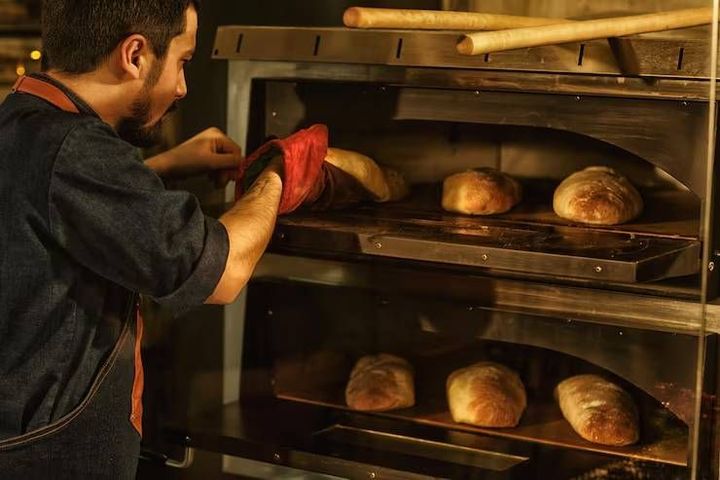
Deck ovens contain one or more heated baking surfaces, known as decks. They are commonly associated with bread, pizza, artisan-style products, and products where direct heat from the baking surface is important.
Rotary rack ovens use a rotating rack or trolley inside the chamber. Rotation helps expose trays to relatively consistent heating and allows several trays to be baked during the same cycle.
Tunnel ovens use a conveyor that continuously moves products through different temperature zones. They are particularly suitable for large-scale continuous production.
Reel ovens use rotating baking platforms or shelves to move products through the heated chamber. They are used in selected bakery applications where controlled batch baking is required.
Combi ovens combine hot-air circulation with steam or humidity control. They can be used for a range of cooking and baking applications, depending on their configuration.
Importance
Consistent Baking
A bakery oven must distribute heat appropriately so that products receive the intended baking conditions. Uneven heating can result in differences in color, texture, moisture, or internal structure.
Temperature sensors, airflow systems, programmable controls, and carefully designed chambers can help maintain more consistent conditions.
Product Quality
Different products respond differently to heat. A crusty bread product may require a different heating pattern from a delicate pastry or sponge cake.
Important variables include:
Baking temperature
Baking duration
Air circulation
Humidity
Heat transfer method
Product thickness
Tray arrangement
Loading density
Controlling these variables helps bakeries repeat a defined baking process across multiple batches.
Production Capacity
Oven capacity is an important consideration for commercial and industrial bakeries. A small batch oven may be appropriate where products are produced in limited quantities, while a tunnel oven can support continuous movement through a production line.
Capacity can be considered in terms of trays per batch, product weight per cycle, conveyor speed, baking chamber dimensions, or output over a defined period.
Energy Management
Heating is one of the major energy-consuming stages of baking. Oven design therefore has an important relationship with energy use.
Insulated chambers, efficient burners or heating elements, controlled airflow, heat recovery systems, accurate temperature control, and appropriate loading can influence overall energy performance.
Main Oven Comparison
| Oven Type | Heating Approach | Typical Applications | Production Pattern |
|---|---|---|---|
| Convection | Circulating hot air | Cakes, cookies, pastries | Batch |
| Deck | Heated deck and radiant heat | Bread, pizza, artisan products | Batch |
| Rotary Rack | Heated chamber with rotating rack | Bread, rolls, pastries | Batch |
| Tunnel | Zoned heating along conveyor | Bread, biscuits, snacks | Continuous |
| Reel | Rotating baking shelves | Bread and selected bakery products | Batch |
| Combi | Hot air with humidity or steam | Mixed baking applications | Batch |
Recent Updates
Greater Automation
Modern bakery ovens increasingly incorporate programmable controls, automatic temperature adjustment, digital monitoring, and integration with upstream and downstream equipment.
An automated baking line can connect dough preparation, proofing, loading, baking, cooling, and packaging into a coordinated production sequence. This can reduce the amount of manual adjustment required during repetitive production.
Digital Temperature Monitoring
Digital sensors can continuously measure temperatures at selected locations inside the oven. Controllers can compare measured conditions with programmed values and adjust heating systems accordingly.
Data logging can also create records of temperature patterns during production. These records can support process analysis and quality-control activities.
Improved Airflow Control
Air movement has a major influence on heat transfer in convection ovens. Modern systems can use carefully designed fans, ducts, dampers, and airflow paths to distribute heat more evenly.
Some ovens allow operators to adjust airflow according to the product and baking stage. This can be particularly relevant for products that are sensitive to surface drying or uneven browning.
Steam and Humidity Control
Steam can influence crust formation, surface appearance, and moisture conditions during selected bread-baking processes.
Modern ovens may include programmable steam injection and humidity controls. These systems allow baking conditions to be adjusted for particular recipes and production requirements.
Energy-Efficient Heating Systems
Manufacturers are developing oven systems with improved insulation, heat recovery, combustion control, and electronic monitoring.
Electric heating is used in many bakery applications, while gas-fired systems remain important in commercial and industrial environments. The appropriate heating source depends on local energy infrastructure, oven design, production requirements, and regulatory conditions.
Continuous Production Technology
Tunnel ovens remain important for large-scale production because products can move continuously through multiple heating zones.
Different zones can be programmed for different temperature and airflow conditions. This allows the baking profile to change as the product travels through the chamber.
Connected Bakery Equipment
Industrial bakery ovens can increasingly connect with production-monitoring platforms and factory automation systems. Sensors may provide information about temperature, airflow, conveyor speed, equipment status, and other operating conditions.
Connected systems can help production teams observe equipment conditions and identify deviations from programmed parameters.
Laws or Policies
International Food Hygiene Principles
Food-processing equipment is generally expected to support hygienic production and prevent contamination. The Codex Alimentarius General Principles of Food Hygiene state that food-contact equipment should be suitable for its intended use and designed so that it can be adequately cleaned, maintained, and inspected.
For bakery ovens, this means that oven construction, surfaces, access points, maintenance procedures, and surrounding production areas should be considered as part of food hygiene planning.
Temperature Monitoring
Codex guidance also states that equipment used to cook or heat food should be designed to achieve required food temperatures as necessary and maintain them effectively. Where appropriate, temperature-monitoring and control systems should be available, with monitoring equipment calibrated when necessary.
This principle is relevant to bakery ovens because temperature is a central part of the baking process.
Codex Bakery Food Category
The Codex General Standard for Food Additives identifies bakery wares as food category 07.0, including bread and ordinary bakery products as well as sweet, salty, and savory fine bakery products. The database is updated through the 48th Session of the Codex Alimentarius Commission in 2025.
Codex standards provide international references, while individual countries may establish additional food-safety, labeling, equipment, workplace, electrical, gas, and environmental requirements.
Electrical and Gas Safety
Bakery ovens can use electricity, natural gas, LPG, thermal systems, or combinations of different heating technologies. Installation requirements therefore vary according to the heating method and country.
Businesses should follow applicable national and local requirements for electrical installations, gas systems, ventilation, combustion equipment, fire protection, and workplace safety.
Cleaning and Maintenance
Food-production equipment should be designed and maintained in ways that reduce contamination risks. Oven chambers, doors, trays, racks, ventilation areas, steam systems, and accessible surfaces may require defined inspection and cleaning procedures.
Maintenance schedules should also account for heating elements, burners, fans, sensors, seals, conveyors, controls, and safety mechanisms.
Tools and Resources
Temperature Sensors
Thermocouples, resistance temperature detectors, infrared instruments, and other temperature-measurement devices can be used to monitor oven conditions.
The measurement method should match the application and should be maintained and calibrated according to appropriate procedures.
Data Loggers
Temperature data loggers can record conditions over time. They can help production teams examine whether a baking cycle maintained its programmed conditions.
Oven Control Systems
Digital control panels allow operators to configure temperature, baking duration, airflow, steam, conveyor speed, and other parameters depending on the oven design.
Energy Monitoring
Energy meters and monitoring systems can track electricity or fuel consumption associated with bakery equipment. This information can help production teams understand how different operating patterns affect energy use.
Calibration Equipment
Calibration tools help verify the accuracy of temperature sensors and other measurement devices. Accurate measurements are important when oven settings are used as part of a controlled production process.
Food Safety Resources
Codex Alimentarius provides international food-hygiene principles and standards. National food authorities, standards organizations, and workplace-safety regulators provide additional requirements that vary by country.
For international bakery operations, the relevant national rules should be checked alongside applicable Codex references.
FAQs
What are Bakery Ovens?
Bakery Ovens are heating systems used to bake bread, cakes, biscuits, cookies, pastries, pizza, rolls, and other bakery products under controlled temperature and processing conditions.
What are the main types of Bakery Ovens?
Common types include convection ovens, deck ovens, rotary rack ovens, tunnel ovens, reel ovens, and combi ovens. Each design uses a different combination of heat transfer, airflow, chamber arrangement, or product movement.
How does a convection bakery oven work?
A convection bakery oven circulates heated air through the baking chamber. The moving air transfers heat around the products and can help create relatively uniform baking conditions.
What is a tunnel oven used for?
A tunnel oven is generally used for continuous baking. Products travel through the oven on a conveyor and pass through different heating zones during the baking process.
How do bakeries monitor oven performance?
Bakeries can use temperature sensors, data loggers, control systems, energy meters, calibration equipment, and production records to monitor oven conditions and process consistency.
Conclusion
Bakery Ovens are important pieces of equipment for transforming prepared dough and batter into finished baked products through controlled heating. Convection, deck, rotary rack, tunnel, reel, and combi ovens provide different approaches to heat transfer, capacity, airflow, and production patterns. Recent developments include digital controls, temperature monitoring, steam management, connected equipment, improved insulation, and automated production lines. International food-hygiene principles also emphasize suitable equipment design, cleaning, maintenance, temperature control, and monitoring as part of safe food production.