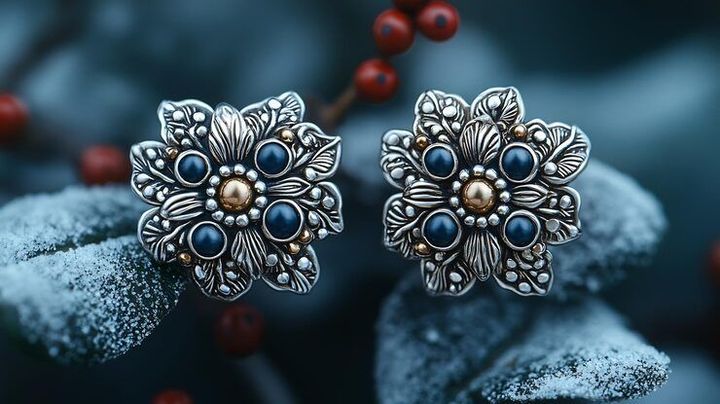
Asymmetrical Jewelry Designs: Guide to Modern Styles and Practical Insights
Asymmetrical jewelry designs use elements that are intentionally different from one another instead of following a perfectly balanced or mirrored arrangement. One earring may be longer than the other, a necklace may place its main feature away from the center, or a ring may combine shapes that do not match on both sides.
Asymmetry does not mean that a piece lacks structure. Designers usually create a visual balance through differences in length, shape, texture, gemstone placement, metal surfaces, or proportions. The result can appear modern while still having a carefully planned composition.
How Asymmetrical Jewelry Designs Developed
Traditional jewelry often uses symmetry because matching shapes can create visual order. However, jewelry designers have also experimented with irregular forms for many decades, particularly within modernist, Art Deco, avant-garde, and contemporary design movements.
Advances in computer-aided design, precision manufacturing, gemstone cutting, and digital modeling have expanded the range of shapes that can be developed. Designers can now test unusual proportions digitally before a physical piece is produced.
Asymmetrical jewelry designs are used across earrings, rings, necklaces, bracelets, brooches, pendants, and body jewelry. The approach can range from a small difference in gemstone placement to an intentionally uneven overall structure.
Main Types of Asymmetrical Jewelry Designs
Several approaches are commonly used:
Mismatched earrings: The two earrings use different lengths, shapes, gemstones, or arrangements while maintaining a visual relationship.
Off-center necklaces: The pendant or gemstone feature is positioned away from the middle of the necklace.
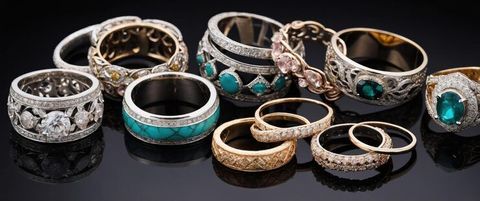
Uneven rings: Decorative elements may appear heavier on one side of a ring rather than being centered.
Irregular bracelets: Links, charms, textures, or gemstone settings can vary along the bracelet.
Sculptural pieces: Organic curves, angular forms, and irregular surfaces create a three-dimensional appearance.
Mixed-material designs: Different metals, gemstones, pearls, enamel, or other materials are combined within one composition.
Geometric asymmetry: Circles, rectangles, triangles, arcs, and other shapes are arranged in deliberately uneven relationships.
A simple example is a pair of earrings where one piece has a small gemstone stud and the other has a longer geometric drop. They are different, but their metal color or gemstone family can visually connect them.
How Designers Create Visual Balance
Asymmetrical pieces generally rely on visual weight. A large gemstone on one side may be balanced by several smaller elements on the other side, while a long shape may be balanced by a wider but shorter form.
Designers also consider scale, negative space, color, texture, and movement. These elements help prevent an irregular arrangement from appearing accidental.
Importance
Why Asymmetrical Jewelry Designs Matter
Asymmetrical jewelry designs provide an alternative to conventional matching patterns. They allow designers to work with unusual proportions, abstract forms, and combinations that may not fit traditional symmetrical layouts.
The approach is also useful for personal styling because individual pieces can be combined in different ways. Mismatched earrings, layered necklaces, and offset pendants can create different visual arrangements without requiring every element to match.
Where These Designs Are Used
Asymmetry appears across many jewelry categories, including everyday pieces, formal accessories, statement jewelry, artistic collections, bridal accessories, and contemporary fashion jewelry.
Designers may use asymmetry for several functional and visual purposes. A pendant can be moved away from the center to follow the neckline, while an earring can use a longer drop to create movement around the face.
Materials and Components
The basic components depend on the type of jewelry, but commonly include precious metals, other metal alloys, gemstones, pearls, enamel, chains, clasps, wires, settings, and decorative surfaces.
Gemstone settings are particularly important because the setting determines how securely a stone is positioned. In an asymmetrical design, different settings may be required on different parts of the same piece.
Practical Design Considerations
Several factors influence the appearance and usability of an asymmetrical piece:
Proportion: Different elements need a relationship in size so the design remains visually organized.
Weight distribution: Uneven earrings or pendants need appropriate weight placement for comfortable wear.
Structural strength: Irregular shapes can create thin sections or unusual connection points that require careful construction.
Movement: Hanging elements can change position as the wearer moves, creating a dynamic appearance.
Material compatibility: Different metals or surface treatments may react differently to wear and environmental exposure.
Wearability: Designers need to consider how a piece sits on the body and whether its unusual shape interferes with clothing or movement.
Comparing Common Design Approaches
| Design Approach | Main Feature | Common Jewelry Type | Main Design Consideration |
|---|---|---|---|
| Mismatched | Different pieces form one pair | Earrings | Visual relationship |
| Off-center | Main feature is shifted | Necklaces, pendants | Placement |
| Uneven geometric | Shapes vary in size or direction | Rings, earrings | Proportion |
| Organic asymmetry | Natural curves and irregular surfaces | Bracelets, pendants | Surface and structure |
| Mixed-material | Different materials are combined | Earrings, necklaces | Material compatibility |
| Sculptural | Three-dimensional irregular form | Brooches, rings | Weight and durability |
Recent Updates
Digital Jewelry Design
Digital design continues to influence contemporary jewelry development. Computer-aided design allows designers to construct three-dimensional models, adjust dimensions, inspect connections, and prepare digital files for manufacturing.
This is particularly useful for asymmetrical jewelry because irregular shapes can be difficult to evaluate from a simple two-dimensional sketch. Three-dimensional modeling allows the designer to view a piece from multiple directions before physical production.
3D Printing and Digital Manufacturing
3D printing has become an established tool within parts of the jewelry production process. Digital models can be converted into physical patterns or components, depending on the material and manufacturing method.
For complex asymmetrical pieces, digital manufacturing can reduce some of the limitations associated with manually creating highly irregular forms. However, finishing, casting, setting, polishing, and inspection may still require additional production stages.
AI-Assisted Design
From 2024 through 2026, AI-assisted creative software has continued developing across design industries. In jewelry, AI can potentially support concept generation, image exploration, pattern variation, and early-stage design ideation.
AI-generated concepts still require human review for proportions, manufacturability, gemstone settings, material behavior, intellectual-property considerations, and wearability. AI should therefore be viewed as a design-support technology rather than an automatic replacement for technical jewelry expertise.
Precision and Standardization
Digital measurement and modeling are increasingly relevant to jewelry design because small dimensional changes can affect fit and appearance. ISO's technical work on jewelry and precious metals covers areas including jewelry sizing, precious-metal analysis, diamonds, coatings, responsible sourcing vocabulary, and functional testing.
For diamond-related work, ISO 24016 addresses terminology, classification, and test methods for grading polished diamonds. The standard was corrected in 2024 and confirmed as current in February 2026.
Laws or Policies
Jewelry Descriptions and Consumer Information
Jewelry regulations vary by country, and there is no single worldwide law governing every jewelry product. Requirements can concern metal content, gemstone descriptions, treatments, weight, origin claims, disclosures, labeling, and advertising.
In the United States, the Federal Trade Commission's Jewelry Guides are associated with 16 CFR Part 23 and address truthful descriptions of jewelry, precious metals, diamonds, gemstones, and pearls. The FTC revised the guides in 2018 to address several technological and industry developments.
International Standards
ISO/TC 174 develops international standards relating to jewelry and precious metals. Its scope includes jewelry sizes, precious-metal colors and coatings, diamonds, gemstones, analysis, sampling, impurities, and responsible sourcing terminology.
These ISO standards do not automatically become law in every country. Their use depends on national regulations, industry practices, contracts, and the particular product involved.
Regional Differences
Countries can use different hallmarking, labeling, import, consumer-protection, and precious-metal requirements. A jewelry item manufactured in one country may therefore need additional documentation or markings before entering another market.
For international jewelry businesses, product descriptions should accurately identify materials, gemstone characteristics, treatments, and relevant measurements according to the rules applicable in the destination market.
Tools and Resources
CAD Software
Computer-aided design software is useful for developing irregular jewelry forms. Designers can create curves, angles, settings, channels, joints, and other structures while checking dimensions in a digital environment.
3D Modeling and Rendering
Three-dimensional rendering tools can show how an asymmetrical design may appear from different angles. Designers can test gemstone placement, metal surfaces, negative space, and proportions before physical production.
3D Printers
Jewelry-oriented 3D printing systems can create patterns, prototypes, models, or selected finished components depending on the technology and material. They are particularly relevant when a design contains complex curves or difficult-to-machine forms.
Digital Measurement Tools
Digital calipers, ring-sizing systems, optical scanners, and other measurement equipment can help verify dimensions. Accurate measurements are important because asymmetrical forms may contain several different thicknesses and connection points.
Standards and Industry Databases
ISO provides information about international jewelry and precious-metal standards, while national standards bodies and regulatory agencies provide country-specific requirements. The FTC's Jewelry Guides can also be useful for understanding U.S. rules concerning product descriptions and disclosures.
FAQs
What are asymmetrical jewelry designs?
Asymmetrical jewelry designs use intentionally unequal shapes, sizes, positions, or decorative elements. The pieces are designed to create visual balance without relying on identical or mirrored forms.
Why are asymmetrical jewelry designs becoming popular?
Asymmetrical jewelry designs provide flexibility for contemporary styling and allow designers to explore irregular shapes, mixed materials, offset gemstones, and different proportions. Digital design tools have also made complex forms easier to model and evaluate.
How do asymmetrical jewelry designs stay balanced?
Designers use visual weight, proportion, color, texture, negative space, and placement to create balance. A larger element can be positioned opposite several smaller elements, for example.
Can asymmetrical jewelry designs be made with CAD?
Yes. CAD software can create detailed three-dimensional models of irregular jewelry shapes. The digital model can then support prototyping, casting, machining, or other production processes depending on the design.
What materials are commonly used in asymmetrical jewelry designs?
Common materials include gold, silver, platinum, other metal alloys, diamonds, colored gemstones, pearls, enamel, and mixed materials. The choice depends on the intended structure, appearance, durability, and manufacturing method.
Conclusion
Asymmetrical jewelry designs use unequal forms, positions, proportions, and materials to create structured visual contrast. They appear across earrings, rings, necklaces, bracelets, pendants, and sculptural jewelry, with digital design tools expanding the range of possible forms. CAD modeling, 3D printing, digital measurement, and AI-assisted ideation are influencing contemporary jewelry development, while international and national standards continue to address materials and product descriptions. Careful proportion, structural design, material selection, and accurate information remain important when creating and evaluating asymmetrical jewelry.