Ancient Civilization Tours: Archaeological Sites & Heritage Travel
Ancient civilization tours are journeys designed around archaeological sites, historic settlements, monuments, museums, landscapes, and cultural remains connected with early societies.
They help travelers understand how people lived, worked, traded, governed communities, practiced religions, and developed technologies in earlier periods.
Unlike a conventional holiday focused mainly on recreation, historical travel places greater attention on evidence from the past. A single itinerary may include an ancient city, archaeological museum, historic temple, fortification, inscription, burial site, or excavation area.
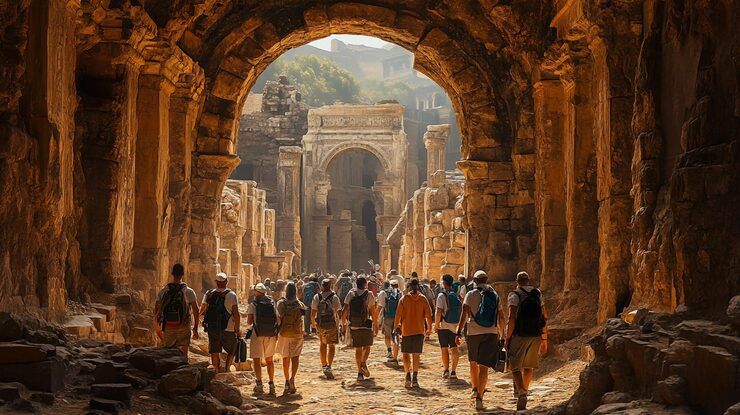
Ancient civilization tours can cover many periods, including the Indus Valley Civilization, ancient Egypt, Mesopotamia, Greece, Rome, the Maya civilization, and early civilizations of China. In India, important examples include Dholavira, Lothal, Rakhigarhi, Sanchi, Nalanda, Bhimbetka, and other archaeological sites.
The purpose is not simply to see old structures. Archaeological tourism can connect physical remains with historical research and explain how civilizations changed over long periods.
India provides a particularly broad setting for this type of heritage travel. UNESCO currently lists 45 World Heritage properties for India, including Dholavira: a Harappan City, the Archaeological Site of Nalanda Mahavihara, Buddhist Monuments at Sanchi, and other cultural properties.
Why Ancient Civilization Tours Matter Today
Ancient civilization tours are relevant to students, researchers, families, history enthusiasts, international travelers, educators, photographers, and people interested in cultural heritage.
They provide a practical way to understand subjects that can otherwise feel distant when studied only through books. Standing near an ancient settlement, for example, can make ideas about urban planning, water management, trade, agriculture, architecture, and social organization easier to understand.
These tours also support broader cultural heritage tourism by encouraging attention toward conservation and historical interpretation.
Important benefits include:
- Historical learning: Visitors can connect archaeological evidence with known historical periods.
- Cultural understanding: Ancient sites can demonstrate how different communities developed traditions, technologies, architecture, and systems of trade.
- Educational value: Students can connect classroom subjects with physical locations and museum collections.
- Heritage awareness: Visiting protected places can encourage greater respect for archaeological preservation.
- Regional understanding: Ancient settlements often explain why particular towns and trade routes developed in specific locations.
- Research interest: Archaeological tourism can introduce visitors to current questions about migration, technology, environment, and ancient economies.
A responsible visit is particularly important because archaeological remains are often fragile. Walking only in permitted areas, avoiding physical contact with structures, following photography rules, and not removing objects are basic parts of responsible heritage travel.
Examples of Major Civilization-Related Destinations in India
| Destination | Historical significance | Major period or theme |
|---|---|---|
| Dholavira, Gujarat | Planned Harappan settlement and water-management remains | Indus Valley Civilization |
| Rakhigarhi, Haryana | Major Harappan archaeological site | Harappan Civilization |
| Lothal, Gujarat | Archaeological remains associated with trade and craft production | Harappan Civilization |
| Bhimbetka, Madhya Pradesh | Rock shelters with prehistoric paintings and archaeological evidence | Prehistoric India |
| Sanchi, Madhya Pradesh | Buddhist monuments and religious architecture | Ancient India |
| Nalanda, Bihar | Remains of a major ancient learning centre | Ancient and early medieval India |
| Sarnath, Uttar Pradesh | Important Buddhist archaeological and religious site | Ancient India |
These destinations demonstrate that ancient civilization tours do not have to focus on one type of monument. They can include settlements, religious complexes, rock art, burial areas, water systems, craft locations, and educational institutions.
Recent Developments and Trends
Several developments during 2025 and 2026 have increased attention toward archaeological research and heritage interpretation in India.
In 2025, Maratha Military Landscapes of India was added to the UNESCO World Heritage List. UNESCO's current India listing identifies it as a cultural property inscribed in 2025.
India's UNESCO Tentative List has also expanded. During 2025, entries included the Serial Nomination for Ashokan Edict Sites along the Mauryan Routes, the Serial Nomination of Chausath Yogini Temples, the Serial Nomination of Gupta Temples in North India, and Mudumal Megalithic Menhirs.
The list continued to develop in 2026. UNESCO's September 3, 2026 update records additions including Bagh Cave Paintings, Udaigiri Caves, Ginnorgarh Fort, the Group of Temples of the Chambal Valley, the Painted Haveli Towns of Shekhawati, and the Sites of Satyagraha.
Archaeological research has also remained active. A July 20, 2026 statement from India's Ministry of Culture reported that the Archaeological Survey of India had issued excavation permissions for 25 projects during 2025, with excavations producing evidence such as structural remains, burials, pottery, coins, beads, ornaments, agricultural tools, and bone objects.
Rakhigarhi has received particular attention. Research from the 2025–26 excavation season included the discovery of eight burials at Mound No. 7, with skeletal material transferred for detailed scientific examination.
Another notable development occurred in July 2025, when information concerning the publication and review process for the Keezhadi excavation report was released. Keezhadi is an important archaeological location associated with research into early settlements in Tamil Nadu.
These developments show that ancient civilization studies are not limited to established tourist landmarks. Archaeological understanding continues to change as excavations, laboratory analysis, historical research, and heritage documentation produce new evidence.
Laws and Policies Affecting Archaeological Travel in India
Ancient monuments and archaeological sites in India are affected by national and state-level heritage regulations. One of the major national laws is the Ancient Monuments and Archaeological Sites and Remains Act, 1958 (AMASR Act). Its purpose includes preservation of monuments and archaeological sites of national importance and regulation of archaeological excavations.
The legislation establishes controls around protected monuments and archaeological areas. Under the AMASR framework, a prohibited area generally extends 100 metres from a protected monument or protected area. A regulated area extends beyond this zone, and construction or other activities may require authorization under the applicable rules.
For visitors, this means archaeological locations cannot always be treated like ordinary public spaces. Certain areas may be closed, access may be restricted, and photography or other activities may be subject to site-specific rules.
The law also protects archaeological excavation and physical remains. Visitors should therefore avoid:
- Removing stones, pottery fragments, coins, or other objects.
- Touching or climbing fragile structures.
- Entering restricted excavation areas.
- Conducting unauthorized digging or collection.
- Damaging inscriptions, paintings, walls, or sculptures.
- Ignoring instructions provided at protected monuments.
India's heritage framework works alongside UNESCO conventions, state archaeology departments, museum authorities, forest regulations where applicable, and local heritage rules.
Tools and Resources for Planning Historical Travel
Several digital resources can make ancient civilization tours easier to research and organize.
UNESCO World Heritage Centre: Useful for checking World Heritage status, historical descriptions, tentative-list entries, and conservation information. India's current UNESCO profile includes both inscribed properties and a substantial Tentative List.
Incredible India: India's official tourism portal provides information on archaeological sites, historical locations, UNESCO World Heritage Sites, attractions, regions, and trip planning. It also provides a mobile application.
Archaeological Survey of India: Useful for understanding nationally protected monuments, archaeological research, excavations, and heritage preservation.
Digital maps: Mapping applications can help identify distances between archaeological sites, museums, railway stations, airports, and accommodation areas.
Travel itinerary templates: A simple spreadsheet can record site names, opening information, travel time, historical period, nearby museums, documentation requirements, and planned visit dates.
Museum catalogues and academic databases: These can provide additional historical context before visiting a site and help distinguish established archaeological evidence from popular interpretations.
A useful research checklist is:
- Historical period
- Archaeological significance
- Site location
- Opening information
- Access restrictions
- Photography rules
- Nearby museums
- Local transportation
- Weather conditions
- Heritage protection requirements
- Official information sources
Frequently Asked Questions
What are ancient civilization tours?
Ancient civilization tours are historical journeys centered on archaeological sites, ancient settlements, monuments, museums, inscriptions, and other evidence connected with earlier civilizations.
Which ancient civilization sites can be visited in India?
Examples include Dholavira, Rakhigarhi, Lothal, Sanchi, Bhimbetka, Nalanda, and Sarnath. The appropriate destinations depend on the historical period and type of archaeology a traveler wants to explore.
Are archaeological sites protected by law in India?
Yes. Nationally protected monuments and archaeological sites can fall under the Ancient Monuments and Archaeological Sites and Remains Act, 1958, along with other national, state, and local regulations.
Can visitors enter excavation areas?
Not necessarily. Active excavation zones and other restricted areas may be closed to visitors. Access should follow instructions from the responsible archaeological or heritage authority.
How can travelers research a civilization before visiting?
Start with UNESCO records, Archaeological Survey of India information, government tourism portals, museum resources, academic publications, and reliable historical references. Comparing several sources can help create a more accurate understanding of the site.
Conclusion
Ancient civilization tours provide a practical way to explore archaeology, history, architecture, and cultural development. They connect physical places with evidence about earlier societies and can make historical study more understandable for general audiences.
India is particularly significant for this form of historical travel because its archaeological landscape covers prehistoric settlements, Harappan cities, Buddhist monuments, ancient learning centres, rock art, temples, inscriptions, and historic urban landscapes.
Recent UNESCO developments and continuing archaeological research show that the understanding of India's past remains an active field of study. For visitors, responsible behavior is essential. Respecting protected areas, following site rules, using reliable historical information, and avoiding damage to archaeological remains help preserve these places for future research and education.