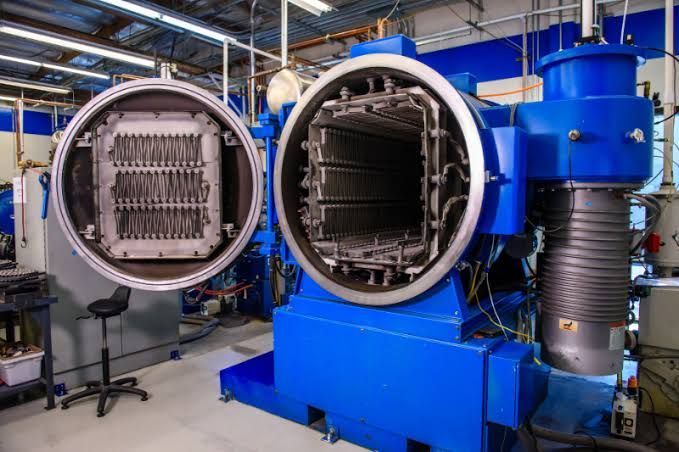
Vacuum Brazing Furnaces Insights: What Can Impact Quality, Precision and Reliability
Vacuum brazing is a joining process used to connect two or more metal components by heating them in a controlled vacuum environment.
Instead of melting the main components, a brazing filler metal melts and flows between closely fitted surfaces, creating a strong joint after cooling. A vacuum brazing furnace provides the controlled temperature, atmosphere, and heating conditions needed for this process.
An industrial vacuum brazing furnace is commonly used when manufacturers need clean joints, controlled heating, and repeatable processing. The absence of air inside the chamber helps reduce oxidation and contamination during heating. This makes vacuum brazing useful for components made from aluminum, stainless steel, titanium, nickel alloys, and other engineering materials.
A vacuum brazing furnace may be configured as a single-chamber system, multi chamber vacuum brazing furnace, or continuous vacuum brazing furnace. The configuration depends on production volume, component dimensions, heating requirements, cooling conditions, and the level of process automation required.
A typical vacuum brazing system includes several connected elements:
- Vacuum chamber for creating the controlled atmosphere
- Heating elements for generating the required thermal cycle
- Vacuum pumps for removing air and other gases
- Temperature sensors for monitoring the load
- Control software for managing heating, holding, vacuum, and cooling
- Cooling equipment for controlling the cooling stage
- Fixtures for maintaining component alignment
The design of a vacuum furnace brazing system has a direct relationship with process consistency. Furnace uniformity, vacuum quality, filler-metal selection, component cleanliness, joint clearance, and temperature control can all influence the finished joint.
Importance
Why vacuum brazing quality matters
Brazed components can be used in heat exchangers, aerospace assemblies, automotive components, medical equipment, electronics, industrial machinery, and energy systems. A joint that contains voids, contamination, incomplete filler-metal flow, or dimensional distortion can affect how the final component performs.
For this reason, manufacturers using vacuum brazing equipment generally pay attention to the complete process rather than focusing only on furnace temperature. The interaction between materials, joint design, furnace conditions, fixtures, and cooling determines the final result.
A high temperature vacuum brazing furnace must maintain stable conditions throughout the thermal cycle. Excessive temperature variation can influence filler-metal flow and may affect the properties of the base material.
Factors that influence precision
Several variables can affect the precision and reliability of vacuum brazing:
- Temperature uniformity throughout the working zone
- Accuracy and placement of temperature sensors
- Vacuum level and chamber cleanliness
- Surface preparation before brazing
- Joint clearance and component alignment
- Filler-metal composition and melting range
- Heating and cooling rates
- Fixture design and material selection
- Furnace loading pattern
- Process monitoring and record keeping
A precision vacuum brazing furnace is therefore more than a heating chamber. It is a controlled processing environment in which multiple variables need to remain within defined ranges.
Materials and applications
Different materials respond differently to brazing temperatures and filler metals. An aluminum vacuum brazing furnace, for example, needs process conditions appropriate for aluminum alloys and their associated filler materials. A vacuum brazing furnace for stainless steel may require a different thermal profile and filler-metal system.
Titanium and nickel alloys can also require carefully controlled atmospheres because their surfaces can react with contaminants at elevated temperatures. Aerospace applications may therefore use an aerospace vacuum brazing furnace with detailed process monitoring and documented procedures.
| Furnace application | Important process considerations |
|---|---|
| Aluminum components | Temperature control, oxide management, filler-metal flow |
| Stainless steel | Joint clearance, filler compatibility, heating uniformity |
| Titanium | Vacuum quality, contamination control, thermal exposure |
| Nickel alloys | High-temperature stability, filler selection, atmosphere control |
| Heat exchangers | Joint accessibility, fixture alignment, flow-path protection |
| Aerospace components | Repeatability, process records, inspection requirements |
Recent Updates
Greater process automation
Recent developments in industrial thermal processing have increased the use of automation for vacuum brazing. A vacuum brazing furnace automation system can monitor temperature, pressure, heating stages, cooling cycles, and alarms through programmable controls.
Automated vacuum brazing furnace systems can also record process information for individual furnace cycles. Digital records make it easier to identify variations between batches and investigate unusual results.
More precise temperature monitoring
Modern furnace designs increasingly focus on temperature uniformity and improved monitoring. Multiple sensors can be positioned at different locations within the working zone to identify temperature differences during qualification and production cycles.
For demanding applications, the furnace may undergo temperature uniformity surveys and system accuracy checks. These procedures help establish whether the furnace can maintain the required thermal conditions across its usable work area.
Improved vacuum monitoring
Vacuum technology continues to be an important part of furnace development. Monitoring pressure at different stages helps operators identify leaks, contamination, pump performance issues, and unusual outgassing behavior.
A high vacuum brazing furnace may use multiple pumping stages or combinations of vacuum-pump technologies depending on the required pressure range and chamber configuration.
Flexible production configurations
Manufacturers are also using different furnace arrangements according to production requirements. A multi chamber vacuum brazing furnace can separate loading, heating, brazing, and cooling activities within different controlled zones.
Continuous vacuum brazing furnace designs can be considered for processes involving repeated production cycles and consistent component movement. Meanwhile, a vacuum brazing production furnace with batch processing may be appropriate for larger or varied component configurations.
Application-specific furnace design
Specialized equipment remains important for applications involving complex geometries or sensitive materials. A vacuum heat exchanger brazing furnace, for example, must accommodate component size, joint arrangement, internal passages, and fixture requirements.
Custom vacuum brazing furnace configurations may also incorporate specialized loading systems, cooling arrangements, temperature monitoring, or chamber dimensions based on the application.
Laws or Policies
Indian regulatory considerations
In India, industrial furnace operations can be influenced by workplace safety, environmental protection, electrical safety, and industrial operating requirements. The applicable requirements depend on the facility, furnace configuration, fuel or electrical system, emissions, and the materials being processed.
The Environment (Protection) Act and related environmental rules provide a broad framework for environmental protection. Where industrial operations involve regulated emissions or other environmental impacts, facilities may also need to consider requirements under applicable air-pollution regulations.
Workplace safety requirements are another consideration. Industrial vacuum brazing equipment involves high temperatures, electrical systems, vacuum chambers, moving mechanisms, and potentially hot components. Facilities should therefore follow applicable occupational safety requirements and maintain appropriate operating procedures.
Depending on the installation, businesses may also need to consider:
- Electrical safety and industrial electrical requirements
- Factory and workplace safety provisions
- Environmental permissions applicable to the facility
- Equipment inspection and maintenance records
- Worker training for furnace operation
- Emergency procedures for electrical or thermal incidents
- Appropriate handling and storage of brazing materials
A vacuum furnace manufacturer may design equipment according to recognized technical standards, while the facility remains responsible for meeting the regulatory requirements applicable to its location and operation.
Tools and Resources
Furnace monitoring tools
Temperature data loggers, thermocouples, vacuum gauges, pressure sensors, and control-system records are commonly used to monitor furnace operation. These tools help establish whether the programmed thermal cycle matches the actual furnace conditions.
For precision applications, temperature uniformity measurement equipment can be used during furnace qualification. Calibration records are also important because inaccurate sensors can lead to incorrect process decisions.
Process planning resources
Process engineers can use material-property databases, brazing filler-metal reference tables, joint-clearance calculations, thermal-cycle documentation, and furnace loading templates when preparing a brazing process.
A basic process record may include:
- Component identification
- Base-material type
- Filler-metal specification
- Joint configuration
- Furnace load arrangement
- Vacuum parameters
- Heating profile
- Brazing temperature range
- Holding period
- Cooling conditions
- Inspection results
Standards and technical references
International and national standards can help organizations establish consistent brazing and furnace-control procedures. Depending on the industry and application, relevant references may cover brazing filler metals, furnace qualification, temperature measurement, quality management, and material specifications.
For aerospace or other highly controlled industries, additional customer, industry, or regulatory specifications may apply. The applicable requirements should always be checked against the exact component and production environment.
FAQs
What is an industrial vacuum brazing furnace?
An industrial vacuum brazing furnace is a controlled heating system designed to join metal components using brazing filler metal in a vacuum environment. It controls temperature and atmospheric conditions to reduce oxidation and contamination during processing.
How does a vacuum brazing furnace affect joint quality?
A vacuum brazing furnace can influence joint quality through temperature uniformity, vacuum stability, heating rate, cooling conditions, and chamber cleanliness. These factors work together with joint design, surface preparation, and filler-metal selection.
What materials can a vacuum brazing furnace process?
Vacuum brazing furnaces can be configured for materials such as aluminum, stainless steel, titanium, nickel alloys, and other engineering metals. The required furnace conditions depend on the base material and brazing filler metal.
Why is an aerospace vacuum brazing furnace highly controlled?
Aerospace components can have demanding dimensional, material, and quality requirements. An aerospace vacuum brazing furnace may therefore use detailed temperature monitoring, process documentation, controlled loading, and inspection procedures.
What is a multi chamber vacuum brazing furnace?
A multi chamber vacuum brazing furnace uses separate controlled areas for different stages of the process, such as loading, heating, brazing, and cooling. This configuration can support process separation and repeatable production workflows.
Conclusion
Vacuum brazing furnaces provide a controlled environment for joining metals where cleanliness, temperature stability, and dimensional control are important. Factors such as vacuum quality, temperature uniformity, material compatibility, joint design, furnace loading, and cooling conditions can all influence results. Recent developments have placed greater emphasis on automation, digital process monitoring, improved vacuum control, and application-specific furnace configurations. Regulatory requirements and technical standards also play an important role in establishing safe and consistent industrial furnace operations.