Importance
This topic matters today because electricity demand is rising, grids are becoming more complex, generation from renewable sources is increasing, and grid reliability and safety are top priorities. Substation equipment affects billions of users, utilities, industries and communities. It solves key problems such as:
-
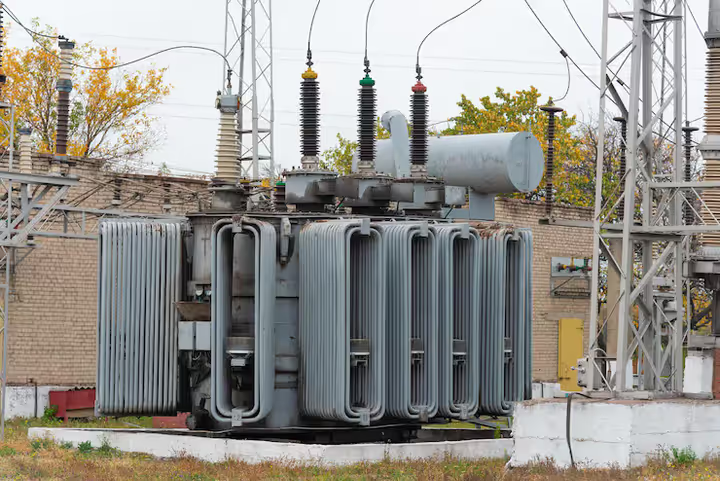
Enabling voltage transformation (from high transmission voltages to lower distribution levels) so electricity can travel long distances efficiently and be used safely locally.
-
Ensuring reliability and continuity of power supply through protective equipment, fault isolation and switching.
-
Supporting integration of renewables and distributed energy resources, which impose new requirements on grid equipment.
-
Enhancing grid stability and safety for people, property and the environment through modern monitoring and control.
Recent Updates
In recent years there have been notable trends and changes:
-
The global automation of electric power substations (substation-automation market) is projected to grow from an estimated USD 23.9 billion in 2024 to USD 25.3 billion in 2025, with further growth to about USD 31.4 billion by 2029.
-
In 2025, the substation automation market is estimated at USD 44.26 billion and expected to reach USD 72.95 billion by 2032—showing strong growth in intelligent electronic devices, communication networks, and SCADA systems.
-
Key technology trends for 2025 include increased adoption of smart grid technologies, IoT sensors in substations, data analytics and heightened cybersecurity measures.
-
In India, for example, a pilot is underway in the state of Andhra Pradesh (October 2025) to make substations unmanned using SCADA and remote control systems.
Laws or Policies
In India, substation equipment and operations are influenced by a number of regulations and policies that ensure safety, reliability and grid-integrity:
-
The Electricity Act, 2003 (Act No. 36 of 2003) sets out the framework for generation, transmission, distribution, trading and use of electricity.
-
The Central Electricity Authority (CEA) issues regulations such as the “Central Electricity Authority (Indian Electricity Grid Code) Regulations, 2023” which apply to substations, transmission and grid operation.
-
The CEA also publishes guidelines for the design, installation and operation of high-voltage substations (e.g., “General Guidelines for 765/400/220/132 kV Sub-Station & Switchyard”).
-
The national electricity policy emphasises substation automation, SCADA deployment and grid modernisation, stating that installation of substation automation equipment should be done in a time-bound manner.
Tools and Resources
Here are some tools and resources useful for learning about, designing or assessing substation equipment:
-
Online calculators for sizing power transformers and switchgear (searchable via engineering portals)
-
SCADA/PLC simulation software which helps simulate substation control and monitoring
-
Industry-guideline documents (e.g., CEA technical standards, IEEE standards) for specification and compliance
-
Training modules and webinars from electrical engineering associations covering substation design, protection systems and automation
-
Condition-monitoring platforms and dashboards that utilities use to monitor substation equipment health (often via IoT sensors)
-
Fault-diagnosis reports and case-studies on substation equipment failures, useful for learning preventive-maintenance best practices
FAQs
Q1: What major types of equipment are found in a power substation?
A1: Key types include transformers (to raise or lower voltages), circuit breakers and switches (to control and isolate circuits), busbars (conductors for power distribution within a substation), protection relays, insulators, disconnectors, surge arresters and control/communication systems.
Q2: Why is automation increasingly important for modern substations?
A2: Automation enables remote monitoring, predictive maintenance (via sensor-data and analytics), faster fault-detection and isolation, better integration of renewables and distributed energy resources, and improved overall grid reliability and efficiency.
Q3: What risks are associated with substation equipment?
A3: Risks include equipment failure or aging, overloads, electrical faults (short circuits, arcing), inadequate protection, cybersecurity threats (for digitised substations), and inability to integrate new generation sources smoothly. Effective equipment design, protection, maintenance and compliance reduce these risks.
Q4: How does renewable energy integration affect substation equipment?
A4: Renewable sources such as wind and solar are variable and often located away from traditional grid centres. Substations must handle fluctuating power flows, bidirectional flows (in distributed generation), and maintain voltage & frequency stability. This requires more advanced equipment, monitoring and control.
Q5: What factors should one consider when evaluating substation equipment performance?
A5: Consider equipment health (age, condition, maintenance history), load capacity vs utilisation, flexibility for future expansion, automation/monitoring capability, compliance with relevant standards, protection and communication systems, and alignment with grid modernisation goals.
Conclusion
Understanding power substation equipment is essential for grasping how electricity is transformed, transmitted and distributed reliably. As electricity demand grows and grids evolve with digitisation and renewable integration, the role of substations and their equipment becomes even more critical. With evolving technologies, updated regulations and improved tools, stakeholders—from utilities to engineers—have the opportunity to enhance grid resilience, efficiency and safety. Keeping informed about the latest trends, standards and practices in substation equipment will support better decision-making in this vital infrastructure domain.