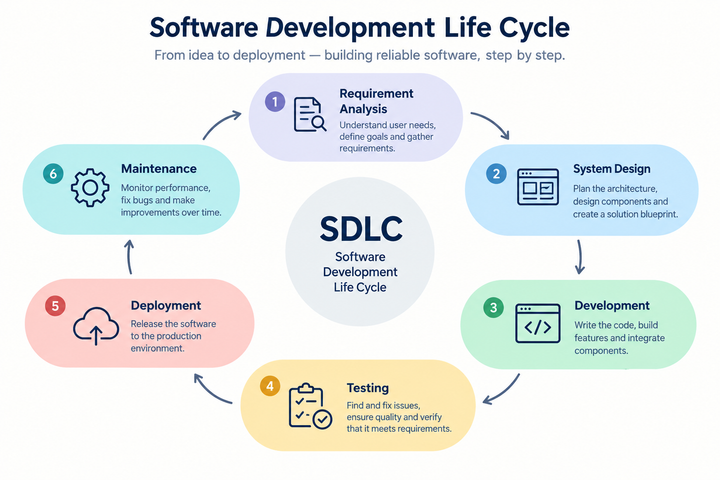
The Software Development Life Cycle is more than just writing code. It includes planning, gathering requirements, designing the system, developing features, testing functionality, deploying the software, and maintaining it after launch. Following a well-defined SDLC helps reduce errors, manage budgets, improve collaboration, and deliver software that meets user expectations.
As software becomes increasingly important in industries such as healthcare, finance, education, manufacturing, retail, and artificial intelligence, understanding SDLC has become essential for businesses, students, developers, and technology professionals.
What Is the Software Development Life Cycle?
The Software Development Life Cycle is a systematic framework used to develop software from the initial idea to long-term maintenance. It divides software creation into multiple stages, ensuring every phase has clear objectives before moving to the next.
Instead of building software without planning, SDLC provides a roadmap that guides the entire development team. Each stage produces outputs that become inputs for the next stage, making the development process organized and easier to manage.
The goal of SDLC is to create software that is functional, secure, scalable, maintainable, and aligned with business requirements while minimizing risks and development delays.
Why the Software Development Life Cycle Matters Today
Modern software projects are becoming more complex. Applications often serve millions of users across multiple devices and cloud platforms. Without a structured development process, projects may face delays, budget overruns, security vulnerabilities, or performance issues.
SDLC helps organizations improve software quality by identifying problems early instead of after release. It also creates better communication between technical teams and business stakeholders, ensuring everyone understands project goals.
Businesses rely on SDLC because it improves planning, resource allocation, documentation, testing, and long-term software maintenance. For users, it results in applications that are more reliable, easier to use, and updated regularly with new features and security improvements.
The Main Stages of the Software Development Life Cycle
The Software Development Life Cycle typically consists of several connected stages. While different organizations may adapt the process, the overall structure remains similar.
Planning and Requirement Analysis
The first stage focuses on understanding why the software is needed and what problems it should solve. Business goals, target users, technical requirements, timelines, and available resources are discussed during this phase.
Project managers, analysts, developers, and stakeholders collaborate to define the software's purpose and expected functionality. This stage also identifies potential risks, project scope, and estimated development effort.
Clear requirements reduce misunderstandings later in development and help create realistic project expectations.
System Design
Once requirements are finalized, the software architecture is designed. Developers and architects determine how different components will interact, how databases will be structured, what technologies will be used, and how users will interact with the application.
This stage includes both high-level architecture and detailed design documents. User interface layouts, workflows, APIs, security mechanisms, and infrastructure planning are also prepared.
A strong design improves scalability, performance, and future maintenance.
Software Development
The development stage transforms design documents into working software. Developers write code based on project requirements using programming languages, frameworks, libraries, and development tools.
Teams often divide work into modules or features so multiple developers can work simultaneously. Version control systems help manage code changes while ensuring collaboration remains organized.
This stage also includes code reviews, internal testing, and documentation to maintain coding quality.
Testing and Quality Assurance
Testing ensures the software works correctly before users interact with it. Quality assurance teams verify functionality, usability, security, compatibility, and performance.
Different testing methods identify bugs, validate business requirements, and ensure software behaves consistently across environments and devices.
Testing helps reduce production issues and improves user satisfaction before deployment.
Deployment
Deployment is the process of releasing software into a production environment where users can access it. Depending on project requirements, deployment may happen gradually or all at once.
Teams configure servers, cloud environments, databases, monitoring systems, and backup strategies before launching the application.
Deployment also includes validating that the live environment functions as expected after release.
Maintenance and Continuous Improvement
Software development does not end after deployment. Maintenance includes fixing bugs, improving security, adding new features, optimizing performance, and ensuring compatibility with changing technologies.
User feedback, analytics, and monitoring tools help development teams identify areas for improvement. Regular updates keep software secure and useful over time.
Popular Software Development Life Cycle Models
Different projects require different SDLC approaches. Several models are commonly used depending on project size, complexity, and business needs.
SDLC Model | Best Used For |
| Waterfall Model | Projects with clearly defined requirements and sequential development stages. |
| Agile Model | Projects requiring continuous collaboration, flexibility, and frequent updates. |
| Scrum Framework | Teams delivering software in short development cycles called sprints. |
| Spiral Model | Large projects with higher technical or business risks. |
| V-Model | Projects emphasizing testing alongside every development phase. |
| DevOps Lifecycle | Organizations combining development, testing, deployment, and operations into continuous delivery pipelines. |
Modern organizations often combine Agile practices with DevOps automation to accelerate software delivery.
Agile SDLC and Why It Is Widely Used
Agile has become one of the most popular software development approaches because it focuses on adaptability and continuous improvement.
Instead of completing the entire project before releasing it, Agile divides development into smaller iterations called sprints. Each sprint delivers working functionality that users or stakeholders can review.
This approach helps teams respond quickly to changing business requirements and user feedback. It also encourages collaboration between developers, testers, designers, and product owners throughout development.
Agile supports continuous planning, faster releases, better communication, and incremental software improvements.
SDLC in Modern Software Development
Today's software development environment includes cloud computing, artificial intelligence, automation, cybersecurity, and continuous integration. As a result, SDLC has evolved beyond traditional development methods.
Modern SDLC often includes automated testing pipelines, cloud deployment, infrastructure as code, container technologies, monitoring systems, and continuous integration and continuous deployment workflows.
Development teams use collaboration platforms, project management tools, version control repositories, and automated build systems to improve productivity and software quality.
These practices enable organizations to release updates more frequently while maintaining stability and security.
Benefits of Following the Software Development Life Cycle
A structured Software Development Life Cycle provides long-term advantages for organizations and development teams.
It improves project planning by defining goals, timelines, responsibilities, and technical requirements before coding begins. Better planning reduces unexpected delays and resource conflicts.
SDLC also improves software quality because testing and reviews occur throughout development instead of only at the end. Security considerations can be integrated early, reducing vulnerabilities after deployment.
Another important benefit is easier maintenance. Well-documented software architecture, code standards, and testing practices make future updates simpler and more reliable.
For businesses, SDLC supports predictable project management, better collaboration, improved customer satisfaction, and reduced development risks.
Common Challenges During the SDLC Process
Although SDLC provides structure, software projects still face challenges that teams need to manage carefully.
Changing business requirements during development can affect timelines and priorities. Poor communication between stakeholders and developers may create misunderstandings about project expectations.
Technical debt can accumulate if development teams prioritize speed over code quality. Inadequate testing may allow bugs or security issues into production environments.
Integration with third-party services, legacy systems, or cloud infrastructure may also increase project complexity.
Successful teams continuously review project progress, maintain documentation, and encourage collaboration across departments to overcome these challenges.
Best Practices for an Effective Software Development Life Cycle
Successful software projects follow consistent development practices throughout the SDLC.
Clear requirement documentation helps everyone understand project objectives before development begins. Regular communication keeps stakeholders informed about progress and changing priorities.
Version control systems protect code history and enable collaborative development. Automated testing identifies issues early, while continuous integration ensures new code integrates safely into existing systems.
Security should be considered throughout the lifecycle rather than only before deployment. Monitoring applications after release helps teams identify performance issues and user experience improvements.
Continuous learning, documentation, and retrospective meetings help teams improve future development cycles.
Recent Software Development Trends in 2025–2026
Software development continues to evolve with new technologies and development methodologies.
Artificial intelligence is assisting developers with code generation, testing, debugging, and documentation. AI-powered development tools help automate repetitive programming tasks while improving productivity.
Cloud-native development is becoming the standard for scalable applications. Organizations increasingly build software using containers, microservices, serverless computing, and managed cloud infrastructure.
DevSecOps integrates security into every stage of software development instead of treating it as a separate process. This helps identify vulnerabilities earlier.
Low-code and no-code platforms continue to grow for business applications, allowing faster application development while professional developers focus on more complex systems.
Observability, application monitoring, and performance analytics are also becoming essential parts of software maintenance in modern SDLC workflows.
Who Uses the Software Development Life Cycle?
The Software Development Life Cycle is used across nearly every industry that develops or manages software.
Technology companies use SDLC to build websites, mobile applications, cloud services, and enterprise platforms. Financial institutions use structured development processes for secure banking systems and payment platforms.
Healthcare organizations rely on SDLC for medical software, electronic health records, and telemedicine applications. Educational platforms use it to build learning management systems and virtual classrooms.
Manufacturing companies develop industrial automation software, robotics systems, and monitoring applications using SDLC principles.
Government organizations, startups, e-commerce businesses, logistics providers, and cybersecurity companies also depend on SDLC to manage software projects efficiently.
The Future of the Software Development Life Cycle
The future of SDLC focuses on faster delivery, higher automation, stronger security, and greater collaboration.
Artificial intelligence will continue supporting software design, testing, documentation, and code reviews. Automation will reduce manual deployment and infrastructure management tasks.
Cloud-native architectures will become more common as organizations build scalable and distributed applications. Security will remain integrated into every development phase through DevSecOps practices.
Data-driven development, real-time monitoring, predictive analytics, and continuous feedback will help teams improve software after release.
As software becomes more connected with AI, Internet of Things devices, and edge computing, SDLC will continue evolving to support increasingly complex digital ecosystems.
Frequently Asked Questions
What is the Software Development Life Cycle?
The Software Development Life Cycle is a structured process for planning, designing, developing, testing, deploying, and maintaining software applications.
Why is SDLC important in software development?
SDLC improves software quality, reduces development risks, enhances collaboration, supports better planning, and ensures applications meet business and user requirements.
What are the main stages of SDLC?
The primary stages include planning, requirement analysis, system design, development, testing, deployment, and maintenance.
What is the difference between SDLC and Agile?
SDLC is the overall framework for software development, while Agile is one development methodology that follows iterative and collaborative development within the SDLC framework.
Which SDLC model is most commonly used today?
Many organizations use Agile combined with DevOps practices because they support continuous development, testing, deployment, and faster software updates.
Conclusion
The Software Development Life Cycle (SDLC) is the foundation of modern software engineering. It provides a clear framework that guides software projects from initial planning through deployment and long-term maintenance. Whether developing a small mobile application or a large enterprise platform, following a structured SDLC helps teams create reliable, secure, and scalable software.
As software development continues evolving with cloud computing, artificial intelligence, DevOps, and automation, SDLC remains an essential methodology for managing complexity while delivering value to users. Understanding its stages, models, best practices, and emerging trends enables businesses and developers to build software that is adaptable, maintainable, and prepared for future technological changes.