Soft Gelatin Encapsulation Machines: Guide to Equipment, Processes, and Insights
Soft Gelatin Encapsulation Machines are industrial systems used to produce soft gelatin capsules by forming a gelatin shell around a measured fill material. These capsules are commonly used for pharmaceutical products, nutritional formulations, supplements, and selected other products that are suitable for encapsulation.
Unlike hard-shell capsules, soft gelatin capsules are generally formed, filled, and sealed during the same manufacturing sequence. The United States Food and Drug Administration describes soft gelatin production as involving gel mass preparation, fill mixing, and encapsulation, with rotary-die equipment commonly used to form the capsules.
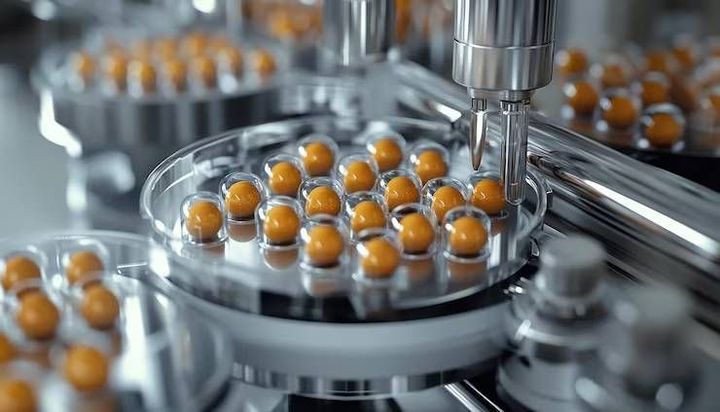
The equipment combines several controlled operations. Gelatin is prepared into a suitable mass, the fill material is prepared separately, thin gelatin ribbons are formed, and the fill is introduced between the ribbons before the capsule is shaped and sealed.
Main Parts of the Equipment
A softgel production line can contain several interconnected systems.
Gelatin preparation tanks heat, mix, and condition gelatin with water, plasticizers, colors, and other permitted ingredients according to the formulation.
Fill preparation tanks mix the liquid, suspension, or other suitable material that will be enclosed inside the capsule.
Gelatin ribbon systems transform the prepared gelatin mass into continuous ribbons with controlled thickness.
Rotary dies bring the gelatin ribbons together around the fill material while shaping individual capsules.
Fill pumps deliver a controlled quantity of fill between the gelatin ribbons.
Drying systems remove moisture from newly formed capsules under controlled conditions.
Inspection equipment can examine capsule shape, size, appearance, and selected physical characteristics.
Where Softgel Machines Are Used
Soft gelatin encapsulation is used in several manufacturing areas. Pharmaceutical production is one major application, while nutritional and supplement products can also use softgel formats.
The technology can accommodate suitable liquids, suspensions, and certain other formulations. WHO technical material describes soft capsules as generally being formed, filled, and sealed in one operation, while noting that liquids can be incorporated directly and solids may be dissolved or dispersed.
The precise equipment configuration depends on the formulation, capsule dimensions, production scale, required controls, and applicable regulatory framework.
Importance
Consistent Capsule Formation
One major purpose of Soft Gelatin Encapsulation Machines is to produce capsules with controlled dimensions and consistent fill quantities.
The gelatin ribbon must maintain suitable thickness and physical characteristics while the fill pump must deliver an appropriate quantity of formulation. Variations in these parameters can affect capsule weight, appearance, sealing, and downstream quality testing.
Controlled Filling
The filling mechanism is an important part of a softgel line. It must transfer the formulation into the developing capsule at a controlled rate and quantity.
FDA documentation identifies fill mixing and encapsulation as separate unit operations within soft gelatin manufacturing. Fill preparation can involve solutions, suspensions, or suitable dry materials depending on the formulation.
Efficient Manufacturing Workflow
A rotary-die system combines ribbon formation, filling, shaping, and sealing into a continuous sequence. This integrated arrangement can support large-scale production while reducing the need to perform each capsule-forming step separately.
The actual production rate depends on machine configuration, capsule dimensions, formulation characteristics, drying requirements, and operating parameters.
Quality Control
Softgel production requires control over several physical and chemical characteristics. Examples include capsule weight, fill weight, dimensions, appearance, moisture content, shell integrity, and dissolution-related properties.
GMP principles place strong emphasis on controlled processes, suitable equipment, documented procedures, and validation. WHO's 2024 GMP compendium specifically covers equipment validation and pharmaceutical quality systems.
Main Equipment Stages
| Equipment or Stage | Main Function | Important Control |
|---|---|---|
| Gelatin tank | Prepares shell material | Temperature and mixing |
| Vacuum system | Removes entrapped air | Vacuum level and time |
| Fill tank | Holds prepared formulation | Mixing and temperature |
| Fill pump | Transfers formulation | Fill quantity |
| Ribbon casting system | Forms gelatin ribbons | Ribbon thickness |
| Rotary die | Shapes and seals capsules | Die alignment |
| Dryer | Removes moisture | Temperature and humidity |
| Inspection system | Checks capsules | Appearance and dimensions |
| Sorting system | Separates selected capsules | Defect detection |
Recent Updates
Greater Process Automation
Modern softgel equipment increasingly incorporates automated controls for temperature, pressure, ribbon thickness, fill delivery, machine speed, and other operating parameters.
Automated monitoring can reduce dependence on manual adjustments and provide electronic records of selected production conditions. The degree of automation varies among equipment designs and manufacturing facilities.
Digital Monitoring
Connected production equipment can collect information from sensors and controllers during manufacturing. Data can be used to monitor machine conditions, identify process deviations, and support investigations.
This trend is part of the broader movement toward digitally connected pharmaceutical manufacturing. However, computerized systems used in regulated production must be appropriately controlled, documented, and validated.
Advanced Inspection Systems
Machine vision and automated inspection can examine capsules for visible defects, shape irregularities, color differences, surface problems, and other characteristics that can be detected optically.
Automated inspection can process large quantities of capsules consistently, while human review and laboratory testing remain relevant for characteristics that cannot be determined through visual inspection alone.
Improved Process Control
Modern encapsulation systems can integrate sensors and control systems to maintain operating parameters within defined ranges.
Examples include monitoring gelatin temperature, ribbon thickness, fill temperature, pump operation, drying conditions, and equipment status. Maintaining stable conditions can help reduce variation between production batches.
Continuous Manufacturing Developments
Pharmaceutical manufacturing is increasingly examining continuous processing and integrated production approaches. In June 2026, WHO published guidance addressing points to consider in continuous manufacturing of pharmaceutical products.
Softgel production is not automatically a continuous pharmaceutical process simply because a rotary-die machine operates continuously. Integration depends on the complete manufacturing design, formulation, controls, and regulatory strategy.
Digital and AI-Based Manufacturing
Artificial intelligence and machine-learning technologies are increasingly being considered for pharmaceutical manufacturing, particularly for monitoring, data analysis, anomaly detection, and process control.
The European Commission has consulted on proposed GMP provisions concerning artificial intelligence and machine learning in pharmaceutical manufacturing. The draft approach emphasizes intended use, model validation, training data, performance monitoring, change control, and human review.
Laws or Policies
WHO Good Manufacturing Practices
WHO GMP principles provide an international reference for pharmaceutical manufacturing. They emphasize suitable premises, equipment, materials, documented procedures, validation, quality control, and risk management.
WHO guidance states that production equipment should be appropriately designed, installed, qualified, operated, cleaned, and maintained for its intended purpose. It also emphasizes maintaining equipment in a qualified state throughout its lifecycle.
United States FDA Requirements
Manufacturers supplying products regulated in the United States must follow applicable FDA requirements. FDA process-validation guidance describes a lifecycle approach to validating pharmaceutical manufacturing processes, including process design, qualification, and continued process verification.
FDA's manufacturing-equipment guidance also identifies soft gelatin capsule operations such as gel mass preparation, fill mixing, and encapsulation as relevant manufacturing equipment categories.
European Union GMP
The European Union uses EudraLex Volume 4 for GMP requirements covering medicinal products. Its framework includes requirements related to premises and equipment, documentation, production, quality control, and qualification and validation.
EU GMP Annex 15 addresses qualification and validation, including design qualification, installation qualification, operational qualification, performance qualification, and process validation.
Equipment Cleaning and Validation
Cleaning is particularly important when equipment is used for different formulations. Residues from previous production runs can create contamination risks if cleaning procedures are not properly designed and controlled.
EU GMP Annex 15 states that cleaning procedures should be validated to demonstrate that equipment is suitable for pharmaceutical processing after cleaning.
Global Regulatory Differences
Although WHO, FDA, European Union, and other regulatory frameworks share many GMP principles, individual jurisdictions can have additional requirements.
Manufacturers therefore need to identify the regulations applicable to the destination market, product classification, manufacturing site, equipment, and formulation.
Tools and Resources
Gelatin Preparation Systems
These systems control mixing, heating, holding, and conditioning of the gelatin mass before ribbon formation. Vacuum capabilities can also be incorporated to reduce entrapped air.
Fill Mixing Systems
Fill tanks and mixers prepare the material that enters the capsule. Agitation may be required to maintain uniformity when a suspension contains dispersed particles.
Rotary-Die Encapsulation Systems
The rotary-die machine is the central forming unit in many softgel production lines. It brings gelatin ribbons together, introduces the fill, forms the capsule, and seals the edges.
Drying Equipment
Freshly formed capsules contain moisture that must be reduced under controlled conditions. Drying systems may use controlled air movement, temperature, humidity, and time to achieve the required shell characteristics.
Inspection and Measurement Tools
Manufacturing facilities can use balances, thickness measurements, dimensional checks, vision systems, moisture analysis, and laboratory testing to monitor capsule characteristics.
Validation Documentation
Important documentation can include equipment qualification records, process-validation protocols, cleaning-validation records, calibration records, operating procedures, maintenance records, batch documentation, and deviation records.
WHO's GMP framework emphasizes documented validation and qualified equipment as important elements of pharmaceutical manufacturing.
International Regulatory Resources
Manufacturers and technical teams can consult resources from organizations such as WHO, FDA, the European Commission, and relevant pharmacopoeias.
WHO's 2024 tenth-edition GMP compendium provides a broad international reference covering pharmaceutical manufacturing and quality assurance.
FAQs
What are Soft Gelatin Encapsulation Machines?
Soft Gelatin Encapsulation Machines are industrial systems that form gelatin shells around measured fill materials and seal the resulting capsules. Rotary-die systems are commonly associated with this process.
How do Soft Gelatin Encapsulation Machines work?
Soft Gelatin Encapsulation Machines generally prepare gelatin ribbons, introduce a measured fill between the ribbons, shape the capsule through dies, seal it, and transfer the newly formed capsules toward controlled drying.
What materials are used in softgel capsule production?
The shell generally contains gelatin, water, and suitable plasticizing materials, with other permitted components depending on the formulation. The fill can be a liquid, solution, suspension, or another formulation compatible with softgel production.
What industries use soft gelatin encapsulation equipment?
Pharmaceutical, nutritional, supplement, and selected other formulation industries can use soft gelatin encapsulation equipment. The exact application depends on the formulation and applicable regulatory requirements.
Why is validation important for softgel equipment?
Validation helps demonstrate that equipment and manufacturing processes can operate consistently within defined requirements. GMP frameworks from WHO, FDA, and the European Union place significant emphasis on qualification, validation, documentation, and controlled manufacturing processes.
Conclusion
Soft Gelatin Encapsulation Machines integrate gelatin preparation, ribbon formation, filling, capsule shaping, sealing, and drying into a controlled manufacturing workflow. Modern systems increasingly use automated controls, sensors, digital monitoring, and automated inspection to improve process visibility and consistency. Worldwide pharmaceutical manufacturing is governed by GMP principles, with organizations such as WHO, FDA, and the European Commission providing important regulatory frameworks. Understanding the equipment, production stages, validation requirements, and international standards helps explain how softgel manufacturing systems operate within modern pharmaceutical production.