Pallet Wrapping Machines: Complete 2026 Guide
Pallet wrapping machines are industrial packaging systems designed to apply stretch film around palletized products.
The wrapping process helps hold cartons, containers, bags, and other packaged goods together during handling, storage, and transportation.
Modern pallet wrapping machines range from basic turntable systems to fully automatic equipment integrated with conveyors and warehouse packaging lines. Machine selection depends on pallet dimensions, load characteristics, production volume, film specifications, and automation requirements.
Why Pallet Wrapping Machines Matter
Palletized loads can shift during movement if individual products are not adequately stabilized. Stretch film creates a continuous layer around the load, helping keep products together and reducing movement.
Machine-controlled wrapping also provides greater consistency in film tension, overlap, wrapping height, and the number of film layers.
Important considerations include:
- Pallet dimensions
- Load height
- Load weight
- Product arrangement
- Film characteristics
- Wrapping speed
- Required film tension
- Production volume
- Automation level
- Available floor space
How Pallet Wrapping Machines Work
Most pallet wrapping machines follow a sequence of load positioning, film attachment, wrapping, tension control, and film cutting.
1. Load Positioning
The products are arranged on a pallet according to the required load configuration. The load should remain within the pallet footprint to support stable wrapping.
The machine may use sensors to detect pallet position, height, or dimensions.
2. Film Loading
Stretch film is mounted on the machine's film carriage. Depending on the machine design, the film can pass through mechanical or powered pre-stretch rollers.
These rollers elongate the film before it reaches the pallet and help regulate film tension.
3. Film Attachment
At the beginning of the wrapping cycle, the stretch film is attached to the pallet or lower portion of the load.
Manual systems may require an operator to secure the film, while automatic machines can perform this step using automated film-handling mechanisms.
4. Wrapping Cycle
The machine begins moving the film around the load.
In a turntable system, the pallet rotates while the film carriage travels vertically. In a rotary arm machine, the pallet remains stationary while the film carriage rotates around it.
5. Tension and Pre-Stretch Control
Controlled tension allows the film to remain in contact with the load.
Machines may use adjustable brakes or powered pre-stretch systems to regulate film elongation and wrapping force.
The correct setting depends on the film and load characteristics.
6. Wrapping Pattern
The machine can apply different wrapping patterns depending on the load.
Parameters may include:
- Bottom wraps
- Top wraps
- Film overlap
- Vertical carriage speed
- Film tension
- Pre-stretch ratio
- Wrapping speed
7. Film Cutting and Securing
After the programmed wrapping cycle is complete, the film is cut and secured.
Automatic machines may perform cutting, film attachment, and sealing without requiring manual intervention.
Types of Pallet Wrapping Machines
Turntable Pallet Wrappers
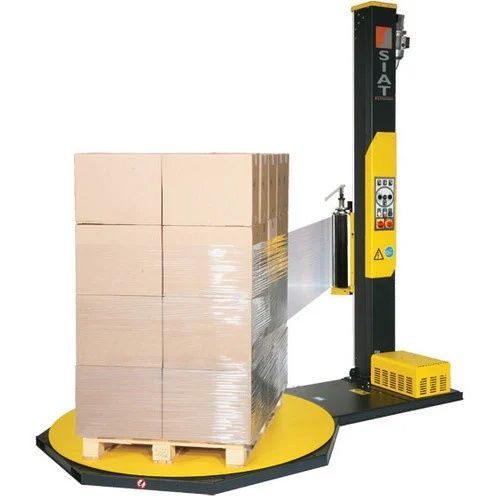
Turntable machines rotate the pallet on a circular platform while the film carriage moves vertically.
They are commonly used for standard palletized loads and can accommodate a variety of product dimensions.
Rotary Arm Pallet Wrappers
Rotary arm machines keep the pallet stationary while a rotating arm moves around it.
This design can be useful for unstable, lightweight, or tall loads that may not be suitable for rotating platforms.
Rotary Ring Wrappers
Rotary ring machines use a rotating ring to carry the stretch film around the pallet.
They can be configured for continuous packaging lines and high-throughput operations.
Automatic Pallet Wrapping Machines
Automatic systems can integrate pallet conveying, load detection, film application, cutting, and discharge.
They are suitable for production environments where pallets move continuously between different packaging stages.
Mobile Pallet Wrappers
Mobile wrapping machines travel around stationary palletized loads.
They can be useful for large or irregular loads that are difficult to position on a fixed wrapping platform.
Main Components of Pallet Wrapping Machines
A typical pallet wrapping system can include several components.
| Component | Function |
|---|---|
| Film carriage | Holds and dispenses stretch film |
| Pre-stretch rollers | Elongate film before application |
| Turntable | Rotates pallet during wrapping |
| Rotary arm | Carries film around stationary loads |
| Mast | Guides vertical film movement |
| Tension control | Regulates film force |
| Sensors | Detect load position and height |
| Control panel | Sets wrapping parameters |
| Drive system | Controls machine movement |
| Film cutter | Cuts film at cycle completion |
Stretch Film Used With Pallet Wrapping Machines
Stretch film selection affects the performance of the wrapping system.
Important film characteristics include:
- Film thickness
- Width
- Stretch capability
- Tensile strength
- Puncture resistance
- Cling characteristics
- Pre-stretch compatibility
Machine settings should correspond to the film being used. Excessive tension can deform certain packages, while insufficient tension may provide inadequate load stabilization.
Pallet Wrapping Machine Comparison
| Machine Type | Load Movement | Typical Use |
|---|---|---|
| Turntable | Pallet rotates | Standard pallet loads |
| Rotary arm | Arm rotates around load | Unstable or tall loads |
| Rotary ring | Ring rotates around load | Continuous production |
| Automatic | Integrated movement | Automated packaging lines |
| Mobile | Machine moves around load | Large or irregular loads |
Factors to Consider When Selecting a Pallet Wrapping Machine
Load Size and Weight
Measure pallet length, width, maximum height, and total load weight. These specifications determine the required machine dimensions and load capacity.
Load Stability
Unstable or irregular loads may require rotary arm or mobile systems instead of conventional turntable equipment.
Production Volume
High-volume operations may require automatic pallet handling, powered conveyors, automated film attachment, and integrated discharge.
Film Requirements
Consider film thickness, stretch ratio, puncture resistance, and pre-stretch requirements when configuring the machine.
Automation
Automation can include pallet detection, wrapping-cycle initiation, film cutting, load discharge, and integration with conveyors.
Installation Space
Consider machine footprint, pallet movement, operator access, film storage, and conveyor positioning before installation.
Applications of Pallet Wrapping Machines
Pallet wrapping equipment is used across a wide range of industries.
Common applications include:
- Food and beverage distribution
- Consumer goods
- Pharmaceutical logistics
- Automotive components
- Industrial manufacturing
- Building materials
- Agricultural products
- Warehouse operations
- Distribution centers
- E-commerce fulfillment
Frequently Asked Questions
What are pallet wrapping machines?
Pallet wrapping machines are automated or semi-automated packaging systems that apply stretch film around palletized products to help stabilize loads during handling, storage, and transportation.
How does a pallet wrapping machine work?
The machine applies stretch film around a pallet while controlling film tension, wrapping speed, overlap, and the number of film layers. Depending on the design, either the pallet or film carriage rotates.
What is a turntable pallet wrapper?
A turntable pallet wrapper uses a rotating platform to turn the pallet while a film carriage moves vertically around the load.
Which pallet wrapping machine is suitable for unstable loads?
Rotary arm systems can be appropriate for loads that may shift or become unstable when rotated on a turntable. The final configuration depends on load characteristics and production requirements.
What is pre-stretch film technology?
Pre-stretch technology uses rollers to elongate stretch film before it reaches the pallet. This allows the machine to control film tension and application characteristics.
Conclusion
Pallet wrapping machines provide a controlled method for applying stretch film around palletized loads. Turntable, rotary arm, rotary ring, automatic, and mobile configurations address different load characteristics and production environments.
For 2026 packaging operations, machine selection should consider pallet dimensions, load stability, production volume, film properties, automation requirements, and available installation space. Understanding these factors helps create a wrapping process that matches the characteristics of the products and packaging line.