Lighting Equipment Manufacturing: Processes, Machines & Technology
Lighting equipment manufacturing covers the design and production of products used to provide, distribute, control, and manage illumination.
The industry includes LED fixtures, commercial lighting systems, industrial luminaires, outdoor lighting, architectural products, and specialized lighting equipment.
Modern production combines electrical components, optical systems, thermal management, mechanical housings, control electronics, and automated assembly. Understanding the manufacturing process can help businesses evaluate production technologies, machinery, materials, and quality requirements.
What Is Lighting Equipment Manufacturing?
Lighting equipment manufacturing involves converting individual electrical, optical, and mechanical components into complete lighting products. Depending on the product, the manufacturing process can involve component preparation, circuit-board assembly, housing fabrication, LED integration, optical installation, wiring, testing, and final assembly.
Lighting products can be designed for different environments, including:
- Residential buildings
- Offices and commercial facilities
- Factories and warehouses
- Roads and public spaces
- Retail environments
- Hospitals and educational facilities
- Sports facilities
- Outdoor landscapes
- Architectural applications
Each application can require different brightness, beam distribution, environmental protection, energy performance, and control capabilities.
Types of Lighting Equipment
Lighting manufacturers produce numerous product categories based on application and technology.
LED Lighting Equipment
LED lighting has become a major category because LED technology supports efficient illumination, compact product designs, and extensive control options.
Common LED products include:
- LED panels
- LED downlights
- LED floodlights
- LED streetlights
- LED high-bay fixtures
- LED tube lights
- LED spotlights
- LED linear fixtures
- LED architectural lighting
LED lighting manufacturing typically requires careful integration of LED modules, drivers, thermal components, optics, and housings.
Commercial Lighting Equipment
Commercial lighting equipment is designed for offices, retail buildings, hospitality facilities, institutions, and other commercial environments.
Typical products include:
- Recessed lighting
- Panel lights
- Track lighting
- Linear lighting
- Pendant fixtures
- Emergency lighting
- Display lighting
- High-efficiency ceiling fixtures
Design priorities can include visual comfort, illumination uniformity, installation requirements, control compatibility, and long operating life.
Industrial Lighting Equipment
Industrial lighting equipment is designed for demanding environments such as factories, warehouses, workshops, and processing facilities.
Industrial fixtures may require:
- High light output
- Robust housings
- Heat management
- Dust protection
- Moisture resistance
- Impact resistance
- Wide operating-temperature ranges
High-bay and low-bay fixtures are common examples used for large indoor spaces.
Lighting Manufacturing Equipment and Machines
Lighting manufacturing equipment varies according to the product and production volume. Automated production facilities can use specialized machinery throughout the assembly process.
PCB Assembly Equipment
Many modern lighting products contain LED driver circuits or control boards. PCB production can involve:
- Solder paste printers
- Pick-and-place machines
- Reflow ovens
- Inspection systems
- PCB cleaning equipment
- Automated testing systems
These machines help assemble electronic components with controlled positioning and soldering processes.
Housing Manufacturing Equipment
Lighting housings can be manufactured from aluminum, steel, plastic, or other suitable materials. Production may involve:
- CNC machining equipment
- Sheet-metal forming machines
- Stamping equipment
- Injection molding machines
- Cutting systems
- Drilling equipment
- Bending machines
The selected process depends on the housing design, material, dimensional requirements, and production volume.
Assembly Equipment
Assembly stations combine electronic, optical, mechanical, and electrical components into completed fixtures.
Equipment may include:
- Automated screw-driving systems
- Wire processing machines
- Crimping equipment
- Adhesive dispensing systems
- Component placement equipment
- Automated assembly stations
Production lines may combine manual workstations with robotic or automated equipment.
Lighting Equipment Manufacturing Process
Although production varies by product, a typical manufacturing workflow can include several stages.
1. Component Preparation
LED modules, drivers, housings, reflectors, lenses, connectors, cables, fasteners, and other components are prepared for assembly.
2. Electronic Assembly
Driver circuits and control boards are assembled using PCB manufacturing and soldering processes where required.
3. Housing Production
The fixture housing is formed or machined according to the product design. Surface treatment may then be applied to improve appearance, durability, or corrosion resistance.
4. LED and Optical Assembly
LED modules, lenses, reflectors, diffusers, or optical components are positioned within the fixture.
Accurate placement is important because optical alignment affects light distribution and overall product performance.
5. Thermal Management
LED components generate heat that must be managed effectively. Heat sinks, thermal interface materials, ventilation structures, or other thermal solutions may be integrated into the fixture.
6. Electrical Assembly
Wiring, connectors, drivers, grounding components, and control interfaces are installed according to the product design.
7. Functional Testing
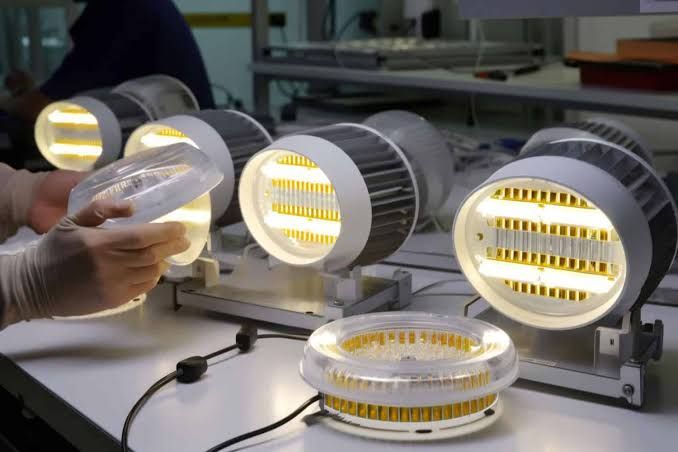
Completed fixtures can undergo electrical, optical, thermal, and functional testing before packaging and distribution.
Lighting Production Comparison
| Manufacturing Stage | Common Equipment | Main Purpose |
|---|---|---|
| PCB Assembly | Pick-and-place machines | Electronic component placement |
| Soldering | Reflow ovens | PCB soldering |
| Housing Production | CNC and forming machines | Fixture structure |
| Surface Treatment | Coating systems | Surface protection |
| Wiring | Wire processing equipment | Electrical connections |
| Assembly | Automated workstations | Component integration |
| Optical Testing | Photometric equipment | Light measurement |
| Electrical Testing | Test systems | Safety and functionality |
| Final Inspection | Vision systems | Quality verification |
Automation in Lighting Manufacturing
Automation is increasingly used in lighting production to improve consistency and process control. Automated equipment can handle repetitive activities such as component placement, screw fastening, soldering, dispensing, testing, and inspection.
Manufacturers can integrate:
- Robotic assembly
- Machine vision
- Automated screw fastening
- Digital production monitoring
- Programmable controllers
- Automated electrical testing
- Optical inspection
- Production data systems
Automation is particularly useful for high-volume production where repeatability and process monitoring are important.
Materials Used in Lighting Manufacturing
Material selection affects the durability, appearance, thermal performance, and environmental resistance of lighting products.
Aluminum
Aluminum is widely used for LED housings and heat sinks because it combines relatively low weight with good thermal conductivity.
Steel
Steel can be used for structural housings and mounting components where additional mechanical strength is required.
Plastics
Engineering plastics and other polymers may be used for diffusers, lenses, housings, connectors, and insulating components.
Glass
Glass can be incorporated into specialized lighting products where optical characteristics, heat resistance, or appearance are important.
The appropriate material depends on the fixture's application, operating environment, thermal requirements, and design specifications.
Quality Control in Lighting Equipment Manufacturing
Quality control is essential because lighting products combine electrical, optical, thermal, and mechanical components.
Manufacturers may evaluate:
- Electrical performance
- Light output
- Color characteristics
- Beam distribution
- Thermal behavior
- Insulation
- Mechanical strength
- Environmental resistance
- Component reliability
- Assembly accuracy
Photometric testing can help manufacturers evaluate characteristics such as luminous output and light distribution.
Electrical testing can identify wiring problems, insulation issues, driver abnormalities, and other potential defects.
Energy Efficiency and LED Technology
Energy efficiency is an important consideration in modern lighting design. LED technology can provide high illumination efficiency while allowing manufacturers to develop compact fixtures for different applications.
Efficiency depends on more than the LED itself. Driver performance, thermal management, optical design, fixture geometry, and control systems can all influence the overall performance of a lighting product.
Smart lighting systems can further improve operational efficiency through technologies such as occupancy detection, daylight sensing, scheduling, dimming, and centralized control.
Smart Lighting Manufacturing
Connected lighting has expanded the role of electronics within lighting equipment. Modern products may include wireless communication, sensors, digital controllers, and programmable lighting functions.
Smart lighting equipment can support:
- Remote monitoring
- Automated dimming
- Occupancy-based controls
- Daylight-based adjustment
- Scheduling
- Building-management integration
- Wireless configuration
- Energy monitoring
These features require manufacturers to integrate lighting hardware with appropriate electronic and communication technologies.
Factors to Consider When Selecting Lighting Manufacturing Equipment
Production facilities should evaluate machinery according to their specific product portfolio and manufacturing requirements.
Important factors include:
- Production volume
- Fixture dimensions
- Component complexity
- Material types
- Required automation level
- Machine precision
- Testing requirements
- Production-line footprint
- Maintenance requirements
- Integration with existing equipment
Manufacturers should also consider future product development. Flexible equipment can be useful when production lines need to accommodate multiple fixture designs or changing component configurations.
Common Challenges in Lighting Manufacturing
Lighting production can involve several technical challenges.
Thermal Management
Poor heat dissipation can affect LED performance and component reliability. Housing design and thermal interfaces therefore require careful engineering.
Electrical Reliability
Drivers, wiring, connectors, and circuit boards must operate reliably under the intended electrical conditions.
Optical Consistency
Small differences in LED placement, lens positioning, or diffuser installation can affect light distribution and visual uniformity.
Component Integration
Modern fixtures combine numerous components within limited spaces. Mechanical, electrical, thermal, and optical requirements must work together.
Production Consistency
Maintaining consistent assembly and testing procedures becomes increasingly important as production volumes increase.
Frequently Asked Questions
What is lighting equipment manufacturing?
Lighting equipment manufacturing is the process of producing lighting fixtures and related systems by integrating electrical, optical, mechanical, and thermal components.
What machines are used in LED lighting manufacturing?
Common equipment includes PCB assembly machines, reflow ovens, CNC machines, sheet-metal equipment, wire-processing systems, automated assembly equipment, and electrical testing systems.
What materials are commonly used for lighting fixtures?
Aluminum, steel, plastics, glass, and specialized electronic materials are commonly incorporated into lighting products depending on their application and technical requirements.
Why is thermal management important in LED lighting?
LED components and electronic drivers generate heat during operation. Effective thermal management helps maintain performance and supports component reliability.
How does automation affect lighting manufacturing?
Automation can improve assembly consistency, component placement, testing, inspection, production monitoring, and repeatability, particularly in higher-volume manufacturing environments.
Conclusion
Lighting equipment manufacturing combines mechanical engineering, electronics, optics, thermal management, and automated production technologies. From LED modules and drivers to housings, lenses, controls, and testing systems, each component contributes to the final performance of a lighting product.
Modern lighting production increasingly incorporates automation, smart controls, machine vision, digital testing, and advanced materials. Manufacturers that carefully align machinery, materials, assembly processes, and quality-control procedures can create lighting equipment suited to residential, commercial, industrial, architectural, and outdoor applications.
Understanding the manufacturing process and equipment categories provides a useful foundation for evaluating production technologies and developing reliable lighting products.