Lab-Grown Diamond Jewelry: Overview of Styles, Settings, and Useful Details
Lab-Grown Diamond Jewelry uses diamonds created through controlled technological processes rather than geological formation inside the Earth. These diamonds are made primarily through Chemical Vapor Deposition (CVD) or High Pressure High Temperature (HPHT) methods. Gemological research confirms that laboratory-grown diamonds have essentially the same chemical and physical characteristics as natural diamonds, although their growth history is different.
The diamonds can be cut and polished into many of the same shapes used in conventional diamond jewelry. They can then be placed into rings, earrings, necklaces, bracelets, pendants, and other designs.
The term “lab-grown” identifies the diamond's origin. It does not mean that the stone is a diamond imitation such as cubic zirconia or another material that only resembles diamond.
How Lab-Grown Diamonds Are Created
Two major technologies are used for gem-quality laboratory-grown diamonds.
CVD, or Chemical Vapor Deposition, grows diamond material from carbon-containing gas inside a controlled chamber. A diamond seed is exposed to the process, and carbon atoms gradually form additional diamond material. GIA notes that CVD diamonds can undergo additional treatment after growth to modify their color.
HPHT, or High Pressure High Temperature, uses high pressure and high temperature to recreate conditions that allow diamond crystals to form. The method uses carbon and a diamond seed within a specialized growth environment.
After growth, the rough diamond is cut, polished, graded, and prepared for jewelry mounting.
From Rough Stone to Jewelry
The general sequence is:
Growth: The diamond is produced using CVD or HPHT technology.
Cutting: Rough material is shaped into a selected diamond form.
Polishing: Facets are created and polished to interact with light.
Grading: Relevant characteristics such as color, clarity, cut, and carat weight can be assessed.
Setting: The polished stone is mounted into a metal jewelry design.
Identification: Documentation or laser inscription can identify laboratory-grown origin.
GIA reports for laboratory-grown diamonds can identify the growth method and indicate evidence of post-growth treatment where applicable.
Importance
Variety of Jewelry Styles
Lab-Grown Diamond Jewelry can be produced in many traditional and contemporary styles. The design depends on the diamond shape, metal, setting, number of stones, and overall arrangement.
Common categories include:
Engagement rings: Usually feature one central diamond, sometimes surrounded by smaller stones.
Stud earrings: Usually use one diamond in each earring with a compact setting.
Tennis bracelets: Use a continuous arrangement of diamonds along a flexible bracelet.
Pendant necklaces: Place a diamond or group of diamonds on a chain.
Diamond bands: Use several stones across part or all of a ring.
Halo designs: Place smaller diamonds around a central stone.
Three-stone designs: Combine three principal diamonds representing a specific visual arrangement.
Cluster designs: Group several diamonds together to create a larger visual pattern.
Understanding Diamond Shapes
Diamond shape refers to the outline or appearance of a polished stone, while “cut” can refer to the quality of the stone's proportions and facets.
Common shapes include:
Round: A circular outline with many facets and a traditional appearance.
Princess: A square or rectangular outline with pointed corners.
Emerald: A rectangular shape with step-cut facets that create a broad, open appearance.
Oval: An elongated rounded shape that can create a larger visual spread across the finger or setting.
Pear: A teardrop-shaped design combining rounded and pointed ends.
Marquise: An elongated shape with pointed ends.
Cushion: A square or rectangular outline with rounded corners.
Radiant: A rectangular or square shape with brilliant-style faceting.
Understanding the 4Cs
The traditional 4Cs are color, clarity, cut, and carat weight.
| Characteristic | What It Describes | Why It Matters |
|---|---|---|
| Color | Body color of the diamond | Influences visual appearance |
| Clarity | Internal and surface characteristics | Describes visible inclusions or marks |
| Cut | Proportions and facet arrangement | Influences light behavior |
| Carat weight | Weight of the diamond | Indicates physical weight |
The 4Cs describe the physical characteristics of a diamond rather than whether its origin is natural or laboratory-grown.
Recent Updates
Growth Technology Has Advanced
Laboratory-grown diamond production has developed substantially over the past two decades. GIA's 2024 research review documented increases in the quantity, size, and quality of laboratory-grown diamonds submitted for evaluation. It also reported that CVD products had become the dominant type among laboratory-grown diamonds submitted to GIA for grading reports.
At the same time, GIA noted that some aspects of laboratory-grown diamond technology have become relatively stable in recent years, while research continues into new colors, growth characteristics, and identification methods.
Identification Technology
Laboratory-grown and natural diamonds can be extremely difficult to distinguish through ordinary visual inspection because their optical and physical properties are very similar.
Professional gemological laboratories use advanced instruments and techniques to determine origin. GIA explains that identification can involve examining inclusions, growth patterns, reactions to ultraviolet light, spectroscopy, and other characteristics.
This is particularly important for jewelry containing numerous small diamonds, where individual stones may be difficult to examine manually.
Laser Inscription
Laboratory-grown diamonds evaluated by GIA can receive a laser inscription on the girdle identifying the stone as laboratory-grown along with its report or assessment number. This creates an additional identification reference that can be examined with magnification.
Expanding Indian Research
India has also been developing domestic capabilities related to laboratory-grown diamond technology. The Department of Commerce has reported an IIT Madras research and development project focused on CVD and HPHT systems, with a grant of ₹242.96 crore over five years. Government material also notes initiatives supporting domestic production of laboratory-grown diamond seeds and related machinery.
These initiatives are connected with India's broader diamond-processing, technology, research, and export ecosystem.
Laws or Policies
Indian Diamond Description Standards
India has introduced IS 19469:2025, titled Jewellery — Consumer Confidence in the Diamond Industry. The standard addresses descriptions, labeling, and advertising of diamonds and diamond-like products, including distinctions between natural, laboratory-grown, treated, composite, and imitation materials.
The standard emphasizes clear terminology so that the origin and nature of a diamond are not confused. This is particularly relevant for Lab-Grown Diamond Jewelry because the diamond's origin should be clearly identified.
Hallmarking of Jewelry Metals
Diamond origin and precious-metal purity are separate matters. In India, BIS hallmarking currently covers gold and silver jewelry, while the diamond itself is identified separately from the metal hallmark.
For hallmarked gold jewelry, BIS identifies three principal marks: the BIS Standard Mark, purity expressed through caratage and fineness, and a six-digit Hallmark Unique Identification number, or HUID.
Therefore, a gold ring containing a laboratory-grown diamond can have a hallmark relating to the gold while the diamond has separate documentation or identification relating to its origin.
Checking Hallmarked Jewelry
The BIS Care app includes a feature for verifying the HUID of hallmarked gold jewelry. BIS also advises consumers to obtain an authentic invoice containing relevant information about the hallmarked article.
This distinction is useful because a metal hallmark does not itself establish whether a mounted diamond is natural or laboratory-grown.
International Disclosure
In the United States, the Federal Trade Commission's Jewelry Guides state that laboratory-created diamonds should be clearly described as laboratory-grown, laboratory-created, or equivalent wording so that consumers understand they are not mined diamonds.
Rules and terminology can differ between countries, so international jewelry businesses need to follow the requirements applicable to the relevant market.
Tools and Resources
Diamond Grading Reports
A laboratory-grown diamond report can provide information about characteristics such as color, clarity, carat weight, and growth method. GIA's laboratory-grown diamond documentation can also identify whether the stone was created through CVD or HPHT and whether evidence of post-growth treatment was found.
Magnification Tools
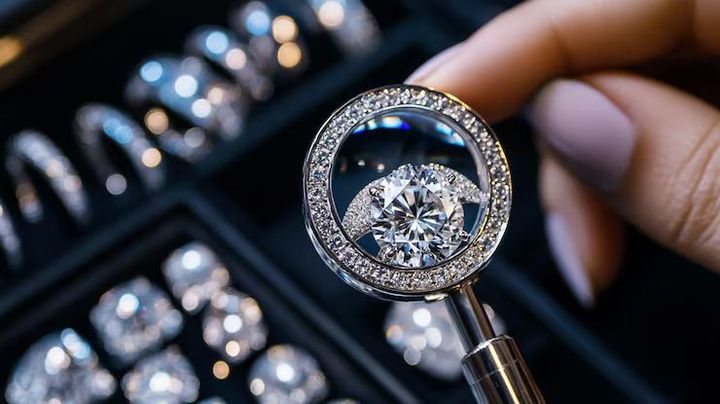
A jeweler's loupe or microscope can help examine facets, inclusions, inscriptions, and other visible characteristics. However, ordinary magnification alone cannot reliably establish whether a diamond is natural or laboratory-grown.
Gemological Testing
Advanced testing equipment can distinguish natural diamonds, laboratory-grown diamonds, and diamond simulants. GIA notes that definitive identification may require sophisticated instrumentation and laboratory examination.
BIS Care App
For applicable hallmarked gold jewelry in India, the BIS Care app can be used to verify the HUID associated with the hallmarked article. It can also provide access to information about Indian Standards.
Jewelry Design References
Design references can help compare settings, diamond shapes, metal colors, band widths, and stone arrangements. A useful comparison should consider the complete piece rather than focusing only on the central diamond.
Common Settings
Prong setting: Small metal claws hold the diamond in place while leaving much of the stone visible.
Bezel setting: A metal rim surrounds the edge of the diamond. It provides a more enclosed appearance.
Halo setting: Smaller diamonds surround the central stone.
Pavé setting: Small diamonds are placed closely together across a metal surface.
Channel setting: Diamonds sit within a channel formed by surrounding metal.
Three-stone setting: Three principal diamonds are arranged across the ring.
Tension-style setting: The design uses carefully engineered metal structures to hold the diamond while creating an appearance of suspension. Such designs require precise engineering and appropriate inspection.
FAQs
What is Lab-Grown Diamond Jewelry?
Lab-Grown Diamond Jewelry contains diamonds created through controlled CVD or HPHT processes rather than geological formation. The diamonds can be cut into many shapes and placed into rings, earrings, bracelets, necklaces, and other jewelry.
Are lab-grown diamonds real diamonds?
Gem-quality laboratory-grown diamonds are diamonds with essentially the same chemical and physical properties as natural diamonds. Their major distinction is their origin: they are created through technological processes rather than formed naturally in the Earth.
What settings are used for Lab-Grown Diamond Jewelry?
Common settings include prong, bezel, halo, pavé, channel, and three-stone settings. The appropriate setting depends on the diamond shape, design, metal, and intended use.
How can a lab-grown diamond be identified?
Identification generally requires specialized gemological testing because visual inspection cannot reliably distinguish laboratory-grown diamonds from natural diamonds. A laboratory report or appropriate screening and testing can provide additional evidence.
What should be checked in Lab-Grown Diamond Jewelry?
Useful details include the diamond's origin disclosure, grading documentation, growth method where documented, 4Cs information, metal purity, applicable hallmark information, setting construction, and any treatment disclosures.
Conclusion
Lab-Grown Diamond Jewelry combines technologically created diamonds with a wide range of traditional and contemporary jewelry designs. CVD and HPHT are the principal growth methods, while prong, bezel, halo, pavé, channel, and three-stone settings provide different visual and structural arrangements. Recent developments have improved production capabilities and identification technology, while India has introduced standards addressing clear diamond descriptions and consumer understanding. Examining both the diamond documentation and the precious-metal details provides a clearer picture of the complete jewelry piece.