Cheese Making Machines – Complete Guide to Types, Working Process, Benefits, and Applications
Cheese is one of the world's most widely consumed dairy products, and its production has evolved significantly with the help of modern technology. Cheese making machines have transformed traditional cheese production into a more efficient, hygienic, and consistent process. Whether producing soft cheese, hard cheese, mozzarella, cheddar, or specialty varieties, these machines help maintain quality while reducing manual labor.
Today, cheese making machines are used in small artisan dairies, medium-sized dairy businesses, and large industrial processing plants. They support different stages of production, from heating milk and adding cultures to curd cutting, stirring, draining, molding, and pressing.
This guide explains how cheese making machines work, their different types, key components, benefits, applications, maintenance practices, and recent developments shaping modern dairy manufacturing.
What Is a Cheese Making Machine?
A cheese making machine is specialized dairy processing equipment designed to automate or assist the cheese production process. It controls important production parameters such as temperature, mixing speed, coagulation time, and curd handling to ensure consistent cheese quality.
Unlike traditional manual methods, modern machines provide precise control throughout production, helping manufacturers create uniform cheese batches while maintaining food safety standards.
Cheese making machines can be compact units designed for small-scale dairy production or fully automated systems integrated into industrial dairy processing lines.
Why Cheese Making Machines Are Important Today
Growing demand for dairy products has increased the need for efficient and reliable cheese production equipment. Consumers expect consistent taste, texture, and quality, while producers need systems that improve productivity without compromising hygiene.
Modern cheese making machines help solve several production challenges. They reduce production time, minimize product waste, improve consistency between batches, and simplify cleaning through hygienic designs.
These machines are especially important because they support food-grade manufacturing environments where temperature control and sanitation play a major role in product quality and shelf life.
How the Cheese Making Process Works in a Machine
Cheese production follows a series of carefully controlled stages. A cheese making machine helps automate these stages while maintaining ideal processing conditions.
Milk Preparation
The process begins with fresh milk entering the processing vessel. The machine gently heats the milk to the required temperature depending on the cheese variety being produced.
Temperature sensors continuously monitor the heating process to prevent overheating and maintain optimal conditions for bacterial cultures.
Adding Starter Cultures and Rennet
Once the desired temperature is reached, starter cultures are added to begin fermentation. Rennet is then introduced to coagulate the milk proteins.
The machine provides gentle mixing so ingredients distribute evenly without damaging the milk structure.
Coagulation
During coagulation, milk transforms into a gel-like structure. The machine maintains stable temperature conditions while allowing the milk to set for a controlled period.
The coagulation stage determines the texture and moisture level of the final cheese.
Cutting the Curd
Special cutting blades divide the coagulated milk into small curd pieces. Different cheese varieties require different curd sizes.
Precise cutting helps control whey separation and influences cheese firmness.
Stirring and Cooking
The curds are stirred slowly while temperature may be gradually increased. This step removes moisture and develops the desired texture.
Automatic stirring prevents curds from sticking together or settling unevenly.
Whey Drainage
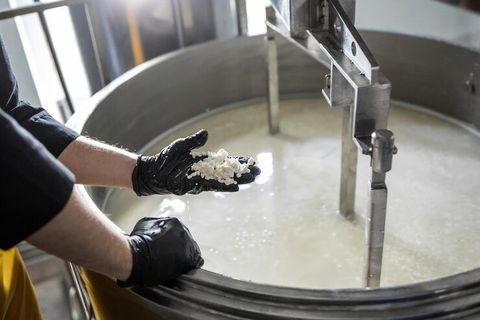
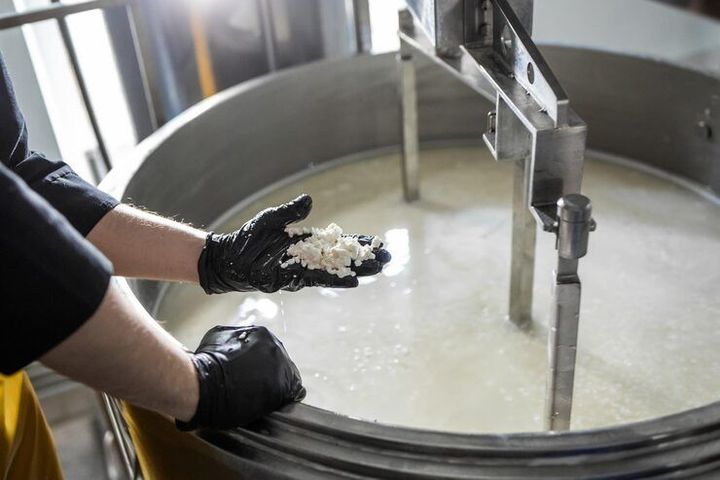
After cooking, whey is separated from the curds. Some machines include automatic drainage systems that remove whey while retaining the curds inside the processing tank.
Molding and Pressing
Curds are transferred into molds where they take their final shape. Pressing machines apply controlled pressure to remove additional whey and create a compact cheese structure.
Cooling and Aging Preparation
The finished cheese is cooled before packaging or transferred to aging rooms depending on the cheese type.
Main Types of Cheese Making Machines
Different cheese varieties require different production equipment. Manufacturers choose machines based on production capacity and cheese style.
Batch Cheese Making Machines
Batch systems produce one batch at a time and are commonly used in artisan and small commercial dairies.
These machines provide flexibility for producing multiple cheese varieties using the same equipment.
Continuous Cheese Making Machines
Continuous systems process milk without interruption, making them suitable for large industrial facilities.
They increase production efficiency and reduce downtime between batches.
Open Vat Cheese Making Machines
Open vat systems allow operators to observe curd formation directly during production.
These machines are often used for traditional cheese recipes requiring manual adjustments.
Closed Cheese Making Machines
Closed systems offer greater hygiene by minimizing exposure to the environment.
Automated controls improve consistency and reduce contamination risks.
Automated Cheese Production Systems
Fully automated systems combine milk heating, culture addition, curd cutting, whey removal, pressing, and cleaning into one integrated production line.
These systems are commonly used in large dairy manufacturing plants.
Key Components of a Cheese Making Machine
A cheese making machine contains several essential components that work together throughout production.
Component | Function |
| Processing vat | Holds milk during heating and coagulation. |
| Heating system | Maintains precise milk temperature. |
| Stirring mechanism | Mixes cultures and curds evenly. |
| Curd cutting knives | Cuts coagulated milk into uniform curds. |
| Temperature controller | Monitors and regulates processing temperature. |
| Drainage outlet | Removes whey efficiently. |
| Control panel | Allows operators to manage processing parameters. |
| CIP cleaning system | Supports automated internal cleaning. |
Each component contributes to product consistency and hygienic production.
Different Cheese Varieties Produced with Cheese Making Machines
Modern machines are versatile enough to produce many cheese types by adjusting processing conditions.
Soft cheeses require gentle coagulation and minimal pressing, while semi-hard cheeses need controlled heating and moderate pressing.
Hard cheeses require longer cooking and higher pressing pressure to remove moisture. Stretch-curd cheeses like mozzarella include additional stretching equipment after curd formation.
Specialty cheeses may require customized fermentation, molding, or aging preparation depending on traditional production methods.
Applications Across the Dairy Industry
Cheese making machines serve multiple sectors within dairy production.
Artisan Dairy Farms
Small farms use compact machines to produce handcrafted cheese with improved hygiene while preserving traditional recipes.
Commercial Dairy Processing Units
Medium-scale dairy businesses use automated systems to increase production capacity while maintaining consistent quality.
Industrial Cheese Manufacturing Plants
Large factories rely on continuous automated systems for high-volume production of packaged cheese products.
Educational and Research Facilities
Food technology institutes use cheese making equipment for dairy research, product development, and student training.
Specialty Cheese Producers
Manufacturers producing regional or premium cheeses use machines with flexible programming for different recipes.
Benefits of Using Cheese Making Machines
Cheese making machines improve nearly every aspect of dairy production.
They provide accurate temperature control, ensuring proper fermentation and coagulation. Automated mixing improves ingredient distribution and reduces manual effort.
Production becomes more consistent because every batch follows controlled processing conditions. Hygienic stainless-steel construction supports food safety and simplifies cleaning.
Automation also reduces labor-intensive tasks such as stirring, heating, and whey drainage while increasing production efficiency.
Another important benefit is scalability. The same production principles can be applied to small or large manufacturing operations by selecting appropriate equipment capacity.
Factors That Influence Cheese Quality During Machine Production
Several processing variables directly affect the final cheese.
Milk quality plays the most important role because protein and fat composition influence curd formation.
Temperature accuracy ensures bacterial cultures develop properly throughout fermentation.
Curd cutting size affects moisture removal and cheese texture. Stirring speed influences curd firmness without damaging delicate curds.
Pressing pressure controls density, while drainage efficiency determines moisture content.
Maintaining consistent processing conditions helps achieve predictable cheese flavor, texture, and appearance.
Cleaning and Hygiene in Cheese Making Equipment
Hygiene is essential in dairy manufacturing because cheese is highly sensitive to microbial contamination.
Modern cheese making machines are designed with smooth stainless-steel surfaces that resist bacterial buildup. Many systems include Clean-in-Place technology that circulates cleaning solutions through internal pipelines and tanks.
Routine cleaning includes rinsing milk residues, applying food-safe cleaning solutions, sanitizing processing surfaces, and inspecting valves and seals.
Proper hygiene helps maintain product quality, improve equipment lifespan, and comply with food manufacturing standards.
Routine Maintenance for Cheese Making Machines
Preventive maintenance keeps equipment operating efficiently and reduces unexpected downtime.
Operators should regularly inspect mixing paddles, cutting blades, temperature sensors, seals, valves, pumps, and drainage systems.
Lubrication of moving components should follow manufacturer recommendations for food-grade machinery.
Calibration of temperature controllers ensures accurate processing conditions during every production cycle.
Regular maintenance also improves production consistency and reduces equipment wear over time.
Choosing the Right Cheese Making Machine
Selecting suitable equipment depends on production requirements rather than simply choosing the largest machine.
Production capacity should match expected milk volume and future expansion plans.
Automation level depends on labor availability and production consistency requirements.
Material quality is important because food-grade stainless steel provides durability and hygienic performance.
Temperature control accuracy, cleaning features, energy efficiency, and compatibility with different cheese varieties should also be considered during equipment selection.
A well-matched machine supports efficient production while allowing flexibility for multiple cheese recipes.
Recent Developments in Cheese Making Technology (2025–2026)
The dairy equipment industry continues introducing smarter and more sustainable cheese production technologies.
Manufacturers are increasingly integrating digital temperature monitoring and programmable recipe management into cheese making systems. These features help operators maintain consistent production across different cheese varieties.
Energy-efficient heating systems have become more common as dairy processors focus on reducing energy consumption during milk processing.
Automated cleaning systems are also becoming more advanced, reducing water usage while improving sanitation.
Another growing trend is modular cheese production equipment, allowing dairy businesses to expand capacity gradually by adding processing modules instead of replacing entire production lines.
Data monitoring and production tracking have also improved, helping manufacturers record processing conditions for quality assurance and food safety documentation.
Sustainability in Modern Cheese Production
Sustainability has become an important focus in dairy manufacturing.
Modern cheese making machines are designed to reduce water and energy consumption while improving production efficiency.
Whey generated during cheese production is increasingly processed into valuable dairy ingredients instead of being discarded.
Efficient insulation, heat recovery systems, and automated cleaning cycles help reduce environmental impact while supporting responsible dairy processing practices.
Sustainable equipment design benefits both producers and long-term resource management.
Common Challenges During Cheese Production
Even with automated equipment, cheese production requires careful process control.
Inconsistent milk temperature can affect coagulation and texture.
Improper curd cutting may lead to uneven moisture distribution.
Insufficient stirring can create uneven curd formation, while excessive stirring may damage delicate curds.
Poor sanitation may affect product quality and reduce shelf life.
Regular monitoring, proper maintenance, and accurate processing settings help minimize these challenges.
The Future of Cheese Making Machines
Cheese making technology is moving toward greater automation, digital monitoring, and sustainable manufacturing. Future systems are expected to use intelligent sensors, recipe automation, predictive maintenance, and improved energy management to increase production efficiency while maintaining consistent cheese quality.
Growing consumer demand for specialty cheeses and high-quality dairy products is encouraging manufacturers to develop flexible equipment capable of producing a wider range of cheese varieties with minimal manual adjustments.
As dairy processing continues evolving, cheese making machines will play an increasingly important role in improving food safety, production efficiency, and product consistency across both traditional and industrial cheese manufacturing.
Conclusion
Cheese making machines have become an essential part of modern dairy production, combining traditional cheese-making principles with precise engineering and automation. They help control temperature, coagulation, curd cutting, stirring, whey separation, and pressing while maintaining hygienic production conditions.
From small artisan dairies to large industrial cheese factories, these machines improve consistency, reduce manual labor, and support efficient production of many cheese varieties. Advances in automation, energy efficiency, digital monitoring, and sustainable processing continue making cheese production more reliable and environmentally responsible.
Understanding how cheese making machines work, their different types, maintenance requirements, and applications helps dairy producers, food processing professionals, and anyone interested in modern dairy technology appreciate the role these systems play in delivering safe, consistent, and high-quality cheese products.