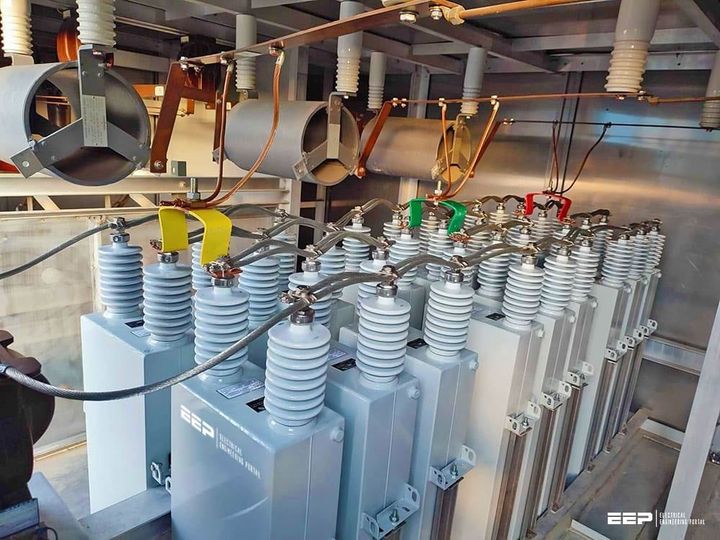
Capacitor Bank Explained: Discover Essential Knowledge, Benefits, and Technical Details
A capacitor bank is a group of capacitors connected in series and/or parallel and treated as a single unit in a power system. Capacitors store electrical energy in an electric field and release it when needed. In power distribution or industrial systems, capacitor banks are used primarily for managing reactive power, improving power factor, stabilising voltage, and reducing losses.
Modern AC-power systems contain many inductive loads such as motors, transformers, and HVAC systems that draw reactive power (kVAR) in addition to real power (kW). Without correction, reactive power leads to inefficiencies, higher line losses, poorer voltage regulation, and possibly extra charges from utilities. A capacitor bank provides leading reactive power (capacitive) which helps cancel out some of the lagging reactive power from inductive loads.
In short, capacitor banks exist to help electrical systems run more efficiently, reliably, and with better power quality.
Importance
Who it affects:
-
Industrial and commercial power users with large inductive loads (manufacturing plants, data centres, large buildings).
-
Utilities and distribution grid operators seeking to optimise transmission/distribution losses and voltage regulation.
-
Renewable-energy systems and grid operators integrating variable generation (solar, wind) requiring better reactive power support.
What problems it solves:
-
Improves power factor, i.e., the ratio of real power used for useful work to the total apparent power drawn. A low power factor means more current is required for the same useful work, increasing losses.
-
Reduces line losses and losses in transformers and cables by lowering the reactive current component.
-
Stabilises voltage levels, reducing under-voltage or over-voltage events.
-
In systems with variable loads or distributed generation (e.g., solar PV), helps maintain power quality and reactive power balance.
| Benefit | Description |
|---|---|
| Better power factor | Reduces the phase shift between current and voltage so more of the drawn power does useful work. |
| Lower losses | Less reactive current flow means less heat loss in conductors, transformers. |
| Voltage regulation | By injecting reactive power locally, voltage drops are mitigated. |
| Improved equipment life | Reduced burden on equipment (less overheating, fewer voltage fluctuations). |
| Grid support for renewables | Capacitor banks help compensate reactive power in systems with solar/wind generation. |
Given increasing industrialisation, electrification, growth of renewable energy, and stricter power-quality requirements, capacitor banks have become more relevant than ever.
Recent Updates
Recent developments show how capacitor bank technology and policies are evolving:
-
Market growth: The global low-voltage capacitor bank market was valued at about USD 534.6 million in 2024 and is projected to reach USD 741.3 million by 2034, growing steadily each year.
-
India’s market outlook: The Indian capacitor bank market is expected to grow at around 5% annually from 2025 to 2032, driven by industrial growth and energy-efficiency programs.
-
Guidelines: In July 2025, updated guidelines for low-tension capacitor bank installation on distribution feeders highlighted safety measures, discharge devices, and standard compliance such as IS 13340 for self-healing capacitors.
-
Automation trend: Many facilities now use Automatic Power Factor Correction (APFC) panels integrated with capacitor banks. These automatically adjust the reactive power compensation depending on the load, improving overall efficiency.
These updates show that capacitor banks are no longer static equipment; they are part of evolving, smarter power-management systems.
Laws or Policies
Rules and standards play a crucial role in how capacitor banks are used and maintained.
India:
-
The Bureau of Energy Efficiency (BEE) requires many industrial users to maintain a minimum power factor (often above 0.9). Consumers falling below thresholds may face penalties.
-
Under the Accelerated Power Development Programme (APDP), capacitor installation and replacement are key measures for distribution system strengthening.
-
Indian Standards such as IS 13340 (for self-healing capacitors) and IS 7752 (guidelines for power factor improvement) regulate equipment quality and installation practices.
-
Utility tariffs often include surcharges for low power factor, motivating industries to maintain efficient reactive power compensation systems.
Failure to comply with these regulations can lead to financial penalties and reduced system reliability. Proper design and maintenance ensure compliance, efficiency, and safety.
Tools and Resources
Professionals can use a range of resources and tools for capacitor bank design, analysis, and monitoring:
-
Reactive Power and Capacitor Sizing Calculators: Online tools help determine the kVAR required to raise the power factor from current to target levels.
-
APFC System Design Guides: Step-by-step documents showing how to combine automatic power factor correction with capacitor banks for dynamic load conditions.
-
BEE Publications: Guides and reports explaining methods for improving power factor and managing reactive power in industrial facilities.
-
Standards and Codes: IS 13340 and IS 7752 provide the basis for proper capacitor bank selection, installation, and safety practices.
-
Utility Installation Guidelines: State utilities publish rules for capacitor bank installation, maintenance, and inspection for both LT and HT systems.
Using these resources helps engineers and energy managers plan effective capacitor bank installations and maintain compliance with national standards.
FAQs
Q1: What is the difference between a fixed capacitor bank and an automatic capacitor bank?
A fixed capacitor bank supplies a constant amount of reactive power and remains connected permanently, ideal for steady loads. An automatic capacitor bank, often used with APFC systems, switches capacitor stages on or off depending on reactive power demand, keeping the power factor within a set range.
Q2: How do you size a capacitor bank for power factor correction?
The required capacitor kVAR can be calculated based on the difference between current and desired power factors, voltage, and load power. Engineers use simple formulas or online calculators to determine the appropriate rating, ensuring neither under- nor over-compensation.
Q3: Can installing a capacitor bank cause problems or failures?
Yes. Possible issues include resonance between the capacitor bank and system harmonics, poor maintenance leading to overheating, and inrush currents when energising large banks. Proper design, harmonic filters, and protection devices can prevent these problems.
Q4: Do capacitor banks store energy like batteries?
No. While capacitors store electrical energy, it’s for short durations and mainly for reactive power correction, not for long-term energy storage. Batteries store energy chemically and can deliver it over time, while capacitors respond instantly to voltage changes.
Q5: Why is power factor correction important in India?
Many utilities require industries to maintain power factors above 0.9. Low power factors cause inefficiency, increased current flow, and voltage drops. Maintaining the correct power factor reduces losses, improves voltage regulation, and avoids utility penalties.
Conclusion
Capacitor banks are essential components in electrical networks, ensuring efficient energy use, better power factor, and improved system stability. They help balance reactive power, reduce losses, and support grid reliability. As industrial power demand and renewable integration grow, capacitor banks remain crucial for energy-efficient operation.
Recent trends, regulatory frameworks, and technological advancements highlight the shift toward smarter, automated capacitor systems. Understanding how capacitor banks function, adhering to standards, and using modern tools for design and maintenance will ensure optimal performance and compliance.
Ultimately, capacitor banks play a quiet but critical role in the smooth functioning of modern electrical infrastructure — keeping power quality high, costs low, and systems reliable.