Autonomous Mobile Manipulators: Guide to Components, Functions, and Applications
Autonomous mobile manipulators are robotic systems that combine a mobile platform with a robotic arm and intelligent control technologies. Unlike stationary industrial robots that remain fixed in one location, these machines can move through a workspace and perform physical tasks using one or more robotic arms.
A typical system may include a wheeled mobile base, robotic manipulator, cameras, sensors, onboard computing hardware, and software for navigation and task control. This combination allows the robot to travel between work areas, identify objects, position its arm, and interact with equipment or materials.
The term “mobile manipulator” describes the physical combination of mobility and manipulation. “Autonomous” means that the system can perform at least part of its navigation or task sequence without continuous manual control.
How Autonomous Mobile Manipulators Work
An autonomous mobile manipulator generally follows a sequence of sensing, planning, movement, manipulation, and verification.
Sensing: Cameras, LiDAR, depth sensors, force sensors, and other devices collect information about the environment.
Mapping and localization: Software determines where the robot is and builds or uses a map of the workspace.
Navigation: The mobile base plans a path around equipment, people, obstacles, and other objects.
Object detection: Vision systems identify relevant objects, tools, containers, or workstations.
Manipulation: The robotic arm moves to the target and performs an assigned physical action.
Verification: Sensors or cameras check whether the task was completed correctly.
For example, in a warehouse, the robot may travel to a workstation, identify a container, use its robotic arm to grasp an item, and place it into another location.
Importance
Autonomous mobile manipulators are important because they combine two capabilities that have traditionally been separated: movement across a workspace and physical interaction with objects.
A fixed robotic arm can perform highly repeatable movements, but its working area is normally limited by its mounting position. A mobile robot can travel between locations, but a basic mobile platform may not have the ability to pick up, place, open, press, or manipulate objects.
Combining these capabilities creates a robotic platform that can move between multiple work areas and perform different physical operations.
Flexible Workspace Coverage
A mobile manipulator can potentially serve several stations instead of remaining permanently assigned to one location. This can be useful in environments where work areas change frequently.
The robot may navigate through aisles, production areas, laboratories, storage zones, or inspection locations depending on its design and safety requirements.
Support for Repetitive Physical Tasks
Some industrial and commercial environments contain repetitive tasks involving transportation, picking, inspection, machine interaction, or material handling.
Mobile manipulators can be designed to repeat predefined sequences while using sensors to adjust their movements to changing conditions.
Human-Robot Collaboration
Many modern robotic systems are designed to operate in environments where people are also present. Cameras, proximity sensors, safety scanners, force sensing, speed control, and other technologies can help the system detect surrounding conditions.
Actual collaborative operation depends on the robot's design, risk assessment, application, and applicable safety requirements.
Components
Mobile Base
The mobile base provides transportation for the entire robotic system.
Common configurations include:
Differential-drive platforms
Omnidirectional platforms
Four-wheel systems
Caster-supported platforms
Specialized industrial mobile bases
The choice depends on floor conditions, turning requirements, payload, speed, and workspace layout.
Robotic Manipulator
The robotic arm provides the physical manipulation capability.
Important characteristics include:
Number of joints
Reach
Payload capacity
Repeatability
Joint speed
End-effector compatibility
Range of motion
Six-axis arms are common because they can provide flexible movement around objects, although other configurations are also used.
End Effectors
The end effector is the device attached to the end of the robotic arm.
Examples include:
Vacuum grippers
Parallel grippers
Adaptive grippers
Magnetic tools
Welding tools
Inspection instruments
Screwdriving tools
Custom-purpose gripping mechanisms
The end effector must match the material, shape, weight, surface characteristics, and task requirements.
Vision and Perception Sensors
Vision systems help robots understand their surroundings.
Common technologies include:
RGB cameras
Stereo cameras
Depth cameras
LiDAR
Infrared sensors
3D vision systems
These sensors can support object detection, obstacle recognition, localization, navigation, and manipulation.
Force and Torque Sensors
Force and torque sensors allow the robot to detect physical interaction with objects.
For example, a robot opening a door or inserting a component may need to detect resistance and adjust its movement instead of continuing along a fixed path.
Computing System
The onboard computer processes sensor information and runs navigation, perception, planning, and control software.
More advanced platforms may use specialized processors for computer vision, machine learning, simulation, and real-time robotic control.
Power System
Batteries provide energy for the mobile platform, robotic arm, sensors, computers, and other equipment.
Battery capacity affects operating duration, payload, movement, charging requirements, and overall system design.
Functions
Autonomous mobile manipulators can perform a wide range of functions depending on their hardware and software.
| Function | Typical Activity | Example Environment |
|---|---|---|
| Material handling | Pick and place objects | Warehouse |
| Machine tending | Load or unload equipment | Factory |
| Inspection | Capture images or measurements | Production area |
| Assembly | Position and join components | Manufacturing |
| Picking | Identify and retrieve items | Logistics |
| Transport | Move materials between areas | Industrial facility |
| Laboratory handling | Move containers or equipment | Laboratory |
| Maintenance support | Manipulate selected components | Industrial plant |
Navigation and Localization
Navigation allows the mobile platform to move from one location to another.
Localization determines the robot's position within its environment. Technologies such as LiDAR, cameras, wheel encoders, inertial sensors, and mapping software may work together to provide positioning information.
Object Detection and Recognition
A mobile manipulator may need to identify the difference between objects before performing a task.
Computer vision can help recognize shapes, colors, labels, containers, components, and other visual features.
Grasping and Manipulation
After detecting an object, the robotic system must determine how to approach and grasp it.
This involves calculating the arm position, wrist orientation, gripper movement, and force required for the task.
Dynamic Path Planning
The robot may encounter unexpected obstacles such as people, carts, equipment, or misplaced objects.
Path-planning software can calculate alternative routes or temporarily stop the robot when the planned path is blocked.
Applications
Manufacturing
In manufacturing environments, autonomous mobile manipulators can support machine tending, component handling, inspection, assembly, and movement between production stations.
A robot could travel between several machines, collect components, perform a manipulation task, and move to another station.
Warehousing and Logistics
Warehouses can use mobile manipulation for item picking, container handling, sorting, and movement between storage and processing areas.
Compared with mobile platforms that only transport materials, a manipulator can physically interact with individual objects.
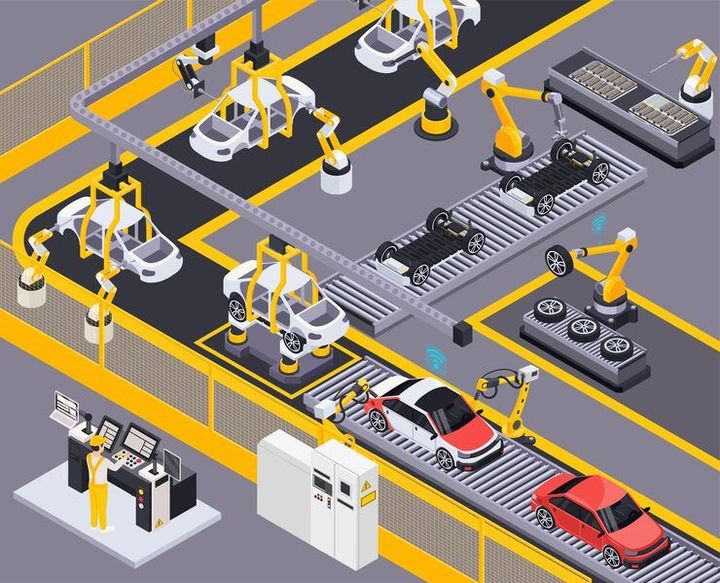
Automotive Manufacturing
Automotive production involves components with different sizes, shapes, and handling requirements.
Mobile manipulators may support inspection, component handling, tool movement, and selected assembly activities.
Electronics Manufacturing
Electronics production requires careful handling of relatively small components.
Robotic arms equipped with suitable grippers and vision systems can support controlled handling and inspection operations.
Laboratories
Mobile manipulation can also be applied to laboratory environments where equipment, containers, samples, and instruments must be moved or positioned.
Laboratory applications require careful consideration of contamination control, object identification, environmental conditions, and task validation.
Healthcare and Research
Robotic platforms are being investigated for tasks involving material transportation, room navigation, equipment handling, and research activities.
Healthcare environments introduce additional requirements related to people, hygiene, accessibility, and operational safety.
Recent Updates
Recent development in autonomous mobile manipulators has focused on improving perception, navigation, manipulation, computing, and system integration.
Improved 3D Perception
Modern robots increasingly use multiple sensing technologies to create more detailed representations of their surroundings. 3D cameras and LiDAR can help robots understand object position, depth, and obstacles.
More Adaptive Grasping
Traditional robotic systems often depend on precisely positioned objects. Newer manipulation systems increasingly use vision and adaptive gripping techniques to handle objects with greater variation.
AI-Assisted Robot Control
Machine learning and other AI techniques are being explored for perception, object recognition, motion planning, task planning, and adaptive manipulation.
However, autonomous behavior still depends on reliable sensing, validated software, hardware limitations, and carefully defined operating conditions.
Digital Simulation
Simulation platforms allow developers to test robot movement, navigation, manipulation, and facility layouts before physical deployment.
Digital environments can also help evaluate different robot configurations and task sequences.
Fleet Coordination
Multiple mobile robots can be coordinated through fleet-management software. Such systems may assign tasks, manage routes, monitor battery levels, and coordinate traffic between robots.
Laws or Policies
Autonomous mobile manipulators operate at the intersection of robotics, industrial machinery, workplace safety, electrical systems, and sometimes collaborative robotics.
Requirements vary by country and application, so organizations should identify the standards and regulations applicable to their specific deployment.
Industrial Robot Safety
International standards such as ISO 10218 address safety requirements for industrial robots and robotic systems. ISO/TS 15066 provides additional guidance for collaborative robot applications.
Machinery Safety
Depending on the jurisdiction, mobile manipulators may fall under machinery safety legislation or regulatory frameworks covering automated equipment.
Organizations should evaluate:
Risk assessment
Emergency stopping
Protective systems
Collision hazards
Safe operating zones
Electrical safety
Software-related safety functions
Human access to robotic workspaces
Workplace Risk Assessment
Before deployment, organizations should evaluate potential hazards involving the mobile platform, robotic arm, payload, end effector, batteries, charging areas, and interaction with people.
Safety requirements should be considered during system design rather than only after installation.
Tools and Resources
Several technologies are commonly used when designing, testing, and operating autonomous mobile manipulators.
Robotics Middleware
Frameworks such as ROS 2 provide software infrastructure for robotics development, including communication between sensors, controllers, navigation systems, and robotic applications.
Simulation Platforms
Simulation tools can model robotic arms, mobile bases, sensors, environments, and task sequences. They can help developers test navigation and manipulation before physical trials.
Mapping and Navigation Software
SLAM, or Simultaneous Localization and Mapping, allows a robot to estimate its position while creating or updating a map of its surroundings.
Navigation software then uses this environmental information to plan movement.
Vision Systems
3D cameras, stereo cameras, and industrial vision systems can provide information required for object detection and manipulation.
Robot Programming Interfaces
Programming environments and application interfaces allow engineers to define movement sequences, task logic, sensor interactions, and integration with factory or warehouse systems.
FAQs
What Are Autonomous Mobile Manipulators Used For?
Autonomous mobile manipulators are used for tasks such as material handling, machine tending, picking, inspection, assembly, laboratory handling, and selected maintenance activities.
How Do Autonomous Mobile Manipulators Navigate?
They can combine LiDAR, cameras, wheel encoders, inertial sensors, maps, and navigation algorithms to determine their position and plan movement through a workspace.
What Is the Difference Between a Mobile Robot and a Mobile Manipulator?
A mobile robot primarily provides movement or transportation. A mobile manipulator adds a robotic arm and end effector, allowing it to physically interact with objects.
Can Autonomous Mobile Manipulators Work Around People?
Some systems are designed for human-robot collaboration, but safe operation depends on system design, application conditions, risk assessment, protective functions, and applicable safety requirements.
What Industries Use Mobile Manipulators?
Potential applications include manufacturing, automotive production, logistics, warehousing, electronics, laboratories, research, and selected healthcare environments.
Conclusion
Autonomous mobile manipulators combine robotic mobility with physical manipulation, creating platforms that can travel through a workspace and interact with objects. Their major components include mobile bases, robotic arms, end effectors, sensors, computing systems, and power systems.
Their capabilities are expanding through improvements in 3D perception, adaptive grasping, AI-assisted control, simulation, and fleet coordination. As these systems become more capable, successful deployment depends on matching the robot configuration to the physical environment, task requirements, software architecture, and applicable safety framework.