Art Deco Jewelry Revival: Learn the Basics of Geometric Jewelry Design
Art Deco jewelry refers to jewelry influenced by the Art Deco design movement that became prominent during the 1920s and 1930s. The style is recognized for geometric shapes, symmetrical arrangements, strong lines, repeated patterns, and combinations of contrasting materials and colors.
The Art Deco jewelry revival refers to renewed interest in these design characteristics in contemporary jewelry. Modern designs may reinterpret classic geometric motifs while using updated manufacturing techniques, different gemstones, and contemporary materials.
Origins of Art Deco Jewelry
Art Deco developed across architecture, fashion, interior design, furniture, graphic design, and decorative arts. Its visual language was influenced by earlier artistic movements, industrial development, travel, archaeology, and changing ideas about modern life.
Jewelry from the period often featured diamonds, emeralds, sapphires, rubies, onyx, platinum, and other precious or decorative materials. Designers frequently arranged stones in precise geometric patterns rather than relying mainly on naturalistic floral forms.
The style became associated with shapes such as rectangles, squares, circles, triangles, stepped forms, sunbursts, and fan patterns. Symmetry was another important feature.
Main Characteristics of Geometric Jewelry Design
Geometric jewelry design uses mathematical-looking forms and structured arrangements. Common characteristics include:
Symmetry: Elements are arranged in balanced patterns around a central point or axis.
Angular shapes: Squares, triangles, rectangles, and other straight-edged forms create a structured appearance.
Repetition: Similar shapes or lines may appear several times across a piece.
Contrast: Light and dark gemstones, polished and textured surfaces, or different materials can create visual contrast.
Linear patterns: Straight lines and borders help define the overall structure.
Step patterns: Gradually reducing or expanding rectangular forms can create a stepped appearance.
Bold proportions: Some pieces use relatively large central forms surrounded by smaller geometric details.
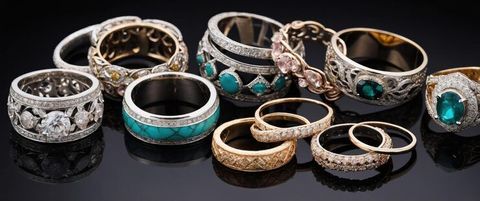
A simple example is a ring featuring a rectangular center stone surrounded by smaller stones arranged in symmetrical rows. The design is geometric because its appearance depends on structured shapes and balanced positioning.
Importance
Why the Art Deco Jewelry Revival Matters
The Art Deco jewelry revival demonstrates how historical design ideas can continue influencing contemporary jewelry. Instead of reproducing every detail from the 1920s and 1930s, modern designers can adapt geometric principles to current preferences.
Geometric jewelry can also be easier to recognize visually because its design is based on clear shapes and repeated structures. This makes elements such as symmetry, proportion, stone arrangement, and metalwork particularly important when analyzing a piece.
Where Geometric Jewelry Design Is Used
Art Deco-inspired geometry can appear across many jewelry categories, including rings, earrings, necklaces, bracelets, brooches, pendants, and watches.
Modern collections may combine Art Deco references with minimalist, contemporary, vintage-inspired, or mixed-material designs. Some pieces use subtle geometric details, while others make the entire design dependent on strong angular forms.
Materials and Gemstones
Historical Art Deco jewelry frequently used platinum because of its strength and ability to support detailed settings. White gold and other metals have also been used in pieces influenced by the period.
Commonly associated gemstones include:
Diamonds: Used for brightness, borders, geometric arrangements, and central stones.
Emeralds: Known for their green color and frequent use as contrasting accents.
Sapphires: Blue sapphires can create strong contrast against light-colored metals.
Rubies: Red stones can introduce a vivid color element into geometric patterns.
Onyx: Black onyx is frequently associated with strong black-and-white Art Deco contrasts.
Pearls: Some period jewelry incorporated pearls within structured compositions.
Modern geometric jewelry can use many other gemstones and materials, depending on the intended design.
Comparing Geometric Design Features
| Design Feature | Typical Appearance | Design Function |
|---|---|---|
| Symmetry | Balanced left and right sides | Creates visual order |
| Rectangles | Straight-edged central or surrounding shapes | Produces a structured appearance |
| Triangles | Angular accents or repeated motifs | Adds directional movement |
| Circles | Rounded centers or decorative details | Creates contrast with straight lines |
| Step Patterns | Gradual geometric layers | Adds depth and visual structure |
| Black-and-White Contrast | Dark and light materials together | Creates strong visual definition |
Craftsmanship and Construction
Creating geometric jewelry requires attention to proportion, stone placement, alignment, and metalwork. Small differences in spacing can change how a symmetrical pattern appears.
Traditional handcrafting methods remain relevant, while computer-aided design and precision manufacturing can help designers plan complex arrangements. The choice of technique depends on the design, material, production method, and required level of detail.
Recent Updates
Digital Jewelry Design
From 2024 through 2026, digital design tools continue to influence jewelry development. Computer-aided design allows designers to create detailed three-dimensional models before physical production.
Digital modeling can help evaluate proportions, stone placement, setting structures, and overall appearance. It can also make it easier to adjust geometric patterns before manufacturing begins.
3D Printing and Prototyping
3D printing is increasingly used in jewelry prototyping and manufacturing workflows. A digital model can be converted into a physical prototype, allowing designers and manufacturers to examine the structure before producing a final metal piece.
For geometric jewelry, this can be particularly useful because symmetrical shapes and repeated patterns can be represented directly from digital models.
Computer-Aided Stone Arrangement
Digital tools can assist with planning gemstone placement. Designers can experiment with different shapes, sizes, spacing, and symmetry before deciding on a final arrangement.
This does not eliminate the importance of craftsmanship. Gemstone characteristics, setting strength, metal behavior, finishing, and wear conditions still require professional consideration.
Renewed Interest in Historical Design
The broader revival of vintage-inspired aesthetics has also encouraged renewed attention to historical jewelry styles. Art Deco remains recognizable because its geometric language can be adapted to both traditional and contemporary forms.
Modern interpretations may simplify elaborate historical motifs or combine them with contemporary proportions and materials rather than reproducing an original period design exactly.
Laws or Policies
Jewelry Materials and Consumer Information
There is no single worldwide law governing all Art Deco jewelry or geometric jewelry design. Requirements vary according to the country where jewelry is manufactured, marketed, imported, or sold.
Rules can cover precious-metal markings, gemstone descriptions, consumer information, product safety, advertising claims, and disclosure of treatments or synthetic materials.
Precious Metal Standards
Countries and regions can use different systems for identifying precious-metal purity. For example, hallmarking requirements in the United Kingdom are governed by specific legislation and involve recognized assay offices.
The European Union has its own regulatory environment, while the United States uses Federal Trade Commission guidance concerning jewelry marketing and descriptions. Requirements should therefore be checked according to the relevant jurisdiction rather than assumed to be universal.
Gemstone and Diamond Disclosure
Descriptions involving natural, laboratory-grown, treated, synthetic, or imitation gemstones may be subject to different disclosure requirements. The exact rules depend on the jurisdiction and the wording used to describe a product.
The Kimberley Process is an international framework addressing rough diamonds associated with conflict financing. It focuses on the international trade in rough diamonds rather than regulating every aspect of finished jewelry.
Tools and Resources
Computer-Aided Design Software
CAD software is widely used for developing jewelry models. Designers can create precise geometric forms, adjust dimensions, test proportions, and prepare models for manufacturing workflows.
Gemstone Measurement Tools
Digital calipers, gauges, microscopes, scales, and gemological instruments can help evaluate gemstone dimensions and characteristics. Professional gemological laboratories can provide more detailed identification and grading information where appropriate.
Jewelry Rendering Software
Rendering tools can create realistic digital representations of jewelry. These can help designers examine how metal surfaces, gemstones, shadows, and proportions may appear before physical production.
Historical Jewelry Archives
Museum collections, auction archives, academic publications, and institutional databases can help researchers compare modern geometric jewelry with historical Art Deco examples.
The Victoria and Albert Museum, The Metropolitan Museum of Art, and other major cultural institutions maintain online collections containing historical jewelry and decorative arts that can support visual and historical research.
Manufacturing and Prototyping Equipment
Jewelry workshops may use casting equipment, CNC systems, laser technologies, polishing tools, and 3D printers depending on the manufacturing process. The appropriate equipment depends on the metal, design complexity, production method, and required finishing.
FAQs
What is the Art Deco jewelry revival?
The Art Deco jewelry revival refers to renewed interest in the geometric shapes, symmetry, contrast, and structured patterns associated with jewelry from the Art Deco period. Modern pieces may reinterpret these characteristics using contemporary materials and technologies.
What are the main features of Art Deco jewelry design?
Common features include geometric shapes, symmetry, straight lines, stepped patterns, contrasting colors, repeated motifs, and carefully arranged gemstones. Rectangles, triangles, circles, and fan-like forms are frequently associated with the style.
Why is geometric jewelry design associated with Art Deco?
Art Deco design strongly emphasized order, geometry, symmetry, and modern industrial influences. Jewelry designers applied these principles through structured gemstone arrangements, angular metalwork, and repeated patterns.
What gemstones are commonly used in Art Deco-inspired jewelry?
Diamonds, emeralds, sapphires, rubies, onyx, and pearls are commonly associated with Art Deco jewelry. Contemporary designs can also use many other natural, laboratory-grown, or decorative materials.
How has technology changed geometric jewelry design?
CAD modeling, digital rendering, 3D printing, and precision manufacturing allow designers to create and test detailed geometric structures digitally. These technologies can support accurate proportions and complex repeated patterns while traditional craftsmanship remains important.
Conclusion
The Art Deco jewelry revival continues the geometric design language associated with the 1920s and 1930s while allowing contemporary designers to reinterpret it. Symmetry, angular forms, repeated patterns, contrasting materials, and structured gemstone arrangements remain central characteristics of geometric jewelry design. Digital modeling, 3D printing, and precision manufacturing have added new tools for developing these designs. Historical research, material knowledge, accurate descriptions, and appropriate regional requirements remain important when studying or creating Art Deco-inspired jewelry.