AI-Powered Design Rings: Explore Technology, Custom Concepts, and Modern Jewelry Trends
AI-powered design rings combine artificial intelligence with jewellery design to create personalized concepts, explore diamond shapes, visualize settings, and develop modern ring styles. This technology is increasingly being used alongside digital rendering, CAD, and traditional jewellery craftsmanship.
AI-Powered Design Rings: Explore Technology, Custom Concepts, and Modern Jewelry Trends
Context
AI-powered design rings represent a developing intersection between artificial intelligence, digital jewellery design, and traditional craftsmanship. Generative AI can create visual concepts from written descriptions, sketches, reference images, or combinations of design preferences, allowing designers to explore multiple ring ideas at an early stage.
The technology does not replace the physical processes required to create jewellery. A generated image still needs to be evaluated for proportions, structure, stone placement, wearability, and manufacturing feasibility before it can become a physical ring. GIA research describes generative AI as a creative tool that can help jewellery designers generate and refine concepts while CAD and manufacturing expertise remain important for transforming concepts into physical pieces.
What Are AI-Powered Design Rings?
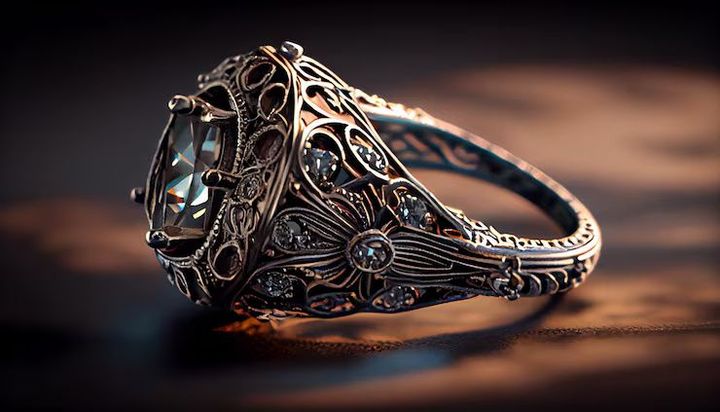
AI-powered design rings are ring concepts developed with the assistance of artificial intelligence tools. A designer can provide details such as metal colour, diamond shape, setting style, band structure, decorative elements, and overall visual direction.
The AI system can then generate one or more visual concepts. Designers can refine those concepts by changing individual elements or combining features from different versions.
AI in the Jewellery Design Process
A typical AI-assisted workflow can include:
Defining the ring concept.
Entering text or image references.
Generating several visual concepts.
Comparing shapes, settings, and proportions.
Refining the selected direction.
Developing a detailed CAD model.
Checking structural and manufacturing requirements.
Creating a physical prototype or production model.
This workflow places AI primarily in the concept-development and visualization stages while retaining human involvement in engineering, material selection, gemstone setting, and craftsmanship.
Main Elements of an AI-Designed Ring
An AI-powered ring concept can include several design variables:
Diamond or gemstone shape
Metal colour
Band profile
Setting structure
Prong arrangement
Halo configuration
Side-stone placement
Engraving concepts
Surface textures
Geometric details
Vintage-inspired elements
Contemporary forms
These elements can be changed independently during the concept-development process.
Importance
AI-assisted ring design can make it easier to explore a wide range of visual possibilities before detailed modelling begins. This is particularly relevant to personalized jewellery, where a single concept may need several variations before the desired design direction is established.
Faster Concept Exploration
Generative AI can create multiple visual variations from a relatively small amount of input. GIA's research describes this process as "AIdeation," where designers use AI to generate numerous possibilities and then refine selected concepts through additional iterations.
This can help designers compare different silhouettes, stone arrangements, textures, and decorative elements during the early design stage.
Personalized Ring Concepts
Personalization is an important part of contemporary jewellery design. A ring concept can incorporate preferred diamond shapes, metal tones, symbolic motifs, initials, geometric patterns, or other visual characteristics.
AI can help visualize these combinations before a detailed digital model is developed.
Visualization Before CAD
Traditional jewellery CAD modelling requires considerable attention to dimensions and three-dimensional geometry. AI-generated imagery can function as an early visual reference before detailed CAD work begins.
GIA notes that AI-generated images can help clients and designers visualize a concept before the designer develops the final CAD model.
Collaboration Between Designer and Client
AI can also support communication between designers and clients by turning verbal descriptions into visual references.
Instead of discussing only abstract characteristics, participants can compare images showing different proportions, settings, stone arrangements, and decorative details.
Design Variety
AI can combine different design influences and generate variations quickly. A single concept might be explored in minimalist, vintage-inspired, geometric, sculptural, or contemporary directions.
The designer remains responsible for selecting practical and aesthetically coherent elements.
Diamond Shape Selection
Different diamond shapes can significantly change the appearance of a ring.
| Diamond Shape | General Design Character | Common Ring Direction |
|---|---|---|
| Round | Balanced and classic | Solitaire, halo, pavé |
| Oval | Elongated silhouette | Solitaire, halo, side stones |
| Emerald | Linear and structured | Solitaire, three-stone |
| Cushion | Soft rectangular outline | Vintage and contemporary |
| Pear | Rounded with pointed end | Directional and distinctive |
| Marquise | Long pointed silhouette | Statement and elongated designs |
| Princess | Angular geometric form | Modern and structured |
| Radiant | Rectangular with brilliant faceting | Contemporary statement rings |
AI visualization can show the same setting with multiple diamond shapes, making comparison easier during the concept stage.
Recent Updates
AI jewellery design has continued to develop during 2024–2026. Current applications include concept generation, sketch-to-image workflows, personalized variations, photorealistic rendering, and integration with established CAD processes.
Generative AI for Jewellery Concepts
GIA published detailed research on generative AI in jewellery design in 2024, examining text-to-image systems, image variations, AI-assisted design, and the ethical and legal questions surrounding generated jewellery imagery.
The research demonstrates how a designer can begin with a short description and progressively refine generated variations.
Sketch-to-Image Workflows
AI can transform an initial sketch or visual reference into a more developed jewellery image. This can help designers communicate a concept before committing substantial effort to detailed three-dimensional modelling.
Sketch-to-image workflows are particularly useful when the design idea is visually clear but has not yet been developed into production-ready geometry.
AI and CAD Integration
AI-generated imagery is not the same as a production-ready jewellery model. Detailed CAD development remains important for establishing dimensions, stone seats, wall thicknesses, proportions, structural relationships, and manufacturing requirements.
GIA's jewellery design and technology programme highlights the relationship between concept development, CAD engineering, rendering, prototyping, and manufacturing.
3D Visualization
Digital rendering allows a ring concept to be viewed from multiple angles and under different visual conditions.
Future AI-assisted workflows are also exploring image-to-depth, text-to-mesh, and other methods intended to move from two-dimensional concepts toward three-dimensional digital models. GIA identified these areas as potential developments while noting limitations in accurately representing complex jewellery geometry.
Personalization and Custom Concepts
Current jewellery design trends increasingly emphasize individual expression rather than identical styles. Recent 2026 fashion coverage highlights greater interest in distinctive settings, antique-inspired cuts, sculptural forms, east-west orientations, and personalized ring aesthetics.
AI can support this trend by allowing designers to visualize several personalized directions before selecting a final concept.
Modern Ring Styles
Contemporary AI-generated ring concepts may explore:
Sculptural bands
East-west settings
Bezel settings
Four-prong settings
Vintage-inspired forms
Mixed-metal designs
Geometric bands
Hidden details
Asymmetrical elements
Minimalist solitaire structures
Current 2026 engagement-ring reporting also points toward more individual and tactile designs, including emerald cuts, antique-inspired stones, chunky bands, and distinctive settings.
Human Creativity Remains Important
AI can generate visual possibilities rapidly, but the technology does not automatically determine whether a design is structurally practical, comfortable, durable, or appropriate for manufacturing.
GIA's research emphasizes that generated images still need to be translated into physical objects through CAD, traditional fabrication, or other jewellery-production methods.
Laws or Policies
AI-powered jewellery design involves several areas of consideration, including intellectual property, truthful representation, gemstone disclosure, digital content, and manufacturing requirements.
AI-Generated Design Content
AI-generated images can raise questions about originality, authorship, and intellectual property. GIA's research discusses ethical, legal, and regulatory questions associated with generative AI in jewellery design.
Designers should therefore maintain records of original sketches, references, human modifications, CAD development, and other stages of the design process where appropriate.
Human Design Input
A generated image should not automatically be treated as a complete jewellery design. Human input remains important when establishing proportions, technical dimensions, setting geometry, materials, and production requirements.
A human-created sketch or detailed design contribution can also provide useful evidence of the designer's creative involvement.
Diamond and Gemstone Disclosure
When an AI-generated ring image depicts a particular diamond or gemstone, the visual representation should not create a misleading impression about the actual physical stone.
Actual jewellery specifications should accurately identify relevant gemstone characteristics, treatments, laboratory-grown status where applicable, and other material information.
Precious-Metal Requirements in India
In India, precious-metal jewellery may be subject to applicable BIS hallmarking requirements. The hallmarking framework concerns the purity and identification of applicable precious-metal articles.
AI-generated visuals do not replace the physical requirements applicable to the finished jewellery article.
Manufacturing Compliance
The final ring must meet the technical requirements associated with its materials, construction, setting, and intended use.
CAD modelling, engineering review, casting, setting, polishing, inspection, and other physical processes remain separate from the AI image-generation stage.
Tools and Resources
AI-powered jewellery design involves a combination of creative, digital, technical, and manufacturing tools.
Generative AI Platforms
Text-to-image and image-to-image systems can create early ring concepts from written descriptions or reference images.
Designers can experiment with different combinations of stone shapes, metal colours, settings, textures, and stylistic influences.
CAD Software
CAD systems are used to convert selected concepts into detailed three-dimensional jewellery models.
GIA identifies CAD, digital rendering, computer-aided manufacturing, and 3D printing as important components of modern jewellery design and technology workflows.
Digital Rendering
Photorealistic rendering can show how a finished ring may appear under different lighting conditions and viewing angles.
This can help compare surface finishes, gemstone arrangements, metal colours, and setting proportions before physical production.
3D Printing and Prototyping
Digital jewellery models can be converted into physical prototypes through suitable additive manufacturing workflows.
Prototype development can help evaluate dimensions, proportions, fit, and construction before final production.
Reference Libraries
Jewellery reference libraries can provide examples of historical settings, gemstone cuts, metal finishes, decorative motifs, and architectural forms.
These references can be combined with AI-assisted concept generation while maintaining a clear distinction between inspiration and an original final design.
Design Review
A design review can examine:
Ring dimensions
Stone security
Prong structure
Band thickness
Finger clearance
Wearability
Surface details
Manufacturing feasibility
Material selection
Final proportions
This review is important because a visually attractive AI image may not accurately represent the geometry required for a physical ring.
FAQs
What are AI-powered design rings?
AI-powered design rings are jewellery concepts created with assistance from artificial intelligence tools. AI can generate or modify visual concepts based on descriptions, sketches, reference images, and selected design characteristics.
How does AI help with custom ring design?
AI can generate multiple visual concepts and variations based on elements such as diamond shape, metal colour, setting style, band structure, and decorative details. The selected concept can then move into detailed CAD development.
Can AI create a production-ready jewellery model?
An AI-generated image is generally a visual concept rather than a complete production-ready model. Detailed CAD development and technical review are still needed to establish accurate geometry and manufacturing requirements.
What ring styles can be created with AI?
AI can visualize solitaire, halo, three-stone, bezel, pavé, vintage-inspired, geometric, sculptural, minimalist, and other ring styles. The range depends on the capabilities of the particular design system and the instructions provided.
Are AI-designed rings becoming a jewellery trend?
AI-assisted design is becoming an increasingly visible part of jewellery concept development, while broader 2026 ring trends emphasize personalization, distinctive settings, sculptural forms, antique-inspired cuts, and individual design choices.
Conclusion
AI-powered design rings combine generative technology with established jewellery design practices to create and visualize new ring concepts. AI can support concept exploration, personalization, diamond-shape comparisons, digital rendering, and early-stage design communication. However, CAD development, engineering review, gemstone setting, manufacturing, and human creative judgment remain important for transforming an AI concept into a physical ring. As jewellery design continues to become more personalized and digitally assisted, AI is likely to remain an important tool within the broader creative and technical workflow.