Adversarial Machine Learning: Types, Attacks, Defense Techniques, and Applications
Adversarial machine learning is an important area of artificial intelligence security that examines how machine learning systems can be manipulated, deceived, or compromised by deliberately crafted inputs or malicious training data.
As organizations increasingly rely on AI for fraud detection, healthcare, cybersecurity, financial services, and autonomous systems, protecting machine learning models against adversarial threats has become essential.
Traditional machine learning systems are designed to identify patterns in data and make predictions or decisions. However, these systems can sometimes produce incorrect results when they encounter inputs specifically designed to exploit weaknesses in their training, architecture, or decision-making process.
For example, a small alteration to an image might cause an image classification model to assign the wrong label. Similarly, manipulated training data could influence a fraud detection system, reducing its ability to identify suspicious transactions.
Understanding adversarial machine learning helps developers, researchers, and organizations identify potential vulnerabilities, strengthen AI systems, and build more reliable applications.
What Is Adversarial Machine Learning?
Adversarial machine learning is the study of attacks against machine learning systems and the techniques used to defend against them.
These attacks may target different stages of the machine learning lifecycle, including data collection, model training, model deployment, and prediction.
An adversary may attempt to manipulate input data, contaminate training datasets, extract sensitive information, or influence a model's behavior. The specific objective depends on the application and the attacker's capabilities.
Adversarial machine learning generally focuses on two major areas:
Adversarial attacks: Techniques intended to exploit weaknesses in machine learning systems.
Adversarial defenses: Methods designed to detect, prevent, or reduce the impact of these attacks.
The field is relevant to supervised learning, deep learning, computer vision, natural language processing, reinforcement learning, and other AI approaches.
Why Adversarial Machine Learning Matters
Machine learning models can influence important decisions, from approving financial transactions to identifying medical conditions and detecting cybersecurity threats.
If an attacker manipulates a model, the consequences may extend beyond inaccurate predictions.
1. Protecting AI Systems From Manipulation
Adversarial attacks can cause models to misclassify inputs or behave in unexpected ways. Security testing helps organizations identify these weaknesses before they affect real users or critical operations.
2. Improving Model Reliability
A reliable AI system should perform well not only on ordinary inputs but also under realistic variations, unusual conditions, and attempts at manipulation.
Adversarial robustness helps evaluate how well a model maintains its performance when faced with challenging inputs.
3. Reducing Security and Financial Risks
In banking, insurance, and cybersecurity, manipulated machine learning outputs can contribute to fraud, unauthorized activity, or missed threats.
Strengthening AI security can help reduce these risks and improve the reliability of automated decisions.
4. Protecting Data Privacy
Some attacks attempt to infer sensitive information about training data or determine whether specific records were used to train a model.
Understanding these threats helps developers evaluate privacy risks and implement appropriate protections.
5. Supporting Responsible AI Deployment
Organizations need to understand the limitations of their AI systems before using them in sensitive or high-impact environments.
Adversarial testing can contribute to responsible deployment by identifying vulnerabilities, documenting limitations, and informing decisions about human oversight.
How Adversarial Machine Learning Works
Adversarial machine learning involves understanding how an attacker might exploit a model and how the model's owner can prevent or limit that exploitation.
A typical adversarial attack-and-defense process includes several stages.
Step 1: Identify the Target Model
The attacker or security researcher identifies the machine learning system being evaluated, such as an image classifier, fraud detection model, or language processing system.
The level of access available can vary. Some evaluations assume access to model internals, while others rely only on the system's outputs.
Step 2: Identify Potential Weaknesses
The evaluator examines the model's inputs, outputs, training process, assumptions, and decision boundaries.
Weaknesses may arise from insufficient training data, poor generalization, inadequate input validation, or a lack of protection against maliciously modified examples.
Step 3: Develop an Adversarial Test
An adversarial test introduces controlled changes to data or system behavior to determine whether the model can be misled.
For example, researchers might evaluate whether a vision model remains accurate when an image contains carefully designed perturbations or whether a text classifier can be confused by changes in wording.
Testing should be conducted in an authorized environment, especially when the system supports critical services.
Step 4: Measure the Impact
Researchers measure how the model performs under attack.
Relevant metrics may include attack success rate, classification accuracy under perturbation, false-positive rates, false-negative rates, and the amount of information an attacker can recover.
Step 5: Apply and Evaluate Defenses
Developers may improve training data, introduce adversarial training, strengthen input validation, or add monitoring and detection mechanisms.
The model is then evaluated again to determine whether the defenses reduce vulnerability without causing unacceptable performance losses.
Major Types of Adversarial Machine Learning Attacks
Adversarial attacks differ according to their target, timing, and objective. Understanding these categories helps organizations develop appropriate security measures.
1. Evasion Attacks
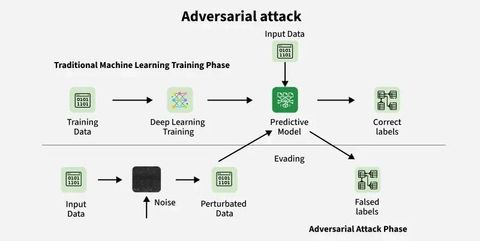
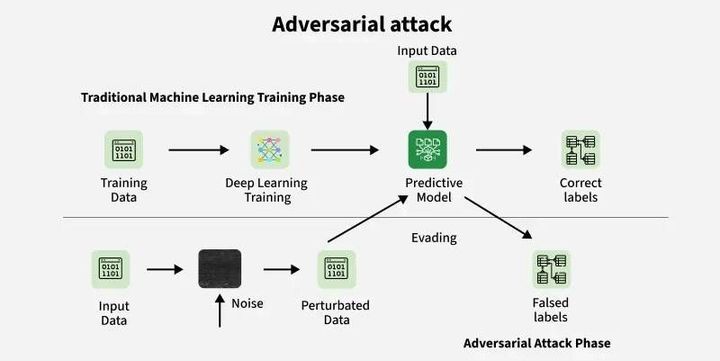
Evasion attacks occur when an adversary modifies an input at inference time, after the model has been trained.
The goal is to cause the model to produce an incorrect prediction or bypass a detection mechanism.
For example, an image classification system might incorrectly identify an object when presented with a carefully modified image. In cybersecurity, manipulated inputs may attempt to evade a machine learning-based threat detection system.
Evasion attacks are particularly relevant to deployed models because an attacker may be able to submit inputs without accessing the underlying training process.
2. Data Poisoning Attacks
Data poisoning attacks involve manipulating the data used to train a machine learning model.
An attacker may introduce incorrect labels, biased examples, or malicious records into a training dataset. If the poisoned data influences the learning process, the resulting model may become less accurate or behave incorrectly in specific situations.
For example, a compromised data pipeline could introduce misleading examples into a fraud detection dataset.
Defenses include dataset validation, trusted data sources, provenance tracking, anomaly detection, and controlled access to training pipelines.
3. Model Poisoning
Model poisoning targets the training process or the model itself, including situations where malicious participants manipulate model updates in collaborative training systems.
In federated learning, multiple participants may contribute updates without sharing their complete local datasets. If an untrusted participant submits malicious updates, the global model may be affected.
Secure aggregation, update validation, participant authentication, anomaly monitoring, and robust aggregation techniques can help reduce these risks.
4. Model Extraction Attacks
Model extraction attacks attempt to reproduce or approximate a target model by analyzing its responses to carefully selected queries.
The resulting substitute model may imitate some of the target model's behavior, potentially exposing intellectual property or helping an attacker develop further attacks.
Organizations can reduce exposure through appropriate API authentication, rate limits, access monitoring, and careful control over the information returned by prediction services.
These controls must be balanced against legitimate customer and developer requirements.
5. Membership Inference Attacks
Membership inference attacks attempt to determine whether a particular record was included in a model's training dataset.
For example, an attacker might attempt to infer whether a person's record was used to train a model developed for a sensitive application.
Such attacks can create privacy concerns, particularly when training data contains personal, medical, or financial information.
Privacy-aware training, data minimization, access controls, and differential privacy where appropriate can help reduce exposure.
6. Backdoor Attacks
Backdoor attacks cause a model to behave normally on most inputs but produce an attacker-controlled result when a specific trigger or condition appears.
For example, a compromised image classifier might misclassify images containing a particular pattern while continuing to classify ordinary images accurately.
Backdoors may be introduced through poisoned training data, compromised pretrained models, or malicious changes to the training pipeline.
Defenses include reviewing data provenance, auditing model behavior, testing unusual input patterns, and verifying the integrity of model artifacts.
Adversarial Examples in Machine Learning
Adversarial examples are inputs deliberately designed to cause a machine learning model to make an incorrect prediction.
In image recognition, an adversarial example may contain small changes that are difficult for a human observer to notice but that significantly affect a model's output.
In natural language processing, carefully modified text may cause a classifier to change its prediction. In speech recognition, manipulated audio may affect how a system interprets spoken content.
Adversarial examples demonstrate that a model's decision process may be sensitive to features that do not align with human expectations.
However, not every unexpected prediction is an adversarial example. Ordinary noise, data quality problems, and distribution shifts can also reduce model performance.
Security evaluations should therefore distinguish deliberate adversarial manipulation from other sources of model failure.
Adversarial Machine Learning Defense Techniques
Protecting machine learning systems requires multiple layers of defense. No single technique can prevent every type of attack.
1. Adversarial Training
Adversarial training exposes a model to carefully generated adversarial examples during training.
The objective is to improve the model's ability to handle the types of perturbations represented in the training process.
This technique can improve robustness against certain attacks, but its effectiveness depends on the attack methods used, the training data, and the model architecture.
Adversarial training may also increase computational requirements and create trade-offs between robustness and performance on ordinary inputs.
2. Data Validation and Sanitization
Training data should be checked for incorrect labels, suspicious records, duplicates, unusual distributions, and unexpected changes.
Data validation can reduce the risk of poisoning and help identify problems before they influence model behavior.
However, simple anomaly detection may not identify sophisticated poisoning attempts. Data provenance and controlled access are also important.
3. Robust Model Design
Developers can select architectures, training procedures, and optimization methods that improve robustness against relevant threats.
Robustness must be evaluated empirically because a model that performs well against one attack may remain vulnerable to another.
Security testing should consider multiple attack types and realistic assumptions about attacker access.
4. Input Validation and Preprocessing
Input validation ensures that data conforms to expected formats, ranges, and structural requirements before reaching a model.
Preprocessing may also help reduce certain forms of noise or malformed input.
However, preprocessing alone is not a reliable defense against adversarial attacks. Some transformations can be bypassed or may reduce accuracy without providing meaningful security improvements.
5. Privacy-Preserving Machine Learning
Privacy-preserving techniques help reduce the risk of exposing sensitive information through model training or inference.
Differential privacy can provide formal guarantees under specified assumptions by limiting the influence of individual records on a model's outputs or training process.
Its effectiveness depends on the privacy parameters, implementation, and utility requirements. It also does not automatically protect against every type of model attack.
6. Continuous Monitoring and Red Teaming
Machine learning systems should be monitored after deployment for unexpected behavior, unusual query patterns, changes in input distributions, and declining performance.
Red teaming involves authorized attempts to discover weaknesses in the model, its surrounding infrastructure, and its operational procedures.
Continuous testing is important because models, data sources, user behavior, and attack techniques can change over time.
Applications of Adversarial Machine Learning
Adversarial machine learning has practical applications across industries that depend on automated predictions and decisions.
Cybersecurity
Security teams use adversarial testing to evaluate machine learning systems that detect malware, phishing attempts, suspicious network activity, and other threats.
Testing can reveal whether detection systems remain effective when attackers modify their behavior to avoid classification.
Banking and Financial Services
Banks use machine learning for fraud detection, credit risk analysis, transaction monitoring, and identity verification.
Adversarial machine learning helps assess whether malicious users can manipulate input signals, contaminate data, or exploit weaknesses in automated decision systems.
Healthcare
Healthcare AI systems may support medical image analysis, clinical decision support, and patient risk prediction.
Adversarial testing can help evaluate the reliability of these models under altered images, unusual inputs, and potential data integrity problems.
Because errors can affect patient care, these systems require rigorous validation and appropriate clinical oversight.
Autonomous Vehicles
Autonomous systems use machine learning to interpret camera images, sensor information, and surrounding environments.
Adversarial research helps evaluate whether environmental changes or manipulated sensor inputs can affect object detection and other safety-related functions.
Testing should consider the full system rather than only an individual model, since failures may arise from interactions between multiple components.
Natural Language Processing
Text classification, content moderation, spam detection, and other language applications can be vulnerable to manipulated wording or carefully constructed inputs.
Adversarial testing helps developers understand these weaknesses and improve model reliability.
Challenges in Adversarial Machine Learning
Despite progress in AI security research, several challenges remain.
Attack diversity: Different attack methods target different vulnerabilities, making it difficult to develop a single defense that works in every situation.
Computational costs: Adversarial training and extensive security testing can require substantial processing power and time.
Robustness trade-offs: Improving resistance to one type of attack may reduce accuracy on ordinary inputs or leave other vulnerabilities unaddressed.
Changing threats: Attackers can adapt their methods as defensive systems improve, requiring ongoing evaluation.
Evaluation difficulties: Results can vary depending on the attack assumptions, datasets, model architecture, and testing procedures. Weak evaluations may overstate a model's robustness.
Operational complexity: A model can be technically robust yet remain vulnerable because of insecure APIs, compromised training data, excessive permissions, or weak deployment controls.
Addressing these challenges requires collaboration between machine learning engineers, cybersecurity specialists, data scientists, and governance teams.
Best Practices for Building Robust Machine Learning Systems
Organizations can strengthen AI security by integrating adversarial risk management throughout the machine learning lifecycle.
Evaluate threats before model development and deployment.
Maintain trusted data sources and track dataset provenance.
Test models against multiple relevant attack scenarios.
Protect model files, training pipelines, APIs, and deployment infrastructure.
Monitor performance and input distributions after deployment.
Apply privacy and access controls appropriate to the data being processed.
Maintain human oversight for sensitive or high-impact decisions.
Retest models when datasets, model versions, or operating conditions change.
These practices help establish a more comprehensive security approach than relying exclusively on model-level defenses.
Future Trends in Adversarial Machine Learning
As AI systems become more capable and widely deployed, adversarial machine learning is likely to remain a significant research and engineering priority.
Future developments may include stronger robustness evaluation methods, more efficient adversarial training, improved privacy protections, and better detection of compromised models and datasets.
The increasing adoption of generative AI also introduces additional security concerns. Researchers are examining how malicious inputs can influence AI assistants, how training data can be manipulated, and how models can be protected against attempts to extract sensitive information or bypass safeguards.
AI security is also moving toward a broader systems perspective. Instead of evaluating only the predictive model, organizations increasingly need to examine data pipelines, application interfaces, infrastructure, access controls, and human workflows.
This approach recognizes that dependable AI requires both robust models and secure operational environments.
Conclusion
Adversarial machine learning is a critical field focused on understanding and defending against attacks that exploit weaknesses in AI systems. Evasion attacks, data poisoning, model extraction, membership inference, and backdoor attacks represent different threats that can affect model accuracy, privacy, integrity, and reliability.
Defense techniques such as adversarial training, data validation, robust model design, privacy-preserving methods, and continuous security testing can help reduce these risks. However, no individual technique provides complete protection against every possible attack.
Organizations should therefore adopt a layered security strategy that combines model-level defenses with secure data management, infrastructure protection, ongoing monitoring, and appropriate human oversight.