What Is Retort Processing Equipment and How Does It Work?
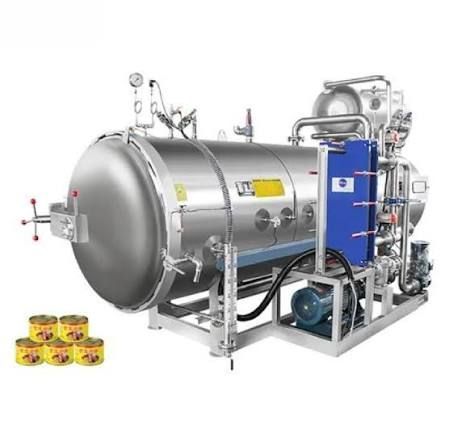
Retort processing equipment is industrial thermal-processing machinery used to heat sealed food or other suitable products under controlled temperature and pressure conditions.
The process is designed to achieve a commercially sterile product when the appropriate validated process is applied.
Retort processing equipment is widely used for shelf-stable foods packaged in cans, pouches, trays, jars, and other heat-resistant containers. A typical system controls heating, pressure, holding time, cooling, and product handling to achieve consistent processing conditions.
The appropriate retort system depends on the product formulation, container type, thermal characteristics, production volume, and required process parameters.
Why Retort Processing Equipment Matters
Many packaged foods contain microorganisms that must be controlled through an appropriate thermal process. Retort processing applies heat after the product has been sealed in its package, allowing the packaged product to undergo controlled thermal treatment.
The process must be carefully designed and validated because different foods heat at different rates. Factors such as product acidity, viscosity, particle size, package dimensions, and container material can influence the required process.
Important considerations include:
- Product formulation
- Product acidity
- Container material
- Package dimensions
- Filling characteristics
- Heating temperature
- Holding time
- Cooling conditions
- Pressure control
- Process monitoring
How Retort Processing Equipment Works
Although retort designs vary, the basic process follows several controlled stages.
1. Product Preparation and Filling
The product is prepared according to its formulation and packaging requirements.
It may be filled into cans, flexible pouches, trays, jars, or other compatible containers. The package is then sealed before retort processing.
The container must be capable of withstanding the thermal and pressure conditions of the selected process.
2. Loading
Sealed containers are loaded into baskets, racks, carts, or carriers designed for the specific retort system.
The loading arrangement should allow the processing medium to circulate effectively around the packages.
Consistent loading patterns are important because package position can influence heat transfer and processing uniformity.
3. Retort Closure
Once the retort chamber has been loaded, the door or closure mechanism is secured.
The chamber must maintain the required pressure and temperature during processing.
Safety interlocks and pressure-control systems are commonly incorporated to prevent the chamber from being opened under unsafe conditions.
4. Heating
The retort introduces a heating medium into the chamber.
Depending on the retort type, the heating medium can be steam, water, or a combination of water and air.
Temperature gradually increases until the required processing condition is reached.
Heating rate is important because the center of the product may take longer to reach the target temperature than the surrounding processing medium.
5. Sterilization or Thermal Processing
Once the required temperature is reached, the product remains under controlled thermal conditions for a defined period.
The exact time and temperature depend on the product and package configuration.
During this stage, sensors and control systems monitor process conditions to maintain the specified parameters.
6. Pressure Control
Pressure management is an important part of retort processing, particularly for flexible packages and containers that may be affected by pressure differences.
The retort can regulate steam, water, and compressed air conditions to maintain an appropriate pressure profile throughout the cycle.
Proper pressure control can help reduce package deformation and maintain container integrity.
7. Cooling
After the required thermal treatment is complete, the products are cooled.
Water or another controlled cooling medium can be introduced to reduce product and container temperature.
Cooling must be managed carefully because rapid pressure changes can affect package integrity.
8. Depressurization
As cooling progresses, the retort gradually returns toward atmospheric pressure.
Controlled depressurization helps reduce stress on containers and prevents sudden pressure differences that could damage flexible packages or closures.
9. Unloading
After the processing cycle is complete, the retort is opened under appropriate conditions.
Processed packages are removed from baskets or carriers and transferred to downstream handling, drying, inspection, labeling, or storage operations.
Types of Retort Processing Equipment
Steam Retorts
Steam retorts use saturated steam as the primary heating medium.
They are commonly used for products packaged in rigid containers and can provide direct heat transfer under controlled conditions.
Water Spray Retorts
Water spray systems circulate heated water over the product packages.
Spray nozzles distribute water throughout the chamber while pumps maintain circulation.
This configuration can provide controlled heating and cooling for various packaging formats.
Water Immersion Retorts
Water immersion systems submerge the product containers in heated water.
The water provides the thermal medium while circulation systems help maintain temperature uniformity throughout the chamber.
Rotary Retorts
Rotary retorts move or rotate packages during processing.
The movement can improve product agitation and heat transfer for selected products, particularly those with liquid or particulate components.
Steam-Air Retorts
Steam-air systems use a combination of steam and controlled air pressure.
The air component can help provide pressure control for packages that require more precise pressure management during heating and cooling.
Batch Retort Systems
Batch retorts process a defined quantity of products during each cycle.
They are available in different chamber sizes and configurations and can be adapted to various container formats.
Continuous Retort Systems
Continuous systems move products through the thermal-processing operation with minimal interruption between stages.
They are generally designed for production environments requiring continuous product flow and consistent process control.
Comparison of Retort Processing Equipment
| Retort Type | Heating Medium | Typical Characteristic |
|---|---|---|
| Steam retort | Steam | Direct thermal processing |
| Water spray retort | Heated water spray | Controlled water circulation |
| Water immersion retort | Water | Full product immersion |
| Rotary retort | Steam or water | Product movement during processing |
| Steam-air retort | Steam + air | Controlled pressure management |
| Batch retort | Steam or water | Defined processing batches |
| Continuous retort | Various | Continuous product flow |
Main Components of Retort Processing Equipment
A retort system can contain several important components.
| Component | Function |
|---|---|
| Processing chamber | Contains products during treatment |
| Retort door | Seals the chamber |
| Heating system | Provides thermal energy |
| Water circulation system | Moves processing water |
| Steam system | Supplies steam where required |
| Air system | Controls pressure |
| Temperature sensors | Monitor process temperature |
| Pressure sensors | Monitor chamber pressure |
| Control system | Coordinates processing parameters |
| Cooling system | Reduces product temperature |
| Product baskets | Hold packages during processing |
Factors for Selecting Retort Processing Equipment
Product Characteristics
Evaluate acidity, viscosity, particle size, density, formulation, and thermal sensitivity.
Package Type
Cans, pouches, trays, jars, and other containers can require different retort configurations.
Production Volume
Batch systems may be appropriate for certain production patterns, while continuous systems can support sustained product flow.
Heat Transfer Requirements
The product's thermal characteristics determine how quickly heat reaches the coldest point of the package.
Pressure Requirements
Flexible packages and certain rigid containers may require carefully controlled pressure during heating and cooling.
Process Monitoring
Accurate temperature and pressure monitoring is essential for maintaining the defined thermal process.
Applications of Retort Processing Equipment
Retort systems are commonly used for:
- Canned vegetables
- Ready-to-eat meals
- Soups
- Sauces
- Meat products
- Seafood products
- Pet food
- Baby food
- Shelf-stable beverages
- Prepared foods
Frequently Asked Questions
What is retort processing equipment?
Retort processing equipment is industrial thermal-processing machinery used to heat sealed products under controlled temperature and pressure conditions to achieve a validated commercial-sterility process.
How does a retort machine work?
A retort loads sealed products into a processing chamber, heats them using steam or water-based systems, maintains the required temperature for a defined period, controls pressure, and then cools the products before unloading.
What products are processed in retorts?
Retorts are commonly used for shelf-stable foods such as canned vegetables, ready-to-eat meals, soups, sauces, seafood, meat products, pet food, and selected beverages.
What is the difference between steam and water retorts?
Steam retorts primarily use steam as the heating medium, while water-based retorts circulate heated water through spray or immersion systems. The appropriate configuration depends on the product and package.
Why is pressure control important in retort processing?
Pressure control helps manage pressure differences between the processing chamber and the inside of packages, particularly during heating and cooling. Proper control can help maintain package integrity.
Conclusion
Retort processing equipment provides controlled thermal treatment for sealed products through coordinated heating, pressure management, holding, cooling, and unloading. Steam, water spray, water immersion, rotary, steam-air, batch, and continuous systems provide different approaches for different product and packaging requirements.
Selecting the appropriate retort requires consideration of product formulation, package type, heat-transfer characteristics, production volume, pressure requirements, and process monitoring. A properly designed and validated retort process helps maintain consistent thermal conditions while protecting the integrity of the packaged product.