Printed Circuit Board Mass Production Overview of Assembly and Quality Processes
Printed circuit boards (PCBs) are the foundation of many electronic products, connecting components and providing the electrical pathways needed for circuits to function.
Printed circuit board mass production refers to the organized manufacturing of large quantities of boards or assembled circuit boards through repeatable processes.
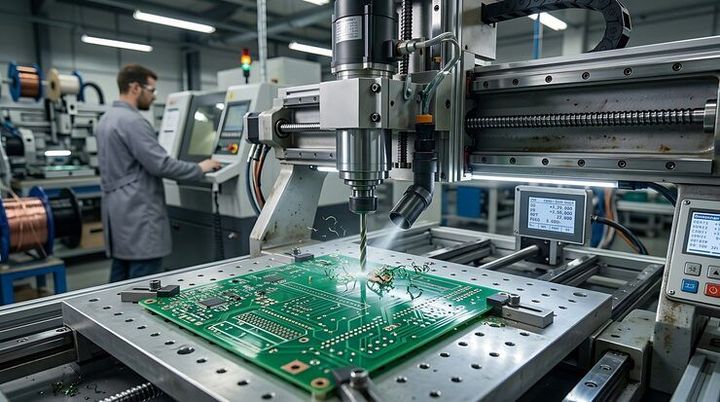
PCB production combines several stages, including board preparation, component placement, soldering, inspection, testing, and quality control. In high-volume environments, these steps are carefully coordinated so that the same design can be reproduced consistently across many units.
From Circuit Design to Assembly
The process begins with a digital PCB design that defines the board layout, component locations, electrical connections, and manufacturing requirements. The design is translated into manufacturing data that guides equipment used during fabrication and assembly.
For an assembled PCB, components may include resistors, capacitors, integrated circuits, connectors, sensors, and other electronic parts. Surface-mount technology is commonly used for compact components, while through-hole assembly remains relevant for certain components and mechanical applications.
Main Production Stages
A typical PCB assembly sequence can include:
- Preparing the bare circuit board and production data
- Applying solder paste to designated areas
- Placing electronic components
- Reflow soldering to form electrical connections
- Performing automated optical inspection
- Conducting electrical or functional testing
- Reviewing defects and carrying out controlled rework when appropriate
- Recording production and inspection information
IPC identifies J-STD-001 as a standard covering requirements for soldered electrical and electronic assemblies, while IPC-A-610 provides visual acceptability criteria for electronic assemblies.
Importance
Printed circuit board mass production matters because modern electronics often require consistent assembly across many units. Phones, computers, vehicles, industrial controls, household electronics, medical equipment, communication devices, and other systems can contain one or more PCBs.
Consistency Across Large Production Runs
Manual assembly alone can become difficult to control when thousands of similar boards are required. Automated placement and soldering equipment can repeat defined movements and process settings, while inspection systems can examine boards according to established criteria.
Consistency does not mean that every board is automatically perfect. Components can be misplaced, solder joints can have defects, and material or equipment conditions can change. This is why inspection and process monitoring are important parts of PCB mass production.
Quality and Reliability
Quality processes help identify problems before an assembled board moves further through production. Automated optical inspection can examine component placement and visible solder-related characteristics, while electrical testing can check whether specified connections or functions are present.
A structured quality process can also create records that help manufacturers trace production conditions. Traceability can connect a board with information such as component batches, inspection results, production stages, and test outcomes.
Common Challenges
PCB mass production can involve several practical challenges:
- Maintaining accurate component placement
- Controlling solder paste application
- Managing moisture-sensitive components
- Preventing contamination and handling damage
- Detecting solder and assembly defects
- Managing changes in component availability
- Keeping production data consistent
- Controlling process variation between production batches
These challenges become more important as boards contain smaller components, tighter layouts, and greater circuit density.
Recent Updates
From 2024 through 2026, electronics manufacturing has continued moving toward connected production systems, automated inspection, digital traceability, and data-based process control. IPC's 2024 industry review described developments involving factory connectivity, traceability, digital twins, cybersecurity reporting, data analytics, and automated optical inspection process control.
Greater Use of Connected Factory Systems
Connected factory technologies allow manufacturing equipment to exchange production information through standardized data structures. IPC has continued developing and maintaining standards around the Connected Factory Exchange, commonly known as CFX, which is intended to support communication between manufacturing equipment and production systems.
This direction can make production information easier to organize across machines. It also supports more detailed monitoring of process conditions and production events.
Automated Inspection and Data Analysis
Inspection technology is becoming increasingly connected with production data. Instead of treating inspection as an isolated final step, manufacturers can use inspection results to identify recurring process patterns.
Data analysis can help production teams investigate issues such as repeated solder defects, placement problems, or changes in process performance. IPC reported work related to data analytics and development of process-control guidance for automated optical inspection systems.
Updated Industry Standards
Industry standards continue to evolve as PCB assembly technologies and application requirements change. IPC materials list newer revisions such as IPC-A-610J and J-STD-001J, along with other documents covering assembly, materials, marking, connected factories, and related production topics.
The applicable revision depends on the production requirements and agreements governing a particular product. Standards should therefore be checked against the relevant manufacturing documentation rather than assumed to apply automatically.
Tools and Resources
Several tools and resources can help readers understand PCB mass production and its assembly and quality processes.
PCB Design Software
PCB design platforms allow engineers to create circuit layouts, define component positions, and prepare manufacturing data. Common capabilities include schematic capture, PCB layout, design-rule checking, and production-file generation.
Automated Optical Inspection
Automated optical inspection, or AOI, uses cameras and software to examine assembled boards. It can identify visible issues such as missing components, incorrect placement, solder-related irregularities, and certain board assembly defects.
X-Ray Inspection
X-ray inspection can examine areas that are difficult to evaluate visually. It is particularly useful for assemblies containing hidden solder connections or components underneath packages.
Electrical Testing
Electrical test systems can check selected connections and circuit characteristics. Functional testing can go further by examining whether a completed assembly behaves according to defined requirements.
Standards and Documentation
IPC standards provide structured references for PCB design, fabrication, assembly, soldering, inspection, and acceptability. Documentation such as manufacturing instructions, inspection criteria, process records, and test procedures helps maintain consistency throughout production.
| Production Stage | Typical Purpose | Example Quality Check |
|---|---|---|
| Solder Paste Printing | Apply controlled solder paste | Paste coverage and alignment |
| Component Placement | Position electronic components | Location and orientation |
| Reflow Soldering | Create solder connections | Temperature profile |
| AOI | Inspect visible assembly features | Component and solder inspection |
| X-Ray Inspection | Examine hidden connections | Internal solder joints |
| Electrical Testing | Check electrical characteristics | Continuity or circuit testing |
| Functional Testing | Evaluate intended operation | Defined operating conditions |
FAQs
What is printed circuit board mass production?
Printed circuit board mass production is the organized manufacture and assembly of large quantities of PCBs using repeatable processes, automated equipment, inspection systems, and defined quality procedures.
What are the main assembly processes in PCB mass production?
Common processes include solder paste printing, component placement, reflow soldering, inspection, electrical testing, and functional testing. The exact sequence depends on the board design and assembly requirements.
Why is quality inspection important in printed circuit board mass production?
Quality inspection helps identify problems such as incorrect component placement, solder defects, damaged parts, and electrical problems. Different inspection methods are used at different production stages.
Which standards are associated with PCB assembly quality?
IPC J-STD-001 addresses requirements for soldered electrical and electronic assemblies, while IPC-A-610 provides acceptability criteria for electronic assemblies. Other standards may apply depending on the board type, industry, and application.
How is technology changing PCB mass production?
Current trends include connected manufacturing equipment, automated inspection, digital traceability, production data analysis, and greater integration between factory systems. These developments support more detailed monitoring of production processes.
Conclusion
Printed circuit board mass production combines circuit-board preparation, component assembly, soldering, inspection, and testing into a structured manufacturing process. Automation helps repeat defined production steps, while quality systems help identify and document potential problems. Recent developments are placing greater emphasis on connected equipment, digital traceability, automated inspection, and production data analysis. Industry standards such as IPC-A-610 and J-STD-001 provide important references for assembly and quality requirements.