Laser Welding Machines Basics: Learn About Welding Methods and Components
Laser welding machines are industrial tools that use a concentrated beam of light to join two or more materials.
The process is based on laser energy being directed onto a small area, where the material absorbs heat and forms a welded joint. This approach is used across manufacturing because it can provide controlled heating and precise weld formation.
An industrial laser welding machine generally includes a laser source, focusing optics, a work area, control system, cooling arrangement, and safety enclosure or protective equipment. Depending on the application, the system may be operated manually, semi-automatically, or through programmed equipment.
The development of laser welding is connected to the wider use of lasers in industrial manufacturing. As laser technology became more practical for production environments, manufacturers began applying it to metals and other materials that require controlled joining. Today, a laser welding system can be configured for different materials, joint designs, thicknesses, and production requirements.
How Laser Welding Works
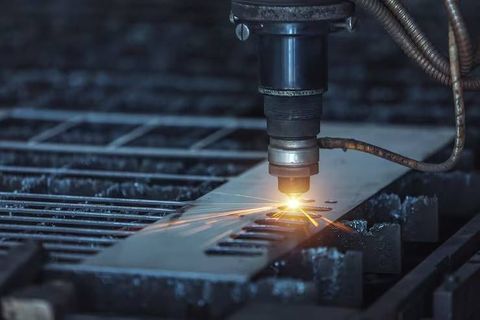
Laser welding begins when a laser source generates a concentrated beam. Optical components guide and focus the beam onto the workpiece. The concentrated energy creates localized heating, allowing the surfaces to melt and form a joint as the material cools.
Several factors influence the resulting weld, including laser power, beam diameter, travel speed, material type, joint design, and shielding conditions. These factors must be selected according to the specific application rather than treated as universal settings.
Common Welding Methods
Laser welding can use different approaches depending on the material and desired joint. Some processes create a shallow weld through heat conduction, while others use higher energy density to create deeper penetration.
Common approaches include:
- Conduction welding, where heat is transferred through the material without creating a deep vapor cavity.
- Keyhole welding, where higher energy density creates deeper penetration into the workpiece.
- Continuous welding, where the laser moves along a joint to create a continuous seam.
- Pulsed welding, where laser energy is delivered in controlled pulses for smaller or heat-sensitive components.
Importance
Laser welding matters because modern manufacturing often requires accurate joining while managing heat exposure and material distortion. Traditional welding methods can be suitable for many applications, but certain small, delicate, or precision-focused components require more localized energy.
A laser welding machine can focus energy within a relatively small area. This characteristic can help limit unnecessary heating around the joint when the process is correctly configured. Reduced surrounding heat can be important when working with thin sheets, small components, or assemblies where dimensional accuracy matters.
Laser welding is also used in industries such as automotive manufacturing, electronics, medical equipment production, aerospace manufacturing, metal fabrication, and industrial machinery. The specific application depends on material properties, required joint strength, production volume, and process design.
Main Components
A laser welding system consists of several coordinated components. Each part contributes to controlling the laser beam, positioning the workpiece, managing heat, or protecting the operator.
| Component | Main Function |
|---|---|
| Laser source | Generates the laser beam used for welding |
| Optical system | Guides and focuses the beam |
| Welding head | Directs the focused beam toward the joint |
| Control system | Manages process settings and movement |
| Cooling system | Helps regulate heat generated during operation |
| Shielding arrangement | Helps protect the weld area from unwanted atmospheric effects |
| Workholding system | Keeps components positioned during welding |
| Safety enclosure | Helps limit exposure to laser radiation |
Materials and Applications
Laser welding is commonly associated with metals such as stainless steel, carbon steel, aluminum, copper, and certain specialized alloys. Material behavior varies considerably, so the same process settings cannot automatically be applied to every material.
Applications can include sheet metal joining, precision components, structural assemblies, enclosures, tubing, electrical components, and small mechanical parts. In each case, joint geometry and material thickness influence how the process should be controlled.
Recent Updates
Recent developments from 2024 through 2026 have generally focused on improving process control, automation, monitoring, and integration with digital manufacturing systems. Rather than relying only on fixed settings, newer equipment increasingly incorporates sensors and software that can help monitor welding conditions during operation.
Automation and Process Monitoring
An automatic laser welding machine can combine laser equipment with programmable motion systems, robotic positioning, or automated material handling. Automation can provide repeatable movement and consistent process sequences when production involves repeated components.
Process monitoring is another continuing area of development. Cameras, sensors, and software can be used to observe factors such as weld position, surface conditions, and process behavior. These systems can support quality-control procedures by providing additional process information.
Greater Integration With Manufacturing Systems
Laser equipment is also becoming more connected with broader manufacturing environments. Digital controls can allow welding parameters, movement instructions, production records, and inspection information to work together within a larger production workflow.
The current trend is toward more adaptable laser welding equipment that can handle different component designs while providing greater visibility into the welding process. However, the level of automation and monitoring varies between systems.
Improvements in Beam Control
Developments in laser sources and beam delivery continue to influence welding applications. Adjustable beam characteristics can provide greater control over how energy is distributed across the weld area.
This can be useful when working with materials that have different thermal properties. For example, highly reflective materials can behave differently from stainless steel or carbon steel when exposed to laser energy, requiring appropriate process planning.
Tools and Resources
Understanding laser welding does not require access to industrial equipment. Several resources can help readers learn how the process works and compare technical requirements.
Technical Calculators and Reference Tools
Engineering calculators can help with basic conversions involving power, speed, dimensions, and material measurements. Heat-input calculations may also be used by technical professionals when evaluating welding processes.
Material reference tables can provide information about thermal conductivity, reflectivity, melting behavior, and other properties. These factors can help explain why welding parameters differ between materials.
Manufacturer Documentation and Training Resources
Technical manuals, equipment documentation, welding standards, and educational materials can explain topics such as laser classification, joint preparation, shielding, beam focusing, and workplace safety.
CAD software and simulation platforms can also be relevant when planning component geometry or automated welding paths. For automated applications, programming interfaces and robotic-control documentation may help explain how a welding system interacts with movement equipment.
Safety Resources
Laser welding involves concentrated optical energy, so safety information is an important part of understanding the technology. Appropriate laser safety procedures address beam exposure, reflections, protective equipment, enclosure design, ventilation, and controlled operating areas.
Workplace requirements can vary according to the equipment and location. General information should therefore be supplemented by applicable occupational and laser-safety requirements.
FAQs
What is a laser welding machine?
A laser welding machine uses a concentrated laser beam to heat and join materials. The equipment normally includes a laser source, optics, controls, cooling components, and a system for positioning the workpiece.
How does an industrial laser welding machine work?
An industrial laser welding machine directs a focused laser beam onto a joint. The concentrated energy heats or melts the material in a controlled area, and the molten region forms a joint as it cools.
What is a laser welding system used for?
A laser welding system can be used for joining metal sheets, tubes, components, enclosures, and precision assemblies. Applications vary according to material, thickness, joint design, and production requirements.
What does an automatic laser welding machine do?
An automatic laser welding machine uses programmed controls and mechanical movement to perform welding sequences with limited manual positioning. Automation can be integrated with robotics, fixtures, sensors, and material-handling equipment.
What factors affect laser welding quality?
Important factors include laser power, beam focus, travel speed, material properties, joint preparation, shielding conditions, and workpiece positioning. Correct process settings depend on the specific application.
Conclusion
Laser welding machines use concentrated light energy to join materials with controlled heat input. An industrial laser welding machine can contain several coordinated components, including the laser source, optics, controls, cooling system, and workholding equipment. Recent developments have placed greater emphasis on automation, process monitoring, digital integration, and beam control. Understanding these fundamentals provides a useful foundation for learning how laser welding is applied across modern manufacturing.