Industrial Robotics Explained: Types, Benefits, Applications, and Future Trends (2026 Guide)
Industrial robotics has become one of the most important technologies shaping modern manufacturing and automation. From assembling cars and packaging food to inspecting electronic devices and handling heavy materials, industrial robots help businesses improve efficiency, accuracy, and workplace safety.
As industries continue to adopt automation, industrial robotics is no longer limited to large factories. Small and medium-sized businesses are also using robotic systems to perform repetitive tasks, reduce production errors, and improve operational efficiency. Advances in artificial intelligence, sensors, and machine vision have also made robots smarter and more adaptable than ever before.
This guide explains what industrial robotics is, how it works, the different types of industrial robots, where they are used, their advantages and limitations, and the trends shaping the future of industrial automation.
What Is Industrial Robotics?
Industrial robotics refers to the design, development, and use of programmable robotic systems to perform manufacturing or industrial tasks automatically. These robots are designed to handle repetitive, precise, and physically demanding jobs that would otherwise require manual labor.
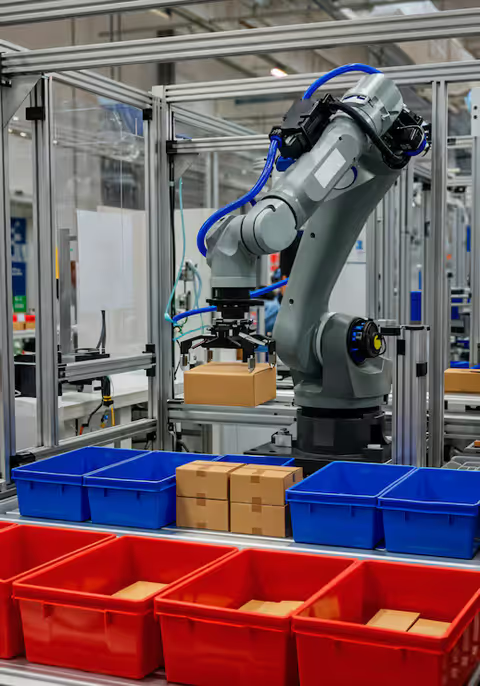
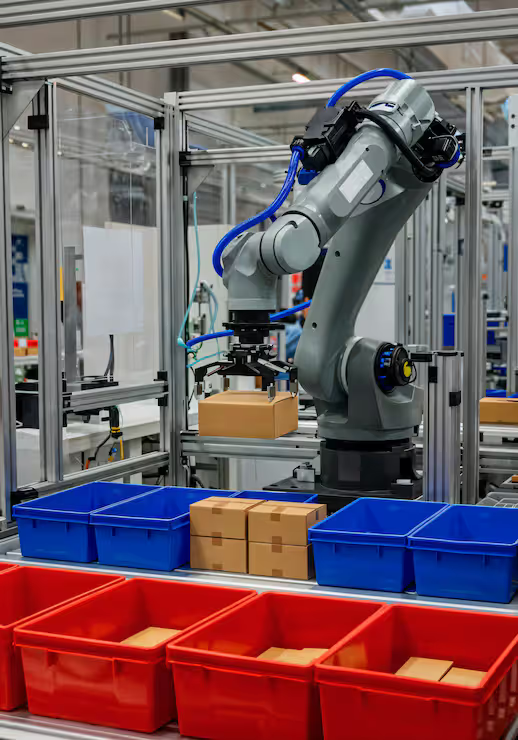
An industrial robot is typically a programmable mechanical arm equipped with motors, sensors, controllers, and specialized tools known as end effectors. Depending on its purpose, the end effector may be a gripper, welding torch, spray gun, cutting tool, or suction device.
Industrial robots operate using programmed instructions and can perform tasks with high speed, accuracy, and consistency. Many modern robotic systems also use cameras, sensors, and artificial intelligence to adapt to changing environments and improve decision-making.
How Industrial Robots Work
Industrial robots work through a combination of hardware and software components that communicate to perform specific tasks.
The basic working process includes:
Programming: Instructions are created using robot programming software or teach pendants.
Control System: A controller interprets commands and coordinates robot movements.
Sensors: Cameras, force sensors, proximity sensors, and vision systems collect information from the environment.
Actuators and Motors: Motors move robotic joints with precise control.
End Effector: The robot performs the required task, such as picking, welding, painting, or assembling.
Modern robots can also communicate with other machines through industrial networks, making them an important part of smart factories and Industry 4.0 environments.
Main Types of Industrial Robots
Different industries require different robot designs depending on workspace, speed, payload, and movement.
Articulated Robots
Articulated robots have multiple rotating joints that provide flexibility similar to a human arm. They are commonly used for welding, assembly, material handling, and painting.
SCARA Robots
Selective Compliance Assembly Robot Arm (SCARA) robots specialize in fast, precise horizontal movements. They are widely used in electronics manufacturing and assembly lines.
Cartesian Robots
Cartesian robots move along three linear axes. They are ideal for CNC machines, 3D printing, packaging, and pick-and-place operations where straight-line movement is required.
Delta Robots
Delta robots use lightweight arms connected to a central base, allowing extremely fast movement. They are commonly used in food processing, pharmaceuticals, and packaging industries.
Cylindrical Robots
Cylindrical robots combine rotational and linear movements and are suitable for machine loading, material handling, and simple assembly tasks.
Collaborative Robots (Cobots)
Collaborative robots are designed to work safely alongside humans. They use advanced sensors and force-limiting technology to detect nearby workers and reduce collision risks.
Cobots are increasingly popular among smaller manufacturers because they are easier to install and reprogram for different production tasks.
Common Applications of Industrial Robotics
Industrial robots are used across many sectors because they improve efficiency and reduce repetitive manual work.
Automotive Manufacturing
The automotive industry is one of the largest users of industrial robotics. Robots handle welding, painting, assembly, material transport, and quality inspection with high precision.
Electronics Manufacturing
Electronics production requires extremely accurate assembly of small components. Robots perform soldering, circuit board assembly, testing, and packaging.
Food and Beverage Industry
Robots assist in sorting, packaging, palletizing, labeling, and quality inspection while maintaining hygiene standards.
Pharmaceutical Manufacturing
Industrial robots handle medicine packaging, laboratory automation, sterile material handling, and inspection in controlled environments.
Metal Fabrication
Robots perform cutting, welding, grinding, polishing, and material handling in heavy manufacturing facilities.
Logistics and Warehousing
Warehouses use robotic systems for picking products, sorting packages, palletizing goods, and moving inventory between storage locations.
Benefits of Industrial Robotics
Industrial robotics provides advantages for manufacturers, workers, and consumers alike.
Higher Productivity
Robots can operate continuously with minimal downtime, increasing production output without reducing consistency.
Improved Accuracy
Programmable robotic systems perform tasks repeatedly with precise movements, reducing manufacturing defects.
Better Workplace Safety
Robots can perform hazardous jobs involving heat, chemicals, heavy lifting, or repetitive movements, reducing workplace injuries.
Consistent Product Quality
Unlike manual operations, robots maintain consistent performance throughout production shifts, improving product quality.
Reduced Material Waste
Accurate robotic movements minimize errors, helping manufacturers reduce waste and improve resource utilization.
Flexible Manufacturing
Modern robotic systems can be reprogrammed for different products, allowing manufacturers to adapt production lines more quickly.
Challenges and Limitations of Industrial Robotics
Although industrial robotics offers many benefits, organizations should understand its limitations before implementation.
High Initial Investment
Installing robotic systems requires investment in equipment, software, integration, and employee training.
Skilled Workforce Requirements
Engineers and technicians are needed to program, maintain, troubleshoot, and optimize robotic systems.
Integration Complexity
Connecting robots with existing manufacturing equipment and software may require significant planning and customization.
Maintenance Requirements
Robotic systems need regular inspection, calibration, and preventive maintenance to maintain performance.
Limited Adaptability for Certain Tasks
Some highly variable or delicate tasks still require human judgment and manual skills despite advances in robotics.
Industrial Robotics and Artificial Intelligence
Artificial intelligence is making industrial robots smarter and more capable.
AI-powered industrial robots can:
Recognize objects using computer vision.
Detect product defects automatically.
Optimize movement paths.
Learn from production data.
Predict maintenance needs.
Adapt to changing production conditions.
Instead of simply repeating programmed movements, AI-enabled robots can analyze their environment and improve efficiency over time.
Machine learning algorithms also help robots improve quality inspection by identifying patterns that traditional systems may miss.
Industrial Robotics in Industry 4.0
Industry 4.0 refers to the integration of digital technologies into manufacturing. Industrial robotics plays a central role in this transformation.
Key Industry 4.0 features include:
Smart factories.
Internet of Things (IoT) connectivity.
Cloud computing.
Real-time production monitoring.
Predictive maintenance.
Digital twins.
Data-driven decision-making.
Robots connected through industrial networks can communicate with machines, sensors, and production software, creating highly automated manufacturing systems.
Industrial Robotics and Human Workers
A common question is whether industrial robots replace human jobs.
The reality is more balanced. Industrial robotics automates repetitive, dangerous, and physically demanding tasks while creating demand for new technical roles such as:
Robot programmers.
Automation engineers.
Maintenance technicians.
AI specialists.
Systems integrators.
Robotics operators.
In many workplaces, humans and robots work together, combining robotic precision with human creativity and decision-making.
Collaborative robots are especially designed to support workers rather than replace them entirely.
Key Components of an Industrial Robotics System
An industrial robotic system includes several interconnected components.
Component | Function |
|---|---|
Robot Arm | Performs programmed movements. |
Controller | Processes instructions and coordinates actions. |
Sensors | Detect objects, position, force, and environmental conditions. |
End Effector | Interacts with products through gripping, welding, cutting, or suction. |
Programming Software | Creates and modifies robotic tasks. |
Safety Systems | Protect workers through emergency stops, sensors, and safety barriers. |
Each component contributes to accurate, reliable, and safe robotic operation.
Safety in Industrial Robotics
Safety remains a priority when deploying industrial robots.
Common robotic safety measures include:
Emergency stop systems.
Safety fences and barriers.
Light curtains.
Motion detection sensors.
Speed monitoring.
Collision detection.
Collaborative safety features for cobots.
Organizations also provide employee training on safe robot operation and maintenance procedures.
Modern safety standards focus on reducing risks while allowing efficient human-robot collaboration.
Future Trends in Industrial Robotics
Industrial robotics continues to evolve with advances in automation and digital technologies.
Collaborative Automation
Cobots are expected to become more common across manufacturing, healthcare, and logistics due to their flexibility and safety.
AI-Driven Robotics
Artificial intelligence will improve autonomous decision-making, predictive maintenance, and adaptive manufacturing.
Machine Vision Improvements
Better vision systems will allow robots to identify objects, inspect products, and operate in more complex environments.
Mobile Industrial Robots
Autonomous mobile robots are increasingly transporting materials across factories and warehouses without fixed tracks.
Cloud Robotics
Cloud-connected robots can receive software updates, share operational data, and learn from centralized systems.
Sustainable Manufacturing
Robotic automation helps optimize energy use, reduce waste, and improve resource efficiency, supporting sustainability goals.
Industries Benefiting Most from Industrial Robotics
Industrial robotics supports a wide range of industries.
Industry | Common Robotic Applications |
| Automotive | Welding, assembly, painting, inspection. |
| Electronics | Soldering, component placement, testing. |
| Food and Beverage | Packaging, sorting, palletizing, labeling. |
| Pharmaceuticals | Sterile handling, packaging, laboratory automation. |
| Logistics | Picking, sorting, warehouse automation. |
| Metal Manufacturing | Cutting, welding, grinding, polishing. |
| Consumer Goods | Assembly, packaging, quality inspection. |
This diversity shows how robotics has expanded beyond traditional manufacturing into many industrial operations.
How Businesses Can Prepare for Industrial Robotics
Successful robotic implementation requires planning beyond purchasing equipment.
Important preparation steps include:
Identifying repetitive tasks suitable for automation.
Evaluating workflow and production requirements.
Training employees on robotic operation and safety.
Planning maintenance schedules.
Integrating robots with existing manufacturing systems.
Monitoring performance using production data.
A gradual implementation strategy often helps organizations adopt automation with minimal disruption.
Conclusion
Industrial robotics has become a foundational technology for modern manufacturing and industrial automation. By combining precision, speed, consistency, and intelligent automation, industrial robots help industries improve productivity, enhance workplace safety, and maintain high-quality production standards.
As artificial intelligence, machine vision, IoT connectivity, and collaborative robotics continue to evolve, industrial robotics will become even more flexible and accessible across industries of all sizes. Rather than replacing human expertise, the future of industrial robotics is increasingly focused on collaboration between people and intelligent machines.
Understanding how industrial robotics works, where it is applied, and the technologies driving its evolution helps businesses, students, engineers, and technology enthusiasts prepare for the next generation of smart manufacturing and automated industrial systems.