Industrial Heat Exchangers: Comprehensive Guide with Practical Advice and Resources
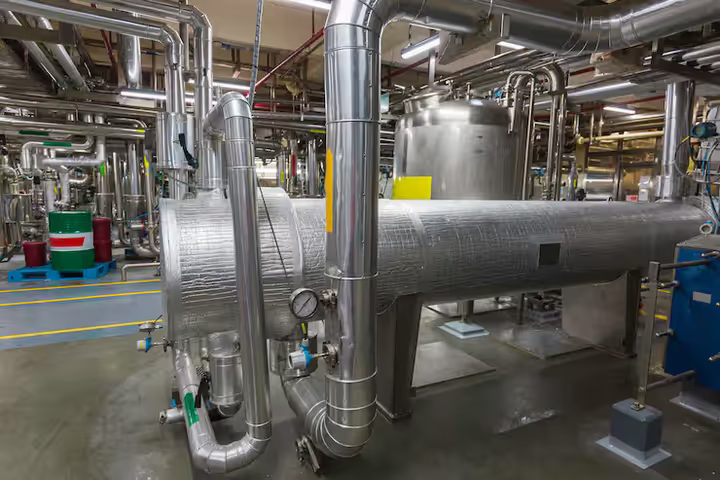
Industrial heat exchangers are mechanical devices designed to transfer thermal energy between two or more fluid streams without the fluids mixing.
In essence, when a hot fluid gives up heat and a colder fluid absorbs it (or vice-versa), a heat exchanger allows that exchange under controlled conditions. The reason they exist is to improve energy efficiency, manage temperatures, enable chemical or mechanical processes to occur under safe conditions, reclaim waste heat and reduce energy losses.
In essence, when a hot fluid gives up heat and a colder fluid absorbs it (or vice-versa), a heat exchanger allows that exchange under controlled conditions. The reason they exist is to improve energy efficiency, manage temperatures, enable chemical or mechanical processes to occur under safe conditions, reclaim waste heat and reduce energy losses.
Importance
The topic matters for several reasons:
-
Energy efficiency: Heat exchangers help industries reduce waste heat, recover energy, and reduce the amount of fuel or electricity needed.
-
Process control and safety: Many industrial processes require specific temperature ranges; a well-designed exchanger ensures thermal regulation.
-
Environmental impact: By improving thermal management and reducing heat losses, they contribute to lower greenhouse-gas emissions or reduced resource consumption.
-
Equipment lifetime and maintenance: Poorly maintained heat exchangers can become inefficient, fouled, corroded, or fail—leading to downtime or higher operating costs.
-
Broad reach: They affect many sectors—power generation, chemical & petrochemical industries, oil & gas, HVAC & refrigeration, food & beverage processing, among others—so stakeholders range from plant engineers to facility managers to sustainability officers.
By solving problems like excess heat discharge, inefficient cooling/heating, unsafe process temperatures or high energy consumption, these devices are central to modern industrial infrastructure.
Recent Updates
In the past year or so, several key changes and trends have emerged:
-
The global heat exchanger market was estimated at USD 17.3 billion in 2024, with an expected compound annual growth rate (CAGR) of around 8.4% from 2025 to 2034.
-
Technology innovation: Advances include integration of digital monitoring, predictive maintenance sensors, data-analytics for fouling detection, and compact/micro-channel designs for higher performance in smaller footprints.
-
In India specifically, the India heat exchanger market is projected to reach around USD 1,428.4 million by 2033, driven by energy-efficiency and industrialisation efforts.
-
A shift toward newer materials and manufacturing technologies (for example additive manufacturing of compact plate heat exchangers) is beginning to influence how heat exchangers are designed and built.
These updates show the field is dynamic: efficiency demands, regulatory pressure and new tech are converging.
Laws or Policies
Since you are based in India (Surat, Gujarat), here are relevant rules & policies that affect industrial heat exchangers in Indian context:
-
The Bureau of Energy Efficiency (BEE) under the Energy Conservation Act 2001 has set frameworks for energy-efficient equipment use.
-
Guidelines exist for periodic performance assessment of heat exchangers: for example, monitoring overall heat transfer coefficient, fouling measures, historical data etc.
-
Standards by the Bureau of Indian Standards (BIS) such as IS 4503 for shell & tube heat exchangers set requirements around design, construction, inspection and testing.
-
The energy conservation guidelines for industries (Category-A) require that major energy-consuming equipment (including heat/recovery systems) be optimised, maintained, documented and audited.
Therefore, anyone working with heat exchangers must be aware of compliance to standards, regular performance monitoring, and energy-efficiency obligations.
Tools and Resources
Here are helpful tools and resources you can use:
-
Performance calculators: Many industrial guides provide spreadsheets or formulas to compute overall heat transfer coefficient (U-value), Log Mean Temperature Difference (LMTD), heat duty, etc. (See energy performance assessment guidelines.)
-
Maintenance and monitoring templates: Facilities often keep historical records of heat exchanger performance (e.g., fouling resistance vs time, pressure drop vs flow) to plan cleaning schedules.
-
Industry-specific data dashboards or market-reports: Reports on market size, growth, regional insights.
-
Standards and specification documents: BIS standards, ISO/ASME equivalents, design manuals.
-
Educational guides and blogs: For example articles discussing “heat exchangers in industrial processes” that explain principles, common issues, maintenance tips.
-
Software tools: Some vendors provide digital-monitoring systems or condition-monitoring sensors that track performance over time, alerting for fouling or degradation.
Using any combination of the above will help you maintain, evaluate and optimise heat exchanger performance.
FAQs
Q1: What are the main types of industrial heat exchangers?
A: The common categories include shell-and-tube, plate-and-frame (or plate-and-shell), air-cooled units, finned-tube designs and double-pipe exchangers. Each has strengths: for example shell-and-tube are robust for high-pressure industrial settings, plate types offer compact footprint and good heat transfer per area.
Q2: Why does heat exchanger efficiency degrade over time?
A: Efficiency falls mainly due to fouling (deposits on tube walls or plates), corrosion, scaling, leaks, flow restrictions or temperature/flow rate deviations from design. These increase resistance to heat transfer or lower the effective surface area, reducing performance. Periodic monitoring (e.g., U-value trends) helps detect these issues.
Q3: How can I tell if a heat exchanger needs maintenance or cleaning?
A: Indicators include increased pressure drop across the unit, decreased temperature change of fluids compared to design, drop in heat duty, reduction in overall heat transfer coefficient. If historical data show a downward trend, it may be time for cleaning or inspection.
Q4: What role does the heat exchanger play in energy savings?
A: By recovering waste heat, reducing the need for fresh heating/cooling power, enabling more efficient operation of process systems, a properly sized and maintained heat exchanger lowers energy use and associated emissions. Therefore it is a key element in an energy-management strategy.
Q5: Are there materials or design choices that improve heat exchanger life and performance?
A: Yes. Materials with higher corrosion resistance (stainless steel, nickel alloys), designs that reduce fouling, compact channels to increase surface area to volume ratio, strategic fluid flow arrangements (counter-flow rather than parallel flow), and advanced manufacturing (e.g., micro-channels, additive manufacturing) all contribute to improved performance and longevity. Recent studies show new geometries improving thermal performance.
Conclusion
Industrial heat exchangers are fundamental to modern process and utility systems. They exist to enable controlled heat transfer between fluids, and they matter today because energy efficiency, process reliability and environmental concerns are central to industrial operations. Recent trends show growing market size, stronger energy-efficiency demands and rapid technological innovation. From a regulatory standpoint, especially in India, standards and energy-conservation laws govern design, operation and monitoring of such equipment. By drawing on performance tools, monitoring systems, maintenance templates and industry knowledge resources, organisations can optimise heat-exchanger performance, reduce energy usage and improve operational reliability. For anyone involved in engineering, facility management or sustainability roles, understanding heat-exchanger systems is a valuable asset.