CNC Milling Machines: Complete Guide to Types, Applications, Benefits, and Modern Technology
CNC milling machines have become one of the most important tools in modern manufacturing. From automotive components and aerospace parts to medical devices and consumer products, these machines help create highly accurate and consistent parts with minimal human intervention.
The term CNC stands for Computer Numerical Control, a technology that allows machines to follow programmed instructions to perform cutting, drilling, shaping, and finishing operations. CNC milling machines are widely used because they combine precision, efficiency, and repeatability, making them suitable for both small-scale production and large industrial manufacturing.
Understanding how CNC milling machines work, their different types, and their applications can help businesses, engineers, and manufacturing professionals make informed decisions when selecting machining solutions.
What Is a CNC Milling Machine?
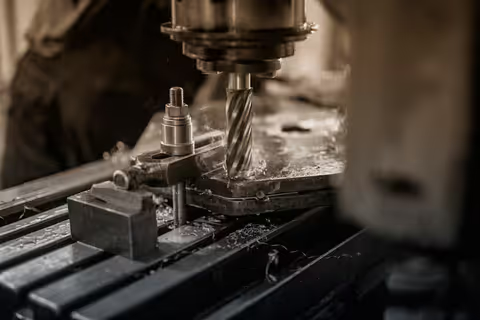
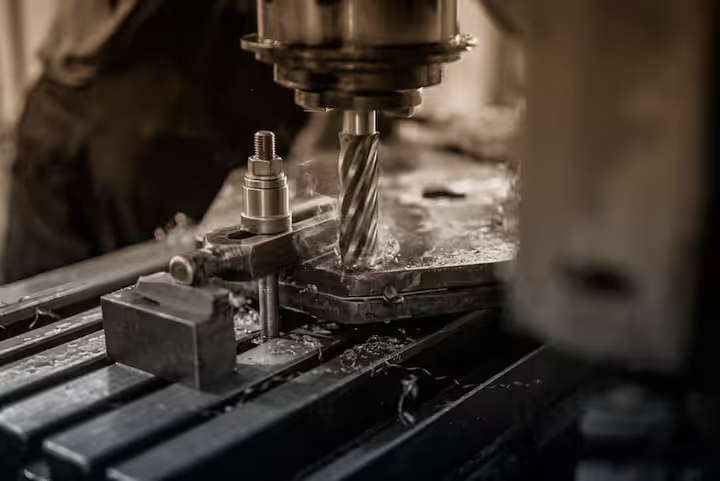
A CNC milling machine is a computer-controlled machine tool that removes material from a workpiece using rotating cutting tools. The machine follows digital instructions created through computer-aided design (CAD) and computer-aided manufacturing (CAM) software.
Unlike traditional manual milling machines, CNC systems automate the machining process, reducing the need for constant operator control. This automation allows manufacturers to produce complex shapes and detailed components with a high degree of accuracy.
The machine can move in multiple directions while the cutting tool rotates at high speed, gradually removing material to create the desired shape and dimensions.
How CNC Milling Machines Work
The operation of a CNC milling machine follows a structured workflow:
1. Design Creation
The process begins with a digital design created using CAD software. Engineers develop a detailed model of the part that needs to be manufactured.
2. Toolpath Generation
CAM software converts the design into machine-readable instructions known as G-code. These instructions define tool movements, cutting speeds, feed rates, and machining operations.
3. Machine Setup
The workpiece is securely mounted on the machine table, and the appropriate cutting tools are installed.
4. Automated Machining
The CNC controller interprets the G-code and directs the machine to perform the required cutting operations with precision.
5. Inspection and Finishing
After machining, the finished component is inspected to verify dimensional accuracy and quality requirements.
This automated workflow significantly reduces human error while improving production consistency.
Main Components of a CNC Milling Machine
Several key components work together to ensure efficient machining operations.
CNC Controller
The controller serves as the machine's brain. It interprets programmed instructions and coordinates movement across multiple axes.
Spindle
The spindle rotates cutting tools at various speeds depending on the material and machining requirements.
Cutting Tools
Different cutting tools are used for specific operations such as drilling, slotting, contouring, and finishing.
Worktable
The worktable securely holds the material being machined and allows precise positioning during operations.
Drive System
Motors and ball screws enable accurate movement of machine components along programmed paths.
Coolant System
Coolant helps reduce heat generation, improve tool life, and maintain machining accuracy.
Types of CNC Milling Machines
Different manufacturing requirements have led to the development of various CNC milling machine configurations.
Vertical CNC Milling Machines
In vertical milling machines, the spindle is positioned vertically above the workpiece.
These machines are commonly used for:
- Surface machining
- Drilling operations
- Slot cutting
- General-purpose manufacturing
Vertical machines are popular because they are versatile, relatively simple to operate, and suitable for many production environments.
Horizontal CNC Milling Machines
Horizontal milling machines feature a spindle mounted parallel to the worktable.
Advantages include:
- Better chip evacuation
- Improved productivity
- Efficient machining of large components
- Enhanced performance for heavy-duty cutting
They are often used in automotive and industrial manufacturing applications.
3-Axis CNC Milling Machines
A 3-axis machine moves along the X, Y, and Z directions.
These machines are ideal for:
- Basic machining operations
- Flat surfaces
- Standard mechanical components
- Educational and small manufacturing environments
4-Axis CNC Milling Machines
A fourth rotational axis allows the workpiece to rotate during machining.
Benefits include:
- Reduced setup time
- Improved part complexity
- Greater machining flexibility
5-Axis CNC Milling Machines
5-axis machines can move along five different axes simultaneously.
They are commonly used for:
- Aerospace components
- Medical implants
- Complex molds
- High-precision engineering parts
These machines enable the production of highly intricate geometries that would be difficult or impossible using traditional methods.
Common Materials Used in CNC Milling
CNC milling machines can process a wide range of materials.
Metals
Common metals include:
- Aluminum
- Steel
- Stainless steel
- Brass
- Copper
- Titanium
Plastics
Many industries machine engineering plastics such as:
- ABS
- Nylon
- Polycarbonate
- Acrylic
- PEEK
Composite Materials
Advanced manufacturing sectors often use composite materials that require precise machining capabilities.
Material selection depends on the final product's strength, durability, weight, and performance requirements.
Applications of CNC Milling Machines
CNC milling technology supports numerous industries worldwide.
Aerospace Industry
Aircraft manufacturers use CNC milling machines to produce lightweight and highly accurate components, including structural parts and engine components.
Automotive Manufacturing
Vehicle manufacturers rely on CNC milling for producing engine parts, transmission components, brackets, and prototypes.
Medical Sector
Medical device manufacturers use CNC machining to create surgical instruments, implants, and precision equipment that require strict dimensional accuracy.
Electronics Industry
CNC milling is used to produce housings, connectors, heat sinks, and specialized electronic components.
Industrial Equipment
Manufacturers of machinery and equipment depend on CNC milling for producing gears, shafts, fixtures, and custom components.
Prototype Development
Product designers and engineers frequently use CNC milling to create prototypes before moving into full-scale production.
Benefits of CNC Milling Machines
The widespread adoption of CNC milling machines is driven by several important advantages.
High Precision
CNC systems can achieve extremely tight tolerances, ensuring consistent quality across production runs.
Repeatability
Once a program is created, the machine can produce identical parts repeatedly with minimal variation.
Increased Productivity
Automation allows continuous operation and faster production cycles compared to manual machining.
Reduced Human Error
Computer-controlled operations minimize mistakes caused by manual adjustments.
Complex Part Production
Advanced CNC machines can manufacture intricate shapes and geometries that would be difficult using conventional methods.
Better Material Utilization
Accurate toolpaths help reduce waste and improve overall manufacturing efficiency.
Challenges and Considerations
Despite their advantages, CNC milling machines also present certain challenges.
Initial Investment
Advanced CNC equipment requires significant capital investment and proper planning.
Skilled Programming Requirements
Operators and programmers must understand CAD, CAM, and machine operation principles.
Maintenance Needs
Regular maintenance is necessary to ensure consistent accuracy and machine reliability.
Tool Management
Cutting tools experience wear over time and require monitoring and replacement.
Organizations should evaluate production goals, material requirements, and workforce capabilities before implementing CNC milling solutions.
Recent Trends in CNC Milling Technology
Modern CNC milling continues to evolve through technological innovation.
Smart Manufacturing Integration
Many CNC systems now connect with industrial networks, enabling real-time monitoring and production optimization.
Automation and Robotics
Automated loading and unloading systems improve efficiency while reducing manual handling.
Advanced Software Solutions
Modern CAD and CAM platforms provide better simulation capabilities, helping manufacturers optimize machining strategies before production begins.
Predictive Maintenance
Machine sensors can monitor performance and identify potential issues before failures occur.
Artificial Intelligence Applications
AI-driven manufacturing systems are increasingly being used to improve process efficiency, tool management, and production planning.
These developments support higher productivity, improved quality control, and more efficient manufacturing operations.
Choosing the Right CNC Milling Machine
Selecting the appropriate CNC milling machine depends on several factors:
- Type of parts being manufactured
- Material requirements
- Production volume
- Required precision levels
- Available workspace
- Automation needs
- Future scalability goals
A thorough evaluation of manufacturing objectives helps ensure the selected machine aligns with long-term operational requirements.
Conclusion
CNC milling machines play a critical role in modern manufacturing by delivering precision, consistency, and efficiency across a wide range of industries. Their ability to automate complex machining tasks has transformed how products are designed, prototyped, and produced.
From basic 3-axis systems to advanced 5-axis machining centers, CNC milling technology continues to evolve alongside innovations in automation, software, and smart manufacturing. As industries demand greater accuracy and faster production, CNC milling machines remain an essential foundation of modern industrial production, supporting the creation of high-quality components that power today's technological world.