Self-Driving Car Sensors: Guide to LiDAR, Radar, Cameras, and Vehicle Perception
Self-Driving Car Sensors: Guide to LiDAR, Radar, Cameras, and Vehicle Perception explains how autonomous vehicles use different sensing technologies to understand roads, objects, vehicles, pedestrians, and surrounding conditions. It covers LiDAR, radar, cameras, sensor fusion, perception systems, environmental factors, and recent developments in vehicle sensing.
Self-Driving Car Sensors: Guide to LiDAR, Radar, Cameras, and Vehicle Perception
Context
Self-driving car sensors are technologies that help vehicles detect and interpret their surroundings. Autonomous driving systems rely on combinations of cameras, radar, LiDAR, ultrasonic sensors, positioning technologies, and other sources of information to build an understanding of the vehicle's environment.
A vehicle needs information about roads, lanes, traffic signals, other vehicles, pedestrians, cyclists, obstacles, and road boundaries. Sensors provide observations that can be processed by onboard computing systems and used by perception, planning, and control software.
No single sensor provides perfect information in every situation. Cameras can capture visual details and colors, radar can measure distance and relative movement, and LiDAR can provide detailed three-dimensional measurements. Combining different sensor types can provide complementary information.
Main Types of Self-Driving Car Sensors
The major sensor categories used in autonomous driving include:
Cameras: Capture visual information such as road markings, traffic signs, objects, and signals.
LiDAR: Uses laser pulses to measure distances and create three-dimensional representations.
Radar: Uses radio waves to detect objects and estimate distance and relative movement.
Ultrasonic sensors: Detect nearby objects at short distances.
GNSS and positioning systems: Provide location information using satellite-based positioning.
Inertial sensors: Measure movement, acceleration, and orientation.
Sensor fusion systems: Combine information from multiple sensing technologies.
Different autonomous-driving architectures use different combinations of these technologies.
How Sensors Support Vehicle Perception
Vehicle perception is the process of interpreting sensor observations to understand the surrounding environment.
A simplified perception workflow can include:
Sensing: Sensors collect information from the vehicle's surroundings.
Preprocessing: Raw sensor signals are prepared for analysis.
Detection: Objects and environmental features are identified.
Classification: Detected objects are categorized.
Tracking: The system monitors how detected objects move.
Sensor fusion: Information from multiple sensors is combined.
Scene understanding: The system builds an environmental representation.
Planning: Driving software uses the perception output to determine possible actions.
Perception is therefore more than simply detecting objects. The system needs to interpret relationships, movement, road structure, and changing conditions.
Importance
Self-driving car sensors are important because autonomous vehicles need continuous environmental information to operate safely within their defined capabilities.
Sensor performance can affect the quality of perception and the decisions made by downstream systems.
Cameras
Cameras provide rich visual information. They can capture colors, shapes, road markings, traffic signs, traffic lights, and other visual features.
Computer vision algorithms can process camera images to identify objects and interpret road scenes.
However, camera performance can be affected by lighting, glare, shadows, fog, rain, dirt, and obstructions. For this reason, autonomous systems may combine cameras with other sensor technologies.
LiDAR
LiDAR, or Light Detection and Ranging, uses laser pulses to measure the distance to surrounding objects. The resulting measurements can form a three-dimensional point cloud.
LiDAR can provide detailed information about object shape and spatial relationships. It can be useful for identifying road boundaries, vehicles, structures, and other objects.
Performance can be influenced by weather, surface characteristics, sensor placement, and other environmental factors.
Radar
Automotive radar uses radio waves to detect objects and measure distance and relative movement. Radar can be useful for detecting vehicles and other objects over different distances.
Radar can provide information that complements camera-based perception. Its characteristics can also make it useful in some conditions where visual sensing is more difficult.
Ultrasonic Sensors
Ultrasonic sensors generally operate over shorter distances than many camera, LiDAR, or radar systems. They can be useful for detecting nearby objects during low-speed maneuvers and parking-related activities.
Their limited range makes them one component of a broader sensing architecture.
Sensor Fusion
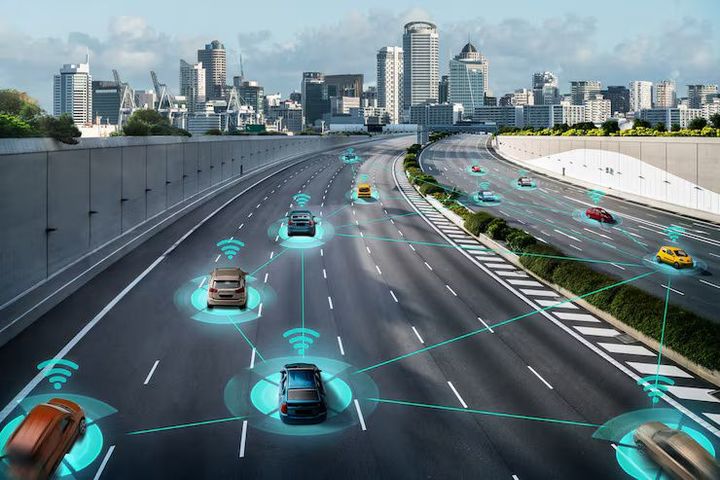
Sensor fusion combines observations from multiple sensors. The purpose is to create a more complete environmental representation than would normally be available from a single sensing technology.
For example, a camera can provide visual classification information while radar provides distance and relative velocity. A fusion system can combine these observations when they refer to the same object.
| Sensor | Main Information | Typical Strength |
|---|---|---|
| Camera | Visual appearance and imagery | Detailed visual information |
| LiDAR | 3D distance measurements | Spatial structure |
| Radar | Distance and relative movement | Object detection and velocity information |
| Ultrasonic | Short-range distance | Nearby-object detection |
| GNSS | Position | Geographic localization |
| IMU | Motion and orientation | Vehicle movement estimation |
Redundancy
Using multiple sensing technologies can provide redundancy. If one sensor has reduced performance under certain conditions, another may provide complementary information.
Redundancy does not automatically guarantee safe operation. The system must still detect sensor failures, interpret conflicting information, and operate within validated limits.
Recent Updates
From 2024 through 2026, self-driving car sensor development has continued to focus on improved perception, sensor fusion, AI-based processing, hardware integration, and better performance across varied driving environments.
Advanced Camera Systems
Camera systems continue to improve through higher-resolution imaging, wider fields of view, improved low-light performance, and computational image processing.
AI-based vision models are increasingly important for interpreting camera data. These systems can identify road users, signs, lanes, traffic signals, and other scene elements.
LiDAR Development
LiDAR technology continues to evolve through improvements in range, resolution, scanning approaches, integration, and hardware design.
Different LiDAR architectures can provide different combinations of field of view, point density, range, and physical packaging.
Radar Improvements
Automotive radar technology is developing toward higher resolution and more detailed environmental information.
Modern radar systems can provide richer information about the location and movement of objects, helping complement cameras and other sensors.
AI-Based Perception
Machine learning has become central to many vehicle perception systems. AI models can process images, point clouds, radar information, and fused sensor data to identify and track objects.
The models require extensive development and validation because road environments contain many unusual and changing situations.
Sensor Fusion
Modern autonomous-driving architectures increasingly combine multiple sensor inputs through sophisticated fusion algorithms.
Fusion can occur at different stages. Some systems combine processed object information, while others integrate lower-level sensor data before producing a final environmental representation.
Edge Computing
Autonomous vehicles require substantial onboard computing because perception and control need to operate with low latency.
Specialized processors and automotive computing platforms can process sensor information inside the vehicle. This reduces dependence on remote systems for immediate driving functions.
Sensor Cleaning and Monitoring
Sensors mounted on vehicles can become affected by dirt, water, snow, dust, or physical damage.
Sensor monitoring and cleaning technologies therefore remain important. Systems can also monitor sensor health and identify conditions that may reduce perception performance.
Software-Defined Vehicles
Vehicle software architectures are increasingly designed to support updates and centralized processing across multiple vehicle functions.
This can affect sensor systems because perception software, sensor calibration, diagnostics, and computing platforms can evolve throughout the vehicle lifecycle.
Laws or Policies
Self-driving car sensors operate within a broader framework of vehicle safety regulations, testing requirements, data protection rules, cybersecurity practices, and local transportation laws.
Requirements differ substantially between jurisdictions and depend on the level of automation, vehicle type, testing environment, and intended deployment.
Vehicle Safety
Autonomous-driving systems must be developed and evaluated according to applicable vehicle safety requirements. Sensor performance is one part of the overall safety architecture.
Testing can evaluate perception under different road, lighting, traffic, and environmental conditions.
Functional Safety
Automotive electronic systems are subject to engineering practices designed to address hazards arising from system failures. Functional-safety processes can apply to sensors, electronic control systems, computing platforms, and related components.
Safety engineering should consider sensor failure, incorrect readings, communication problems, and other potential failure modes.
Cybersecurity
Connected vehicles contain numerous electronic systems and communication interfaces. Sensor data can therefore be part of a broader vehicle cybersecurity architecture.
Security measures can include authentication, secure communications, access controls, software integrity protections, monitoring, and controlled software updates.
Data Privacy
Vehicle cameras and other sensors may capture information about people, license plates, locations, or surrounding properties.
Where such information constitutes personal data under applicable law, organizations need to consider appropriate privacy, processing, retention, access, and security requirements.
Testing and Deployment
Autonomous-driving systems may be subject to specific testing or deployment requirements depending on the jurisdiction.
Organizations should distinguish between experimental testing, driver-assistance functionality, and higher levels of vehicle automation when evaluating applicable requirements.
Tools and Resources
Developing and evaluating self-driving car sensors requires hardware, software, simulation, data, and testing resources.
Sensor Calibration Tools
Cameras, LiDAR units, radar systems, and other sensors need appropriate calibration so that their measurements can be correctly interpreted by the vehicle system.
Calibration requirements vary by sensor type and vehicle architecture.
Simulation Platforms
Simulation environments can recreate road scenes, traffic conditions, weather scenarios, and sensor inputs.
They allow developers to evaluate perception systems across many scenarios before or alongside physical testing.
Data Collection Systems
Autonomous-driving development requires large collections of sensor data for training, validation, testing, and system analysis.
Datasets can include camera imagery, LiDAR point clouds, radar measurements, vehicle motion data, and environmental information.
Perception Software
Perception software processes sensor inputs and identifies objects, road structures, movement, and other environmental features.
Modern systems often use machine-learning models alongside traditional algorithms.
Sensor Fusion Frameworks
Fusion frameworks combine information from different sensors and align observations in time and space.
Accurate synchronization and calibration are important because sensors may have different sampling rates, fields of view, measurement characteristics, and locations on the vehicle.
Vehicle Testing Equipment
Physical testing can use instrumented vehicles, test tracks, controlled environments, data-recording systems, and measurement equipment.
Testing helps compare sensor performance under different conditions and identify system limitations.
Mapping and Localization Tools
Autonomous vehicles can use maps, positioning information, inertial measurements, and sensor observations for localization.
The appropriate combination depends on the driving system and operating environment.
FAQs
What are Self-Driving Car Sensors?
Self-driving car sensors are technologies that collect information about a vehicle's surroundings and movement. Common examples include cameras, LiDAR, radar, ultrasonic sensors, GNSS, and inertial sensors.
What is the difference between LiDAR and radar?
LiDAR uses laser light to measure distances and create detailed three-dimensional information, while radar uses radio waves to detect objects and measure distance and relative movement. Their different characteristics allow them to complement one another.
Why are cameras important in autonomous vehicles?
Cameras capture detailed visual information about road scenes. They can help identify lanes, signs, traffic signals, vehicles, pedestrians, and other visually recognizable features.
What is sensor fusion in self-driving vehicles?
Sensor fusion combines information from multiple sensing technologies to create a more comprehensive representation of the surrounding environment. It can combine complementary information from cameras, LiDAR, radar, and other sensors.
Can self-driving car sensors work in all weather conditions?
No sensor technology performs identically under every environmental condition. Rain, fog, snow, dirt, glare, darkness, and other conditions can affect sensing performance, which is one reason autonomous-driving systems may use multiple sensor types and monitoring mechanisms.
Conclusion
Self-driving car sensors form a fundamental part of autonomous vehicle perception. Cameras, LiDAR, radar, ultrasonic sensors, positioning systems, and inertial sensors provide different types of environmental and vehicle information.
Sensor fusion allows autonomous-driving systems to combine these observations and build a more comprehensive understanding of surrounding conditions. Advances in AI perception, automotive radar, LiDAR, camera systems, onboard computing, and sensor monitoring continue to shape the development of vehicle perception.
The performance of a self-driving system depends on the complete architecture rather than one sensor alone. Hardware, software, calibration, data quality, computing, safety engineering, cybersecurity, and testing all contribute to how effectively an autonomous vehicle can perceive and respond to its environment.