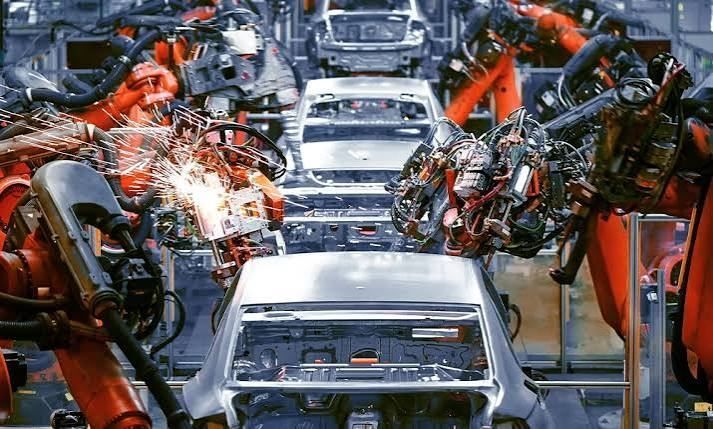
Robotic Welding Manufacturing: A Guide to Automated Welding Processes
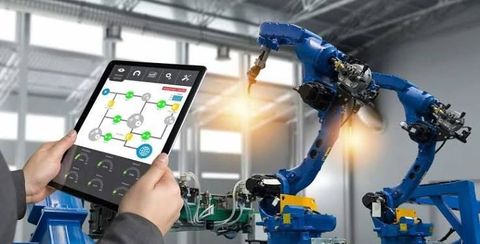
Robotic welding manufacturing is the use of programmable robots, welding equipment, sensors, control software, and related systems to perform welding operations with limited direct manual movement.
The technology developed from industrial robotics and automated welding methods used in manufacturing environments where repeated weld paths and consistent positioning are important.
Robotic welding equipment generally combines a robotic arm with a welding power source, torch, workholding equipment, safety systems, and control software. Depending on the application, robotic welding machines may use processes such as gas metal arc welding, gas tungsten arc welding, resistance welding, or other joining methods.
Industrial robotic welding systems are commonly arranged as robotic welding cells. A cell may include the robot, welding positioner, fixtures, sensors, material handling equipment, and protective barriers. Together, these components create an organized production environment in which the robot follows programmed movements and welding parameters.
How Automated Welding Works
Robotic welding automation begins with a digital or programmed description of the weld path. The robot moves the welding torch along the required route while the welding system controls parameters such as current, voltage, wire feed, and travel speed.
The workpiece must normally be positioned accurately so that the robot can reach the intended joints. Sensors or vision systems may also help detect part position, joint location, or process conditions.
Automated welding equipment can therefore perform a sequence such as:
- Positioning a component in a fixture.
- Moving the welding torch toward the joint.
- Starting the welding process according to programmed parameters.
- Following the specified weld path.
- Stopping the arc or welding operation.
- Moving the robot to its next programmed position.
The exact sequence depends on the component, welding method, production environment, and control system.
Main Components
Robotic welding machinery can contain several interconnected components. The robot provides movement, while the welding equipment creates the weld. Fixtures hold parts in a defined position, and controllers coordinate the different operations.
CNC robotic welding machines may combine computer-controlled movement with welding equipment for applications that require programmed paths. Robotic welding assembly systems can also be integrated into larger production lines where welding is only one stage of manufacturing.
Importance
Robotic welding is relevant to industries that manufacture products containing repeated welded joints. Automotive components, structural products, agricultural machinery, metal enclosures, appliances, and industrial equipment can involve welding operations that follow defined patterns.
The technology can address several practical challenges associated with repetitive welding. Human welders remain important for setup, inspection, programming, maintenance, complex fabrication, and tasks that require judgment. Robots can handle certain repetitive movements while people supervise the broader production process.
Consistency and Repeatability
A programmed robot can repeat a defined movement many times under similar operating conditions. This can help maintain consistent torch positioning and movement when the workpieces are accurately located.
High precision robotic welding systems can incorporate sensors and control features to monitor joint position or other process conditions. However, the resulting weld still depends on material preparation, joint design, fixtures, welding parameters, and other factors.
Workplace Considerations
Welding involves heat, bright arc light, fumes, sparks, and moving machinery. Robotic welding cells therefore use protective measures such as barriers, interlocks, ventilation, emergency controls, and appropriate personal protective equipment.
Automation can change how workers interact with welding processes. Instead of manually guiding every weld, workers may spend more time on programming, inspection, setup, troubleshooting, material preparation, and equipment monitoring.
Production Flexibility
Traditional automation can be designed around a relatively fixed production sequence. Modern automated robotic welding systems increasingly incorporate sensors, programmable controls, and digital interfaces that allow processes to be adjusted for different components.
Flexibility remains dependent on the robot's reach, payload, tooling, fixtures, software, production volume, and the number of different parts that must be handled.
| Component | Primary Function | Typical Role |
|---|---|---|
| Robotic arm | Controlled movement | Positions the welding torch |
| Welding power source | Generates welding current | Supports the selected welding process |
| Torch | Applies the welding process | Creates the weld |
| Fixture | Holds components | Maintains part position |
| Controller | Coordinates operations | Executes programmed movements |
| Sensors | Collect process or position data | Supports monitoring and adjustment |
| Safety equipment | Controls access and hazards | Protects personnel around the cell |
Recent Updates
From 2024 through 2026, robotic welding has increasingly incorporated artificial intelligence, machine vision, sensor-based monitoring, synchronized robots, and more flexible programming methods. The wider industrial robotics sector has also continued expanding. The International Federation of Robotics reported that more than five million industrial robots were operating in factories globally at the end of 2025, with more than 600,000 new units installed during that year.
AI and Sensor-Based Welding
AI is being explored for applications such as weld monitoring, process analysis, quality assessment, path planning, and predictive analysis. Research discussed by the American Welding Society has examined deep learning and generative AI for understanding welding signals and improving the ability of automated systems to interpret complex welding conditions.
This does not mean that every robotic welding system uses AI. Many production systems continue to rely on established programming, sensors, control logic, and predefined welding parameters.
Synchronized Robotic Cells
Multirobot systems are another area of development. Modern synchronized automation can allow several robots to work around the same component while coordinating their movements to reduce collision risks. Such systems may combine welding robots with robots performing material handling or other production activities.
Easier Robot Programming
Programming has traditionally been an important part of deploying robotic welding machinery. Recent systems increasingly use vision, graphical interfaces, assisted programming, and AI-based tools to reduce the amount of manual programming required for certain applications.
The American Welding Society has reported that AI-enabled welding systems are being explored for tasks such as joint tracking, path planning, process monitoring, and programming assistance.
Tools and Resources
Several tools can help people understand, plan, or operate robotic welding production systems. CAD software can be used to create component designs and identify weld locations. Simulation software can then model robot movement and help examine reach, positioning, and potential interference.
Planning and Programming Tools
Useful resources include:
- CAD models for defining component geometry.
- Robot simulation software for testing movement sequences.
- Welding parameter charts for understanding process variables.
- Digital checklists for inspection and cell preparation.
- Maintenance records for tracking equipment condition.
- Vision systems for part and joint detection.
- Welding procedure documentation for defining process requirements.
Industrial welding automation equipment may also use human-machine interfaces that display operating conditions and production information. Data logging can help technicians review welding parameters and identify changes in process behavior.
Learning Resources
Educational materials from organizations such as the American Welding Society can provide information about welding processes, safety, automation, and emerging technologies. Manufacturer documentation, technical manuals, robotics training materials, and welding procedure references can also help explain how individual components operate.
For advanced welding automation systems, simulation and training environments can provide a controlled way to understand programming concepts before changes are introduced to physical production equipment.
FAQs
What is robotic welding manufacturing?
Robotic welding manufacturing uses programmable robots and welding equipment to perform defined welding operations. A complete robotic welding manufacturing system may include robots, welding power sources, fixtures, controllers, sensors, safety equipment, and software.
How do robotic welding machines work?
Robotic welding machines follow programmed movement paths while the welding system controls the required welding parameters. Fixtures and sensors help maintain or identify the position of the workpiece.
What are robotic welding cells?
Robotic welding cells are organized work areas containing a robot and the equipment required to perform welding. A cell can include fixtures, positioners, sensors, controllers, safety barriers, and material handling equipment.
What is the role of AI in robotic welding automation?
AI can be used for applications such as vision-based detection, weld monitoring, path planning, data analysis, and process prediction. Its use varies between systems, and human oversight remains relevant for process control and quality evaluation.
What industries use industrial robotic welding systems?
Industrial robotic welding systems are used across manufacturing sectors that involve repeated welded joints. Examples include automotive production, machinery manufacturing, metal fabrication, structural components, agricultural equipment, and industrial assemblies.
Conclusion
Robotic welding manufacturing combines programmable robotics, welding technology, sensors, fixtures, and control systems to automate defined welding activities. Robotic welding equipment can support repeatable operations while workers remain involved in programming, inspection, setup, maintenance, and process oversight. Recent developments have introduced greater use of AI, machine vision, synchronized robots, and assisted programming. The technology continues to develop as manufacturing systems become more connected and data-driven.