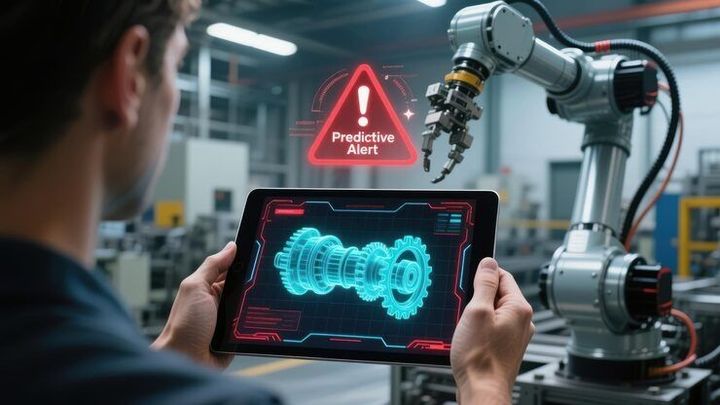
Predictive Maintenance: Discover How It Works and Important Facts
What Is Predictive Maintenance? Predictive Maintenance is a maintenance approach that uses equipment data, condition monitoring, sensors, analytics, and other technologies to identify signs of potential equipment problems before a major failure occurs. Instead of relying only on fixed maintenance schedules or waiting for equipment to stop working, organizations can monitor operating conditions and use the information to plan maintenance activities.
The approach is particularly relevant for machinery that operates continuously or contains components that gradually change through wear, vibration, temperature variation, pressure changes, electrical behavior, or other measurable conditions.
Predictive Maintenance can be used in manufacturing plants, power facilities, transportation systems, buildings, data centers, oil and gas operations, mining, and other environments containing critical equipment.
How Predictive Maintenance Works
A typical Predictive Maintenance system combines physical equipment with sensors, data collection systems, analytical software, and maintenance workflows.
The process generally follows these steps:
- Equipment selection: Important machines and components are identified according to their operational role and failure characteristics.
- Data collection: Sensors and monitoring equipment capture information such as vibration, temperature, pressure, current, speed, or acoustic signals.
- Data transmission: Measurements are transferred to local monitoring systems or centralized platforms.
- Data analysis: Software examines current readings and historical patterns to identify unusual behavior.
- Condition assessment: The system compares observed conditions with established operating ranges or learned patterns.
- Failure prediction: Analytical models estimate whether an abnormal condition could indicate developing equipment degradation.
- Maintenance planning: Maintenance personnel review the information and determine an appropriate inspection, repair, or component replacement activity.
- Verification: After maintenance, equipment data can be reviewed to determine whether the condition has returned to the expected range.
The goal is not simply to collect large amounts of data. Useful Predictive Maintenance depends on reliable measurements, appropriate analysis, equipment knowledge, and clear maintenance decisions.
Predictive Versus Preventive Maintenance
Preventive maintenance generally follows a predetermined schedule. For example, a machine component may be inspected after a certain number of operating hours regardless of its actual condition.
Predictive Maintenance instead considers equipment condition and operational data. This can allow maintenance decisions to be based more closely on observed equipment behavior.
Both approaches can be used together. Scheduled inspections remain useful when manufacturers or safety requirements specify particular maintenance intervals.
Importance
Reducing Unexpected Equipment Problems
Unexpected equipment failures can interrupt production, transportation, energy generation, or other operations. Predictive Maintenance can help identify abnormal conditions early enough for personnel to investigate them.
However, prediction is not certain. Sensor limitations, incomplete historical data, unusual operating conditions, and changes in equipment behavior can affect analytical results.
Improving Equipment Monitoring
Traditional inspections may provide information only at particular intervals. Continuous or periodic sensor monitoring can provide a more detailed view of equipment behavior.
For rotating machinery, vibration measurements can reveal changes associated with bearings, shafts, imbalance, alignment, or other mechanical conditions. Temperature monitoring can identify overheating, while electrical measurements can reveal changes in motors and electrical systems.
Supporting Maintenance Planning
Maintenance teams can use condition information to prioritize inspections and plan activities around operational requirements.
A data-based approach can also help distinguish between normal variation and conditions that require closer investigation.
Applications Across Industries
Predictive Maintenance has applications across many sectors.
Manufacturing: Production machinery, motors, pumps, compressors, CNC equipment, conveyors, and industrial robots can be monitored.
Energy: Generators, turbines, transformers, pumps, and electrical equipment can be assessed using condition data.
Transportation: Aircraft systems, railway equipment, vehicles, and fleet components can be monitored for developing mechanical or electrical issues.
Buildings: Heating, ventilation, air-conditioning systems, elevators, pumps, and other building equipment can use sensor-based monitoring.
Data centers: Cooling systems, power equipment, backup systems, and computing infrastructure can be monitored for changes in operating conditions.
Infrastructure: Bridges, water systems, industrial facilities, and other assets can incorporate sensors and analytical systems where continuous condition information is useful.
Common Equipment Signals
| Signal | What It Can Indicate | Example Equipment |
|---|---|---|
| Vibration | Mechanical changes | Motors, pumps, turbines |
| Temperature | Heat or cooling changes | Motors, bearings, electrical systems |
| Pressure | Flow or mechanical changes | Pumps, compressors |
| Electrical current | Motor or electrical behavior | Motors and drives |
| Acoustic signals | Mechanical or fluid-related changes | Valves, bearings, compressors |
| Lubricant condition | Wear or contamination | Gearboxes and engines |
Recent Updates
AI and Machine Learning
Artificial intelligence and machine learning are increasingly being incorporated into industrial monitoring systems. These methods can analyze large volumes of sensor data and identify patterns that may be difficult to detect through simple threshold-based monitoring.
Machine-learning models can be trained using historical equipment data, operating conditions, maintenance records, and known failure events. The quality of the result depends heavily on the quality and relevance of the training data.
Digital Twins
Digital twins are another important development. A digital twin creates a digital representation of a physical asset or system and can combine equipment information, operating data, simulations, and historical records.
India's NITI Aayog identified digital twins, artificial intelligence, machine learning, and robotics as high-impact technologies within its 2025 advanced-manufacturing roadmap.
Digital twins can support condition analysis by providing a broader operational context for sensor readings.
Industry 4.0 Integration
Predictive Maintenance is increasingly connected with the wider Industry 4.0 environment. Sensors, industrial IoT systems, cloud platforms, analytics, digital twins, robotics, and connected machinery can operate as parts of a broader digital manufacturing system.
In 2025, India's Department of Public Enterprises highlighted AI, IoT, digital twins, 3D printing, and 5G-enabled infrastructure as technologies relevant to digital transformation across Central Public Sector Enterprises.
AI for Manufacturing Engineering
India has also increased attention on applying AI to manufacturing engineering. In 2026, the Ministry of Electronics and Information Technology highlighted AI for Manufacturing Engineering Technology and discussed responsible and scalable AI adoption across the manufacturing ecosystem.
This direction is relevant to Predictive Maintenance because equipment monitoring is one of the areas where industrial AI can combine sensor information with engineering knowledge.
Predictive Maintenance in Telecommunications
Predictive Maintenance is also being explored beyond factories. A 2025 collaboration between India's Telecom Engineering Centre and IIIT-Hyderabad included AI-driven applications for intelligent telecom networks, automation, and predictive maintenance, with a longer-term focus on AI-native network technologies.
More Connected Sensors
Industrial sensors are becoming increasingly connected to centralized monitoring platforms. This allows information from multiple machines or facilities to be analyzed together.
The expansion of IoT infrastructure can make it easier to collect information from equipment that previously depended mainly on manual inspection.
Laws or Policies
Industry 4.0 and Digital Manufacturing
India does not have one single law specifically governing Predictive Maintenance. Instead, organizations may need to consider regulations and standards related to industrial safety, electrical systems, data protection, cybersecurity, environmental management, and sector-specific operations.
Government initiatives supporting advanced manufacturing and digital transformation provide a broader policy environment for technologies such as industrial IoT, AI, robotics, and predictive analytics.
National Mission on Interdisciplinary Cyber-Physical Systems
The National Mission on Interdisciplinary Cyber-Physical Systems, implemented by the Department of Science and Technology, supports technologies including AI, machine learning, IoT, data analytics, robotics, autonomous systems, and cybersecurity.
As of 2026, the mission was continuing under a ₹3,660 crore outlay for the 2018–2027 period and had established 25 Technology Innovation Hubs.
These technologies provide foundational capabilities relevant to sensor-based monitoring and intelligent equipment management.
Condition Monitoring Standards
ISO 17359:2018 provides general guidelines for establishing condition-monitoring programs for machines. ISO states that the standard applies to all machines and was reviewed and confirmed in 2023, meaning the 2018 edition remains current.
The standard can provide a useful reference for organizations developing systematic condition-monitoring programs.
Workplace Safety
Predictive Maintenance does not replace established workplace safety procedures. Maintenance activities can involve electrical equipment, rotating machinery, elevated areas, heat, pressure, chemicals, or stored energy.
Organizations therefore need appropriate isolation procedures, machine safeguards, personal protective equipment, inspection practices, and worker training according to the equipment and applicable regulations.
Data and Cybersecurity
Connected maintenance systems can collect operational information from industrial equipment. When these systems communicate over networks or cloud platforms, cybersecurity becomes an important consideration.
Access controls, secure communications, system monitoring, software updates, network segmentation, and appropriate data-management practices can help protect connected industrial environments.
Tools and Resources
Vibration Monitoring
Vibration sensors and analyzers are widely used for rotating equipment. They can help identify changes associated with bearings, imbalance, misalignment, looseness, and other mechanical conditions.
Thermal Monitoring
Temperature sensors and infrared measurement equipment can identify unusual thermal patterns. These tools can be applied to motors, electrical systems, bearings, pumps, and other equipment.
Industrial IoT Platforms
Industrial IoT platforms connect sensors, machines, gateways, and analytical applications. They can provide dashboards showing equipment status, historical measurements, alerts, and operating trends.
Machine Learning Platforms
Machine-learning tools can analyze historical and real-time equipment information. Depending on the application, models can classify equipment conditions, detect anomalies, estimate remaining useful life, or identify relationships between operating variables and equipment behavior.
Digital Twin Platforms
Digital twin systems combine digital models with information from physical equipment. They can be used to visualize assets, simulate operating conditions, and support engineering analysis.
Maintenance Management Systems
Computerized maintenance management systems can organize equipment records, inspections, maintenance schedules, work orders, spare-component information, and historical maintenance data.
When combined with condition-monitoring information, these systems can connect equipment observations with maintenance planning.
Standards and Technical References
ISO 17359 is a useful reference for organizations studying condition monitoring and diagnostic programs.
Technical references from engineering organizations, equipment manufacturers, industrial automation organizations, and national standards bodies can provide additional information about sensors, measurement techniques, machine diagnostics, and maintenance procedures.
FAQs
What is Predictive Maintenance?
Predictive Maintenance is an approach that uses equipment-condition data, sensors, monitoring systems, and analytics to identify potential equipment problems before they develop into major failures.
How does Predictive Maintenance work?
It generally involves collecting equipment data, analyzing operating patterns, identifying abnormal conditions, assessing potential degradation, and using the findings to support maintenance decisions.
What technologies are used in Predictive Maintenance?
Common technologies include IoT sensors, vibration monitoring, temperature measurement, machine learning, artificial intelligence, cloud platforms, edge computing, digital twins, and maintenance-management software.
What is the difference between Predictive Maintenance and preventive maintenance?
Preventive maintenance usually follows predetermined schedules, while Predictive Maintenance uses observed equipment conditions and data to help determine when investigation or maintenance may be appropriate.
Can Predictive Maintenance be used in manufacturing?
Yes. It can be applied to motors, pumps, compressors, CNC machines, conveyors, robotic equipment, production lines, and other industrial assets where measurable operating conditions can provide useful information.
Conclusion
Predictive Maintenance combines equipment monitoring, sensors, data analysis, engineering knowledge, and maintenance planning to identify developing equipment conditions. AI, IoT, machine learning, digital twins, and connected industrial systems are expanding its capabilities across manufacturing and other sectors. India is also developing a broader digital-manufacturing ecosystem through initiatives involving AI, cyber-physical systems, IoT, robotics, and advanced manufacturing. Effective implementation depends on reliable data, suitable sensors, appropriate analytical methods, qualified personnel, and clear maintenance procedures.