How Industrial Cranes Work: A Complete Guide
Industrial cranes are mechanical lifting systems used to move heavy materials, equipment, components, and loads within industrial environments.
They are commonly found in manufacturing plants, warehouses, shipyards, construction facilities, power plants, and material-handling areas.
These systems combine structural frames, hoisting mechanisms, motors, controls, ropes, chains, hooks, and safety devices to move loads vertically and horizontally. Different crane designs are selected according to load capacity, operating space, movement requirements, and working conditions.
What Are Industrial Cranes?
Industrial cranes are engineered lifting machines designed to handle loads within a defined working area. Unlike simple lifting devices, cranes can provide several types of movement, such as lifting, lowering, travelling, and traversing.
A typical industrial crane consists of a supporting structure and a lifting mechanism. The lifting mechanism raises the load, while travelling and positioning mechanisms move it to the required location.
How Industrial Cranes Work
The operation of an industrial crane generally involves several coordinated steps.
1. Load Attachment
The load is connected to a hook, sling, clamp, magnet, spreader beam, or another lifting attachment. The attachment must be appropriate for the load's shape, weight, and handling requirements.
2. Load Hoisting
The hoist mechanism raises the load vertically. Electric motors commonly drive the hoist, while gears and drums or chain mechanisms transfer mechanical movement to the lifting element.
3. Horizontal Movement
After the load reaches the required height, the crane moves it horizontally. Depending on the crane design, this may occur through bridge travel, trolley movement, boom rotation, or gantry travel.
4. Load Positioning
Operators or automated control systems position the load over its destination. Controlled movement helps reduce unwanted swinging and improves placement accuracy.
5. Load Lowering
The hoisting mechanism gradually lowers the load until it reaches the designated position. Braking systems help control the descent and keep the load stable.
6. Load Release
Once the load is safely positioned, the lifting attachment is released. The crane can then return to its starting position or continue with another lifting cycle.
Main Types of Industrial Cranes
Different industrial crane configurations are designed for different operating environments.
| Crane Type | Main Characteristics | Common Applications |
|---|---|---|
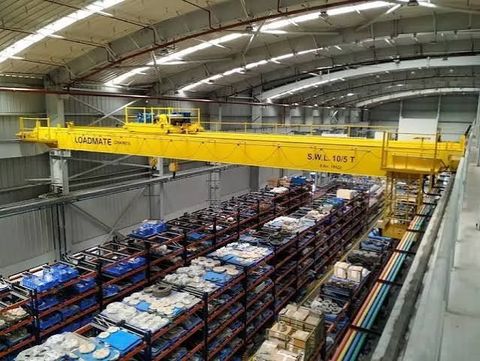
| Overhead Crane | Travels along elevated runways | Manufacturing plants and workshops |
| Bridge Crane | Uses parallel runways and a movable bridge | Heavy material handling |
| Gantry Crane | Supported by legs running on ground rails | Warehouses and yards |
| Jib Crane | Uses a rotating horizontal boom | Workstations and assembly areas |
| Monorail Crane | Travels along a fixed overhead path | Repetitive material movement |
| Portal Crane | Uses a portal-style supporting structure | Outdoor industrial areas |
| Tower Crane | Tall vertical structure with horizontal jib | Construction activities |
| Mobile Crane | Mounted on a movable carrier | Multiple work locations |
Main Components of Industrial Cranes
Crane Structure
The structural frame supports the crane's operating mechanisms and the loads handled during lifting. Depending on the design, it can include bridges, gantries, columns, booms, legs, and runways.
Hoist
The hoist provides vertical lifting and lowering. It may use wire rope, chain, drums, gears, motors, and braking mechanisms.
Trolley
A trolley carries the hoisting unit and moves it horizontally along a bridge or supporting structure.
Bridge
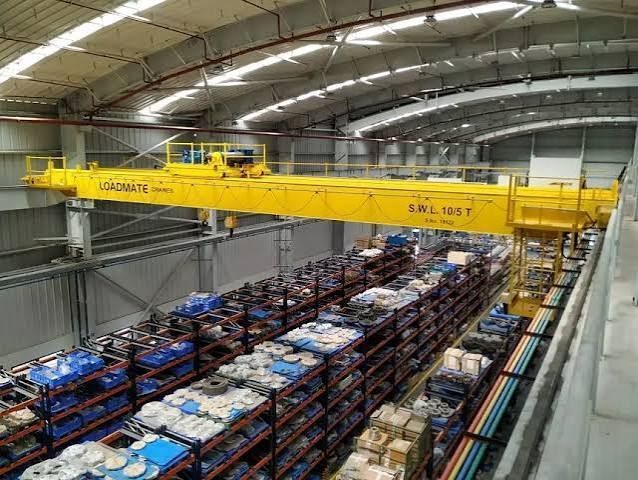
Bridge cranes use a horizontal bridge that travels along runways. The bridge supports the trolley and hoisting equipment.
Runway
Runways provide the travel path for overhead crane bridges. They are generally installed on building structures or dedicated support columns.
Hook and Lifting Attachments
Hooks connect the crane to the load. Other attachments may include lifting beams, clamps, magnets, buckets, and specialized grabs.
Motors and Drives
Electric motors provide movement for hoisting, trolley travel, bridge travel, or boom rotation. Variable-frequency drives may be used to regulate motor speed.
Braking System
Brakes help stop and hold crane movements. Different braking arrangements can be used for hoisting and travelling mechanisms.
Control System
Controls allow operators or automation systems to manage lifting, lowering, travelling, and positioning movements.
Crane Movement Types
Industrial cranes commonly perform three primary movements.
Hoisting: Vertical movement that raises or lowers a load.
Trolley movement: Horizontal movement of the hoist along a bridge or beam.
Bridge or crane travel: Movement of the complete crane along its runway.
Jib and portal cranes may use additional movements, including boom rotation or radial positioning.
Electrical and Control Systems
Modern industrial cranes frequently use electrical control systems to coordinate multiple movements. Control panels, motor drives, sensors, limit switches, and emergency stopping devices work together to manage crane operation.
Remote controls can allow operators to control the crane from a suitable location. Automated systems can integrate sensors, programmable logic controllers, positioning systems, and production software for repetitive lifting tasks.
Crane Capacity and Operating Factors
Several technical factors influence how an industrial crane is configured.
| Factor | Importance |
|---|---|
| Rated load capacity | Determines the maximum intended load |
| Span | Defines the horizontal distance covered by the bridge |
| Lift height | Determines the vertical lifting range |
| Duty cycle | Indicates expected frequency of crane operation |
| Travel speed | Influences material movement time |
| Working environment | Affects structural and electrical requirements |
| Load characteristics | Influences hooks and lifting attachments |
| Available floor space | Determines crane layout and movement area |
Crane capacity must be considered together with lifting height, span, duty cycle, load characteristics, and environmental conditions.
Applications of Industrial Cranes
Industrial cranes are used across many sectors.
Manufacturing
Cranes move raw materials, machine components, molds, fabricated structures, and finished assemblies between production areas.
Warehousing
Overhead and gantry cranes can move heavy materials where conventional handling equipment may have limited lifting capability.
Construction
Tower and mobile cranes support the movement of structural materials, equipment, and construction components.
Shipbuilding
Large cranes handle steel sections, engines, machinery, and other ship components during fabrication and assembly.
Power Plants
Cranes are used to move generators, turbines, transformers, maintenance equipment, and other heavy components.
Steel and Metal Processing
Heavy-duty crane systems can transport steel coils, plates, beams, molten material containers, and fabricated products, depending on the facility.
Crane Automation
Automation is increasingly used for repetitive industrial lifting operations. Sensors can monitor load position, travel distance, speed, and equipment conditions.
Automated cranes may use programmable controllers and positioning systems to repeat predefined movement sequences. Anti-sway technology can also help reduce load oscillation during movement.
Safety Considerations
Crane operation requires careful planning and adherence to applicable safety requirements. Loads should remain within the crane's rated capacity, and lifting attachments should be appropriate for the intended load.
Operators and maintenance personnel should understand control functions, emergency procedures, inspection requirements, and site-specific hazards. Exclusion zones can help keep unauthorized personnel away from suspended loads and moving equipment.
Regular inspection of hooks, ropes, chains, brakes, electrical systems, structural components, and limit devices is also important.
Maintenance of Industrial Cranes
Preventive maintenance helps identify mechanical and electrical problems before they interfere with normal operation.
Common maintenance activities include:
- Inspecting wire ropes and chains
- Checking hooks and lifting attachments
- Examining brakes
- Inspecting gears and bearings
- Testing limit switches
- Checking electrical connections
- Monitoring motors and drives
- Inspecting structural components
- Lubricating applicable moving parts
- Reviewing control-system performance
Maintenance intervals depend on crane design, operating frequency, load conditions, and the manufacturer's technical requirements.
Factors to Consider When Selecting an Industrial Crane
The appropriate crane configuration depends on the facility and lifting requirements. Important considerations include:
- Maximum load weight
- Required lifting height
- Horizontal travel distance
- Available installation space
- Indoor or outdoor operation
- Operating frequency
- Load dimensions
- Required lifting attachments
- Control method
- Environmental conditions
- Inspection and maintenance requirements
A detailed assessment of these factors helps determine the suitable crane structure and operating configuration.
Frequently Asked Questions
What is an industrial crane used for?
Industrial cranes are used to lift, move, position, and lower heavy materials and equipment within defined industrial work areas.
What are the main types of industrial cranes?
Common types include overhead cranes, bridge cranes, gantry cranes, jib cranes, monorail cranes, portal cranes, tower cranes, and mobile cranes.
How does an overhead crane move a load?
An overhead crane normally uses a hoist for vertical lifting, a trolley for horizontal movement across the bridge, and bridge travel for movement along the runway.
What components are found in an industrial crane?
Major components can include the structural frame, hoist, trolley, bridge or boom, motors, gears, brakes, hooks, lifting attachments, controls, sensors, and safety devices.
How often should industrial cranes be inspected?
Inspection frequency depends on the crane type, operating conditions, usage, applicable regulations, and manufacturer requirements. Routine checks and periodic inspections should follow the relevant technical and regulatory guidance.
Conclusion
Industrial cranes combine structural systems, lifting mechanisms, motors, controls, and safety equipment to move heavy loads in controlled industrial environments. Their operating principles are based on coordinated lifting, travelling, positioning, and lowering movements.
Understanding crane types, components, capacity requirements, automation, safety practices, and maintenance procedures helps facilities plan appropriate lifting operations. The final crane configuration depends on the load, workspace, movement requirements, operating conditions, and applicable safety requirements.