How Demineralization Systems Work: A Complete Guide
Water used in industrial processes often contains dissolved minerals and ionic compounds that can interfere with equipment, chemical processes, boilers, cooling systems, and product quality.
Demineralization systems are designed to reduce dissolved ions from water and produce water with a lower mineral content.
A common approach uses ion exchange, where specially formulated resins exchange unwanted ions for hydrogen and hydroxide ions. These ions subsequently combine to form water. Depending on water quality requirements, demineralization may be combined with filtration, reverse osmosis, degassing, polishing, and other treatment stages.
Understanding the working principle, components, types, and operating factors helps explain how demineralization systems are used in industrial water treatment.
Why Demineralization Systems Matter
Dissolved minerals such as calcium, magnesium, sodium, chloride, sulfate, and silica can affect industrial processes in different ways. Some may contribute to scaling, corrosion, deposits, or unwanted reactions.
Demineralized water systems can be used when lower ionic content is required.
Common objectives include:
- Reducing dissolved ionic contaminants
- Producing process water with controlled mineral content
- Supporting boiler feedwater preparation
- Protecting sensitive equipment
- Supporting laboratory and manufacturing processes
- Reducing mineral-related deposits
- Preparing water for additional purification stages
The required treatment level depends on the source-water chemistry and the intended application.
How Demineralization Systems Work
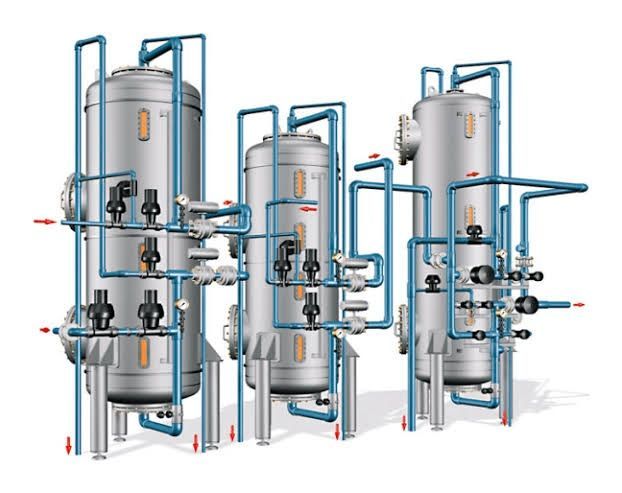
A conventional ion-exchange demineralization system commonly contains a cation exchange unit followed by an anion exchange unit.
Cation Exchange
Water first passes through a cation exchange resin. The resin captures positively charged ions such as calcium, magnesium, sodium, and potassium.
In a hydrogen-cycle system, these cations are exchanged for hydrogen ions.
For example:
R-H + Na⁺ → R-Na + H⁺
The process reduces the concentration of dissolved cations while releasing hydrogen ions into the water.
Anion Exchange
The treated water then passes through an anion exchange resin. This resin removes negatively charged ions such as chloride, sulfate, bicarbonate, and some forms of silica.
In a hydroxide-cycle system, anions are exchanged for hydroxide ions.
The released hydrogen and hydroxide ions combine:
H⁺ + OH⁻ → H₂O
The result is water with substantially reduced concentrations of dissolved ions.
Main Stages of a Demineralization System
A typical system can include several stages:
- Pretreatment – Removes suspended solids, chlorine, hardness, or other substances that could affect downstream equipment.
- Cation exchange – Removes positively charged dissolved ions.
- Degassing – May remove dissolved carbon dioxide in selected system designs.
- Anion exchange – Removes negatively charged ions.
- Polishing – Provides additional ion removal when lower conductivity is required.
- Monitoring – Measures parameters such as conductivity, pH, flow, and pressure.
- Storage or distribution – Transfers treated water to the required process.
Not every demineralization plant requires every stage.
Key Components of Demineralization Systems
| Component | Main Function |
|---|---|
| Cation exchange vessel | Removes positively charged ions |
| Anion exchange vessel | Removes negatively charged ions |
| Ion exchange resin | Provides ionic separation |
| Degasser | Removes selected dissolved gases |
| Regeneration system | Restores resin exchange capacity |
| Chemical storage tank | Holds regeneration chemicals |
| Pumps | Move water through the system |
| Valves | Control water and regeneration flow |
| Conductivity meter | Monitors ionic content |
| Control panel | Coordinates system operation |
The exact configuration depends on feed-water chemistry, required water quality, and system capacity.
Types of Demineralization Systems
Two-Bed Demineralization Systems
A two-bed system uses separate cation and anion exchange vessels. It is one of the conventional arrangements for industrial demineralized water production.
Mixed-Bed Demineralization Systems
A mixed-bed unit contains cation and anion exchange resins in the same vessel.
Because the resins are closely mixed, mixed-bed systems can provide a higher level of ion removal than a conventional two-bed arrangement when properly operated.
They are often used as polishing stages after primary demineralization.
Electrodeionization Systems
Electrodeionization, or EDI, combines ion-exchange media with electricity and selective membranes to continuously remove ions.
EDI systems can be integrated with reverse osmosis and are commonly used where continuous production of low-ion water is required.
Reverse Osmosis Followed by Ion Exchange
Some modern industrial demineralization systems use reverse osmosis as pretreatment before ion exchange. Reverse osmosis can reduce a substantial portion of dissolved salts, which can lower the ionic load reaching the resin system.
Factors Affecting Demineralization Performance
Feed-Water Quality
The concentration and types of dissolved ions in the source water directly influence resin loading and regeneration requirements.
Resin Condition
Ion exchange resin gradually becomes exhausted as it captures dissolved ions. Resin condition, age, fouling, and chemical exposure can influence treatment performance.
Flow Rate
Water must remain within the system's specified flow range. Excessive flow can reduce contact time and affect ion exchange efficiency.
Regeneration
Once resin capacity is reached, regeneration chemicals restore the exchange sites. Regeneration conditions must be controlled according to resin type and system design.
Temperature
Water temperature can influence resin performance, chemical reactions, and equipment materials. Operating limits depend on the specific resin and system components.
Silica and Carbon Dioxide
Silica and carbon dioxide can require special consideration because their behavior differs from many other dissolved ions. Degassing or additional polishing may be incorporated when required.
Demineralization vs Reverse Osmosis
Both technologies reduce dissolved substances in water, but they work through different mechanisms.
| Feature | Demineralization | Reverse Osmosis |
|---|---|---|
| Main principle | Ion exchange | Membrane separation |
| Main target | Dissolved ions | Dissolved salts and other contaminants |
| Main components | Ion-exchange resins | Semi-permeable membranes |
| Regeneration | Required for conventional resin systems | Membrane cleaning rather than resin regeneration |
| Water recovery | Depends on system design | Produces permeate and concentrate streams |
| Common role | Low-ion water production and polishing | Broad dissolved-contaminant reduction |
The two technologies can also be combined. Reverse osmosis is frequently used as pretreatment for ion-exchange or EDI systems.
Applications of Demineralization Systems
Demineralization systems are used in various industrial and technical environments, including:
- Boiler feedwater treatment
- Power generation
- Pharmaceutical manufacturing
- Chemical processing
- Electronics manufacturing
- Laboratory water preparation
- Food and beverage processing
- Textile manufacturing
- Metal processing
- Industrial process-water treatment
Water-quality requirements differ significantly between applications, so system configuration should be matched to the process.
Best Practices for Operating Demineralization Systems
Proper operation can help maintain consistent treated-water quality.
- Analyze source-water chemistry regularly.
- Use appropriate pretreatment to protect ion-exchange resin.
- Monitor conductivity and pH.
- Track resin exhaustion and regeneration cycles.
- Maintain correct regeneration chemical concentrations.
- Inspect valves, pumps, vessels, and piping.
- Monitor pressure drop across treatment vessels.
- Prevent prolonged exposure to unsuitable operating conditions.
- Record treated-water quality over time.
- Follow resin and equipment manufacturer guidelines.
Regular monitoring can help identify changes in feed-water quality or resin performance before they affect downstream processes.
Automation and Monitoring
Modern demineralization plant equipment can include automated valves, conductivity meters, flow sensors, pressure transmitters, pH instruments, and programmable control systems.
Automated controls can coordinate:
- Service cycles
- Backwashing
- Chemical regeneration
- Rinsing
- Valve sequencing
- Conductivity monitoring
- Alarm conditions
Data logging can also help operators compare treated-water quality across different operating cycles.
Who Uses Demineralization Systems?
Demineralization systems can be relevant to facilities that require water with reduced ionic content, including:
- Power plants
- Industrial manufacturing facilities
- Pharmaceutical plants
- Chemical plants
- Electronics facilities
- Textile plants
- Food-processing facilities
- Laboratories
- Boiler-water treatment facilities
The appropriate configuration depends on feed-water composition, required water quality, daily water demand, regeneration strategy, and available infrastructure.
FAQs About Demineralization Systems
What are demineralization systems used for?
Demineralization systems reduce dissolved ions in water. They are commonly used for boiler feedwater, industrial process water, pharmaceutical production, power generation, and other applications requiring low-ion water.
How does a demineralization system work?
A conventional system uses cation and anion exchange resins. The cation resin removes positively charged ions, while the anion resin removes negatively charged ions. Hydrogen and hydroxide ions combine to form water.
What is the difference between demineralized and distilled water?
Demineralized water is produced primarily by removing dissolved ions through processes such as ion exchange or membrane-based treatment. Distilled water is produced through evaporation and condensation, which separates many dissolved substances from the water.
How often do demineralization resins need regeneration?
Regeneration frequency depends on source-water chemistry, flow volume, resin capacity, operating conditions, and required water quality. Systems may regenerate after a defined volume of treated water or when water-quality indicators reach a specified limit.
Can reverse osmosis be used with demineralization?
Yes. Reverse osmosis can be used as pretreatment before ion exchange or EDI. Removing a substantial portion of dissolved salts upstream can reduce the ionic load placed on downstream treatment stages.
Conclusion
Demineralization systems reduce dissolved ionic contaminants through technologies such as ion exchange and electrodeionization. Conventional systems commonly use cation and anion exchange stages, while mixed-bed units, reverse osmosis, degassing, and polishing stages can be added according to water-quality requirements.
System performance depends on source-water chemistry, resin condition, flow rate, regeneration, temperature, and monitoring. Proper pretreatment and regular measurement of conductivity, pressure, and other operating parameters can help maintain consistent treated-water quality.