Beauty Education Insights: Skills, Trends, and Learning Guide
Beauty education has evolved far beyond learning basic techniques. Modern beauty education combines practical skills, scientific understanding, hygiene awareness, communication, technology, and knowledge of changing consumer preferences. Whether someone is exploring beauty as a personal interest, developing professional skills, or trying to understand the wider beauty industry, structured education can provide a stronger foundation.
Beauty education insights are useful because the field covers many areas, including skincare, hair care, makeup, nail care, cosmetic ingredients, personal grooming, wellness-related practices, and professional standards. Understanding how these areas connect can help learners make more informed decisions and develop skills systematically.
What Is Beauty Education?
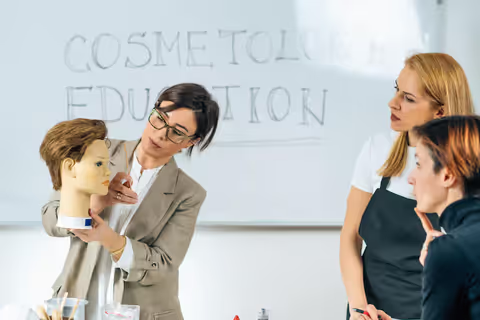
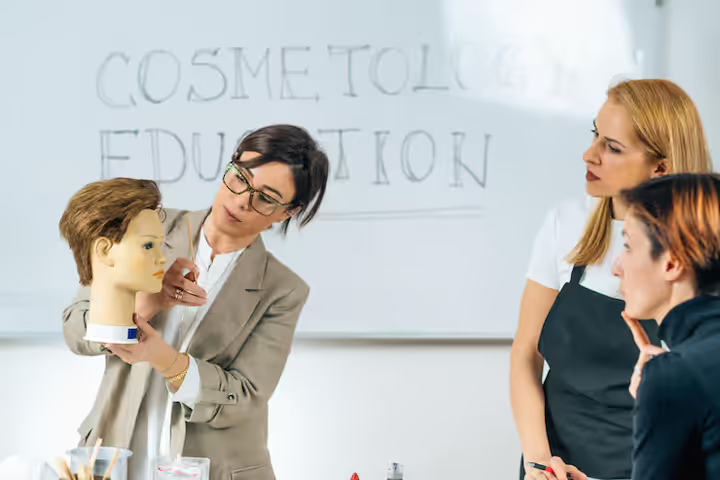
Beauty education refers to the structured learning of knowledge and techniques related to personal appearance, cosmetic practices, grooming, and beauty-related professional activities. It can range from introductory learning to advanced technical education.
A well-rounded beauty education generally combines theoretical knowledge with practical application. For example, someone learning skincare may need to understand skin types and product ingredients alongside practical cleansing and application techniques. Similarly, makeup education can involve color theory, facial features, skin preparation, product selection, and application methods.
The purpose is not simply to memorize techniques. Good education helps learners understand why a particular approach is appropriate and when it may need to be adjusted.
Why Beauty Education Matters
The beauty field changes continuously. New formulations, application techniques, devices, tools, and consumer preferences appear regularly. Education helps learners distinguish fundamental principles from short-term trends.
One important benefit is improved decision-making. When people understand basic concepts such as skin characteristics, hair structure, ingredient functions, sanitation, and color theory, they can approach beauty-related choices more thoughtfully.
Education can also encourage safer practices. Clean tools, appropriate product handling, proper storage, hand hygiene, and awareness of individual sensitivities are important components of responsible beauty practice.
Another important aspect is communication. Beauty professionals often need to understand what a person wants, identify practical limitations, explain procedures clearly, and set realistic expectations. These interpersonal skills are an important part of modern beauty education.
Core Areas of Beauty Education
Beauty education covers several interconnected disciplines. The appropriate combination depends on the learner's interests and goals.
Skincare Education
Skincare education introduces concepts such as skin types, skin conditions, cleansing, moisturization, sun protection, cosmetic ingredients, and basic skin assessment.
Understanding ingredients can be particularly useful. Terms such as humectants, emollients, antioxidants, exfoliating ingredients, and occlusive agents describe different functions. Learning these concepts provides more useful knowledge than simply memorizing individual product names.
A strong educational approach also explains the limits of cosmetic care. Persistent, painful, unusual, or worsening skin problems may require assessment by an appropriately qualified healthcare professional rather than experimentation with beauty routines.
Hair Care and Styling
Hair education includes hair structure, texture, scalp considerations, cleansing, conditioning, styling, heat management, and chemical treatments.
Different hair characteristics can affect how techniques work. Hair thickness, porosity, texture, previous chemical processing, and environmental exposure may all influence the result of a particular routine.
Learning these fundamentals helps people understand why the same technique may produce different outcomes for different hair types.
Makeup Education
Makeup education combines artistic and technical concepts. Color theory, facial proportions, skin preparation, blending, lighting, product compatibility, and application techniques are common areas of study.
Rather than treating makeup as a fixed set of rules, education can teach learners how to adapt techniques according to individual features and intended results.
Understanding lighting is also valuable. Makeup that appears balanced under natural daylight can look different under artificial lighting or on camera. This is particularly relevant to modern beauty content and digital communication.
Nail and Personal Grooming Education
Nail education can include nail structure, basic grooming, product application, sanitation, maintenance, and recognition of situations where cosmetic treatment may not be appropriate.
Personal grooming education similarly emphasizes technique, cleanliness, appropriate tool use, and individual preferences. These fundamentals provide a foundation for more specialized learning.
The Role of Science in Modern Beauty Education
Modern beauty education increasingly connects practical techniques with basic scientific knowledge. Cosmetic chemistry, skin biology, hair science, and ingredient research can help explain how beauty products and techniques interact with the body.
Learners do not necessarily need advanced scientific training to benefit from these concepts. Even a basic understanding of pH, skin barrier function, hair structure, formulation types, and ingredient categories can improve everyday decision-making.
Scientific literacy is especially valuable when evaluating beauty claims. Marketing language and social media trends can sometimes simplify complicated subjects. Education encourages people to look at evidence, understand limitations, and avoid assuming that a single ingredient or technique produces the same result for everyone.
Hygiene, Safety, and Professional Standards
Hygiene is one of the most important foundations of beauty education. Tools and work surfaces should be handled appropriately, and reusable equipment should be cleaned and disinfected according to applicable requirements.
Learners should also understand the importance of hand hygiene, appropriate product storage, avoiding cross-contamination, and following manufacturer instructions.
Beauty education should teach recognition of situations that require caution. Irritation, allergic reactions, infections, unexplained skin changes, or other concerning symptoms should not automatically be treated as ordinary cosmetic problems.
Professional standards can vary depending on location and the specific beauty activity. Learners should therefore understand the relevant rules and educational requirements that apply to their area before performing regulated procedures.
Digital Technology and Beauty Learning
Technology has changed how people learn beauty skills. Online courses, instructional videos, digital classrooms, interactive demonstrations, and educational communities provide access to information in different formats.
Digital learning can be particularly useful for reviewing techniques repeatedly. However, learners should consider the quality and credibility of educational material rather than assuming that popular content is automatically accurate.
Artificial intelligence is also becoming part of beauty-related education. AI tools can help organize learning materials, explain terminology, generate study questions, or provide general educational information. They should complement reliable education rather than replace qualified instruction or professional assessment when expertise is required.
Understanding Beauty Trends Critically
Beauty trends can introduce new ideas, but not every trend has lasting educational value. A useful learner asks whether a technique is supported by established principles, whether it is appropriate for the individual, and whether potential limitations are clearly understood.
Trend awareness is still valuable because it helps learners understand changing preferences and industry developments. The key is separating temporary popularity from foundational knowledge.
For example, techniques may change, but concepts such as hygiene, skin preparation, color theory, hair structure, communication, and responsible product handling remain relevant across many trends.
Building a Strong Beauty Learning Path
A practical learning pathway usually begins with fundamentals before moving toward specialization. Learners can start by identifying the area they want to understand, such as skincare, makeup, hair, nails, or broader beauty knowledge.
The next step is developing foundational theory. This may include anatomy and basic science, tools, terminology, hygiene, product categories, and common techniques.
Practical application should then reinforce the theoretical material. Repetition, observation, structured practice, and constructive feedback can help develop consistency.
Continuous learning is equally important. Beauty education is not necessarily a one-time process because techniques, technologies, formulations, consumer preferences, and professional standards continue to change.
The Future of Beauty Education
The future of beauty education is likely to become increasingly interdisciplinary. Traditional practical techniques are being combined with cosmetic science, digital learning, personalized approaches, sustainability awareness, and technology.
Personalization is particularly significant. Beauty education is gradually moving away from universal routines toward greater consideration of individual characteristics and needs.
Sustainability may also become a larger educational topic. Learners can benefit from understanding responsible product use, packaging considerations, ingredient sourcing concepts, waste reduction, and efficient use of materials.
Ultimately, the strongest beauty education combines practical ability with informed judgment. Learning how something is done is valuable, but understanding why it is done, when it is appropriate, and what its limitations are creates deeper knowledge.
Conclusion
Beauty education insights provide a broader understanding of a field that combines creativity, practical skills, science, hygiene, communication, and continuous learning. From skincare and hair care to makeup and personal grooming, strong fundamentals help learners approach beauty practices with greater awareness.
The most useful approach is to build knowledge gradually, practice responsibly, evaluate trends critically, and continue learning as the field develops. With a balanced foundation, beauty education becomes more than learning techniques; it becomes a way to understand the principles behind them and apply that knowledge thoughtfully.