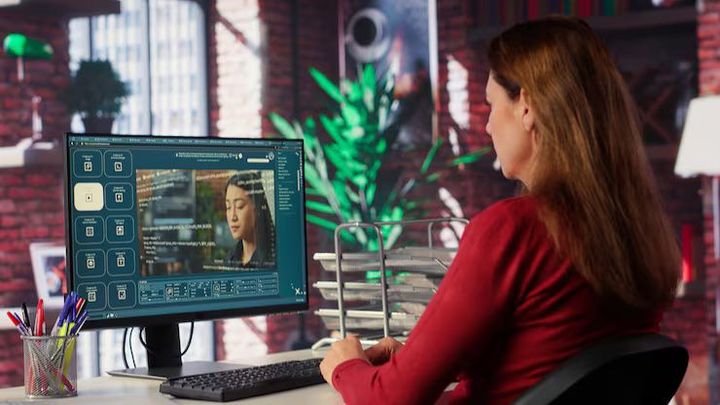
AI Video Generators: Discover How They Work and Helpful Facts
AI Video Generators are software systems that use artificial intelligence to create or modify video content from instructions such as text prompts, images, existing video clips, or combinations of these inputs. Depending on the system, they can generate scenes, animate still images, extend clips, create visual effects, or produce synchronized sound.
The technology developed from several areas of artificial intelligence, including computer vision, machine learning, natural-language processing, and image generation. Earlier video tools generally depended on manually arranged footage, predefined effects, and traditional editing workflows. Generative AI introduced another approach in which a model can interpret a description and produce new visual content.
Modern AI Video Generators are based on models trained to recognize patterns in images, movement, objects, environments, and language. Some systems can also understand relationships between frames, helping maintain continuity as a scene progresses.
How AI Video Generators Work
A typical system begins with an input. This may be a written description such as a scene instruction, an image that should be animated, or an existing clip that needs modification.
The AI model then interprets the input and predicts visual information that fits the requested result. Many modern systems use diffusion-based methods or related generative architectures. In a diffusion process, the model gradually transforms a noisy representation into a structured visual result.
The workflow may include:
- Prompt interpretation: The system identifies subjects, actions, environments, camera perspectives, styles, and other instructions.
- Visual generation: The model creates frames that correspond to the requested scene.
- Motion prediction: The system determines how people, objects, cameras, and backgrounds may change between frames.
- Consistency processing: The model attempts to maintain important visual characteristics across a sequence.
- Audio generation: Some newer systems can generate dialogue, sound effects, or background audio together with video.
- Output refinement: Users may adjust prompts, images, duration, framing, or other settings to create another version.
The exact process varies between AI video systems. Results can also differ according to the prompt, source material, model architecture, and available controls.
Importance
AI Video Generators are becoming relevant because video creation traditionally involves several stages, including planning, recording, animation, editing, sound design, and visual effects. Generative systems can combine some of these stages within a digital workflow.
For educators, these systems can help illustrate abstract ideas through animated scenes. Designers can explore visual concepts, while researchers can create simulations or demonstrations. Individuals can also experiment with storytelling, personal projects, presentations, and educational clips.
The technology also introduces limitations. AI-generated video may contain incorrect physical movements, inconsistent objects, distorted text, unusual facial expressions, or changes in character appearance between frames. Human review therefore remains important when accuracy or authenticity matters.
Common Applications
AI video technology can be applied across several areas:
- Education: Visual explanations, demonstrations, historical reconstructions, and instructional scenes.
- Storytelling: Concept scenes, character animation, visual experiments, and short narrative sequences.
- Presentation: Animated backgrounds, explanatory clips, and visual demonstrations.
- Design: Early visualization of scenes, environments, camera concepts, and motion ideas.
- Training: Simulated situations that demonstrate processes or workplace scenarios.
- Accessibility: Visual explanations and alternative forms of communication when appropriate.
- Video editing: Background changes, clip extension, object modification, and image-to-video animation.
The suitability of generated video depends on the purpose. A fictional visual sequence may tolerate creative variation, while an educational or factual presentation may require much closer human verification.
Common Input and Output Types
| Input | Possible output | Typical purpose |
|---|---|---|
| Text prompt | New video scene | Storytelling and visualization |
| Still image | Animated clip | Bringing images into motion |
| Existing video | Extended or modified clip | Editing and experimentation |
| Text and image | Guided video | More specific visual direction |
| Video and audio | Edited or transformed sequence | Multimedia production |
| Multiple reference images | Consistent visual scene | Character or environment continuity |
Recent Updates
From 2024 through 2026, AI video development has moved toward longer, more coherent clips, stronger prompt interpretation, improved physical movement, image-to-video generation, editing controls, and integrated audio.
OpenAI introduced Sora as a text-to-video model and later released Sora 2 with improvements in physical accuracy, realism, controllability, synchronized dialogue, and sound effects. OpenAI's current information also states that the Sora product became unavailable in April 2026.
Google introduced Veo 3 in 2025 with native audio generation, allowing generated scenes to include elements such as dialogue, background sounds, and environmental effects. Google also introduced Flow, a filmmaking tool designed around its generative video models and controls for creating and extending scenes.
Further development continued in 2026 with Veo 3.1. Google described updates involving image-based video creation, vertical video generation, improved consistency, and higher-resolution output options. These developments show a broader movement toward combining video generation with editing and creative control rather than limiting systems to simple text-to-clip generation.
Another significant trend is the combination of different media types. At Google I/O 2026, Google announced Gemini Omni, a model designed to work with inputs including text, images, audio, and video while producing video outputs. Google also described digital watermarking through SynthID for generated content.
Content identification has also received greater attention. OpenAI described the use of visible and invisible provenance signals and C2PA metadata for Sora-generated videos. These mechanisms are intended to provide information about the origin of generated media.
These developments indicate that AI video technology is moving beyond simple visual generation toward multimodal creation, scene continuity, audio integration, editing, provenance, and greater control over generated content.
Laws or Policies
In India, AI-generated video is affected by rules concerning digital content, personal data, online platforms, copyright, privacy, and unlawful or misleading material. There is not one single rule covering every AI-generated video. The applicable requirements depend on how the content is created, what it contains, where it is published, and whose likeness or information is involved.
The Information Technology (Intermediary Guidelines and Digital Media Ethics Code) Rules, 2021 were updated in 2026 to address synthetically generated information. MeitY's published materials describe requirements relating to identification, labelling, traceability, and intermediary responsibilities for certain synthetic content.
MeitY's explanatory material describes a framework under which lawful AI-generated video falling within the relevant synthetic-information provisions may need a visible indication that it is synthetically generated, along with permanent metadata or another provenance mechanism containing identifying information.
Personal data is another consideration. The Digital Personal Data Protection Rules, 2025 were notified by MeitY, with a phased implementation framework. These rules are relevant when systems process digital personal data, which can include information associated with identifiable individuals.
Likeness and privacy also require attention. Generating a realistic video that depicts a real person can raise questions about consent, impersonation, reputation, and misuse. AI video tools may therefore include restrictions around real-person images, particularly where the generated material could create confusion about whether the person actually appeared or acted in the scene.
Copyright can also matter when users provide protected footage, images, music, characters, or other creative material as inputs. The legal position can depend on the source material, the transformation performed, the intended use, and applicable law. These issues are specific to individual circumstances and should not be treated as legal advice.
Tools and Resources
Several resources can help readers understand AI video generation and evaluate its results.
Prompt-writing guides can help users describe subjects, movement, lighting, camera position, environment, duration, and visual style more clearly. A structured prompt can make it easier to identify which part of an instruction produced an unexpected result.
Storyboard templates can divide a video into separate scenes and describe the intended action, camera view, characters, setting, and audio. This approach can be useful when a project contains several connected shots.
Video metadata and provenance tools can provide information about the origin or history of digital media when supported by the relevant format. C2PA is one example of a technical standard used for content provenance.
Video editing software can be used after generation to arrange clips, adjust timing, add captions, edit sound, or combine generated material with recorded footage. AI generation does not eliminate the need for conventional editing in many workflows.
AI safety documentation can help users understand restrictions, content controls, real-person likeness rules, privacy considerations, and known limitations. Reading the documentation associated with a particular model can provide more accurate information than assuming every AI video system works in the same way.
Government resources can help readers follow changes in India's digital-content rules. MeitY publishes current versions of the IT Rules and materials concerning synthetically generated information, along with data-protection documents.
FAQs
What are AI Video Generators?
AI Video Generators are artificial intelligence systems that create or modify video from inputs such as text, images, video clips, or audio. Depending on the model, they can generate scenes, animate images, extend footage, or make other visual changes.
How do AI Video Generators create videos from text?
The system interprets the written prompt and converts its meaning into visual and motion information. A generative model then produces frames that correspond to the requested subjects, environment, actions, and visual characteristics.
Can AI Video Generators create videos from images?
Yes. Many current systems support image-to-video generation, where a still image is used as a starting point and the model creates movement around the subjects or environment. The exact controls vary between systems.
What are the limitations of AI Video Generators?
Common limitations include inconsistent objects, incorrect physical movement, distorted text, changing facial characteristics, continuity problems, and inaccurate details. Longer or more complex scenes can create additional challenges.
Are AI-generated videos regulated in India?
Certain aspects of AI-generated and synthetically generated content are addressed through India's digital-content and information-technology framework. The 2026 amendments to the IT Rules include provisions concerning synthetically generated information, including identification and traceability measures in relevant circumstances.
Conclusion
AI Video Generators use artificial intelligence to transform text, images, video, and other inputs into new or modified moving content. Recent developments have expanded capabilities in motion, scene continuity, audio, editing, multimodal inputs, and content provenance. At the same time, generated footage can contain visual or factual errors and may raise privacy, likeness, copyright, and authenticity concerns. India's evolving digital-content and data-protection framework is also shaping how synthetic media is identified and handled.